

(UroToday.com) The 2025 SNMMI annual meeting featured a clinical diagnosis and therapy session and a presentation by Dr. Kambiz Rahbar discussing the utility of the PROSTest to predict response to 177Lu-PSMA therapy in metastatic castration resistant prostate cancer (mCRPC). Treatment of mCRPC has advanced with therapies such as androgen receptor pathway inhibitors, taxane chemotherapies such as docetaxel, and novel agents such as 177Lu-PSMA. However, predicting patient response and sequencing therapies remain critical unmet needs. This study presented at SNMMI 2025, investigated whether the PROSTest, a novel, blood-based 27-marker gene mRNA expression machine learning-based liquid biopsy assay that was developed to help detect prostate cancer, could predict treatment response or prognosticate outcome in mCRPC patients receiving 177Lu-PSMA.
There were 48 mCRPC patients with a median age of 73 years (range: 58-89) treated with a median of 2 cycles of 177Lu-PSMA. PSA and PROSTest scores were measured at baseline and after one treatment cycle. PROSTest, which evaluates tumor associated signaling pathways, was analyzed via qPCR, and PSA levels were measured using standard clinical assays. Response was categorized per PCWG-3 criteria. Associations between baseline biomarkers, changes in biomarker (baseline versus after 1 cycle), and overall survival or progression free survival were evaluated using AUROCs, Kaplan-Meier survival analysis, and hazard ratios.
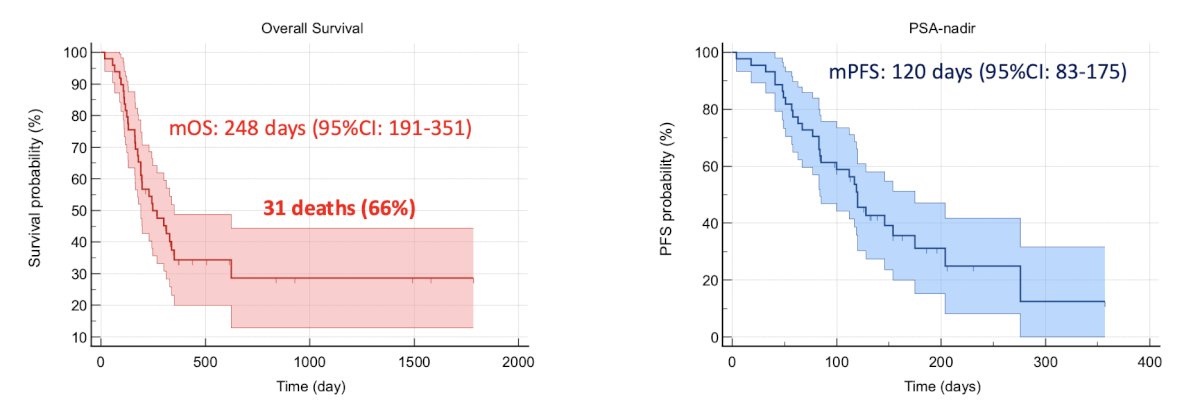
Median overall survival was 248 days (95% CI 191-351) and median progression free survival was 120 days (95% CI 83-175), with no correlation between progression free survival and overall survival:
Baseline PSA was associated with overall survival (AUC: 0.69 ± 0.09, p = 0.037) but not progression free survival (AUC: 0.65 ± 0.1, p = 0.12). Baseline PROSTest scores were not predictive of response or survival. Additionally, early changes in PSA (after one treatment cycle) were not associated with overall survival (p = 0.30, HR 0.66) or progression free survival (p = 0.47, HR 0.74) in this cohort. In contrast, changes in the PROSTest after one treatment cycle significantly correlated with overall survival. The median overall survival was 509 days (16.7 months) in those with a decrease in score, whereas those with an increase in score had a median overall survival of 191 days (6.3 months). The HR was 0.29 (95% CI: 0.09-0.95), Chi-square = 8.26, p = 0.004:

Dr. Rahbar concluded his presentation discussing the utility of the PROSTest to predict response to 177Lu-PSMA therapy in mCRPC with the following take home points:
- This study suggests that early changes in PROSTest were significantly associated with overall survival in contrast to PSA changes
- PROSTest may have superior predictive and prognostic utility in mCRPC patients undergoing 177Lu-PSMA therapy
- Larger, multicenter studies are needed to confirm these findings and validate the assay’s clinical integration
Presented by: Kambiz Rahbar, MD, University Hospital Münster, Münster, Germany
Written by: Zachary Klaassen, MD, MSc – Urologic Oncologist, Associate Professor of Urology, Georgia Cancer Center, Wellstar MCG Health, @zklaassen_md on Twitter during the Society of Nuclear Medicine and Molecular Imaging (SNMMI) 2025 Annual Meeting, New Orleans, LA, Sat, Jun 21 – Tues, Jun 24, 2025.