

(UroToday.com) The 2025 SNMMI annual meeting featured a prostate cancer and dosimetry session and a presentation by Dr. Jiarou Wang discussing a dose-escalation study of the novel PSMA-targeting drug 177Lu-P17-088 in patients with metastatic castration-resistant prostate cancer (mCRPC). Radioligand therapy targeting PSMA with 177Lu-PSMA-617 has shown remarkable therapeutic efficacy in patients with mCRPC in recent years with the VISION1 and PSMAfore2 trials. However, there is still potential for improvement, as numerous studies are currently focused on improving tumor uptake and extending retention time. Previous research has confirmed that the novel PSMA-targeting drug, 177Lu-P17-088, demonstrates promising tumor uptake in dosimetry studies (5x greater tumor dose versus 177Lu-PSMA-617):
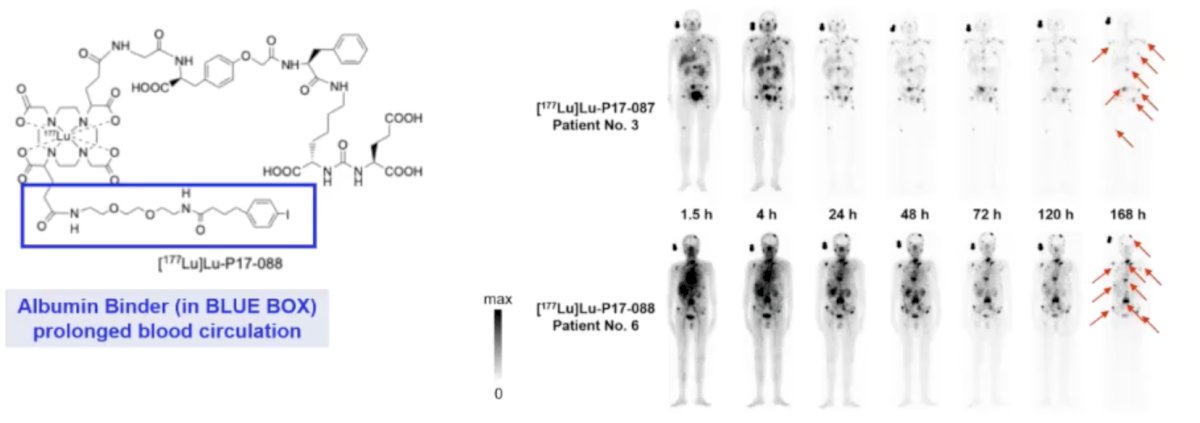
This study, presented at SNMMI 2025, aimed to further evaluate the safety profile and determine the optimal therapeutic dose of 177Lu-P17-088, while also exploring its preliminary efficacy in the treatment of mCRPC.
This study was a 3+3 dose-escalation design (mCRPC patients with PSMA SUVmax >20 and no PSMA negative/FDG positive lesions), beginning with an initial dose of 1.11 GBq. Adverse events were classified using the CTCAE 5.0 criteria, and treatment efficacy was evaluated according to the PCWG3 guidelines for the optimal PSA response. Imaging assessments employed the RECIST 1.1 as well as the RECIP 1.0 criteria:

A total of 12 patients participated in this study, divided into three cohorts: four patients in the 1.11 GBq group, three in the 2.96 GBq group, and five in the 4.44 GBq group. The patients in the 1.11 GBq cohort completed one treatment cycle, while those in the higher dose cohorts completed two cycles, with a mean interval of six weeks (ranging from five to seven weeks). Throughout the study, no immediate adverse events, treatment-related deaths, or grade 3 or higher hematological or biochemical toxicities were reported. The most common adverse events observed were anemia, thrombocytopenia, and fatigue:

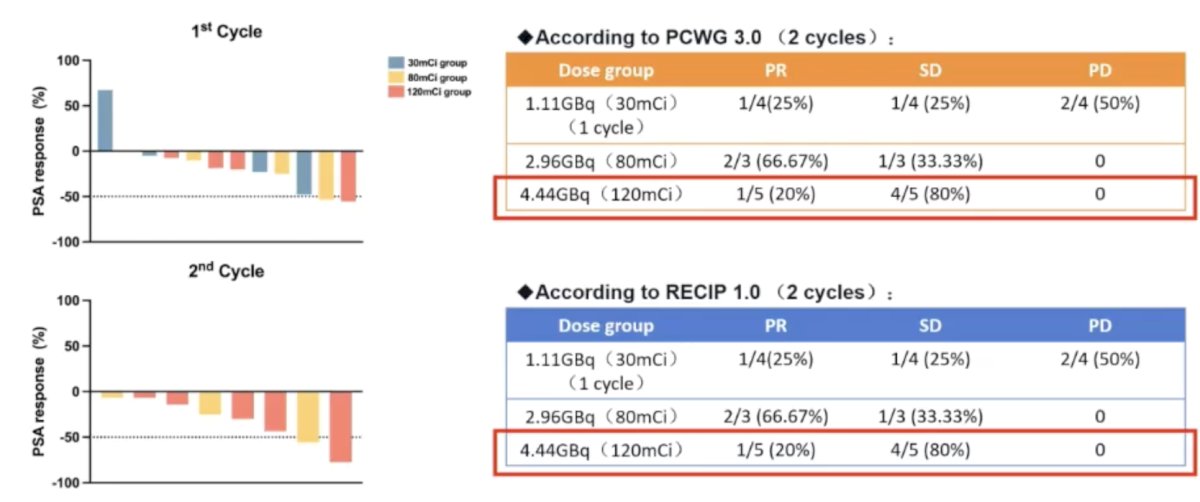
Notably, a reduction in PSA levels was noted in 11 of 12 patients (92%) during the treatment. Using the PCWG3 criteria, four patients (33%) achieved a partial response, six patients (50%) had stable disease, and two patients (17%) experienced progressive disease. In the 1.11 GBq cohort, one patient had a partial response, one had stable disease, and two patients had progressive disease. In the 2.96 GBq cohort, two patients achieved a partial response, and one patient had stable disease. In the 4.44 GBq cohort, one patient had a partial response and four patients had stable disease. According to RECIP 1.0, in the 1.11 GBq cohort, one patient achieved a partial response, one patient had stable disease, and two patients experienced progressive disease. In the 2.96 GBq cohort, two patients achieved a partial response, while one patient had stable disease. In the 4.44 GBq cohort, one patient had a partial response, and four patients maintained stable disease:
Dr. Wang concluded this presentation discussing a dose-escalation study of the novel PSMA-targeting drug 177Lu-P17-088 in patients with mCRPC with the following take home points:
- The treatment with 177Lu-P17-088 was safe, showing no grade 3+ hematological or biochemical toxicities as the dose increased
- A dose of 4.44 GBq demonstrated an objective response rate of 20% and a disease control rate of 100%, indicating improved therapeutic effects with manageable side effects, thus qualifying as the recommended phase 2 dose
Presented by: Jiarou Wang, Peking Union Medical College Hospital, Beijing, China
Written by: Zachary Klaassen, MD, MSc – Urologic Oncologist, Associate Professor of Urology, Georgia Cancer Center, Wellstar MCG Health, @zklaassen_md on Twitter during the 2025 Society of Nuclear Medicine and Molecular Imaging (SNMMI) Annual Meeting, New Orleans, LA, June 21st – 24th, 2025
References:
- Sartor O, de Bono J, Chi KN et al. Lutetium-177-PSMA-617 for Metastatic Castration-Resistant Prostate Cancer. N Engl J Med. 2021 Sep 16;385(12):1091-1103.
- Morris MJ, Castellano D, Herrmann K, et al. 177Lu-PSMA-617 versus a change of androgen receptor pathway inhibitor therapy for taxane-naïve patients with progressive metastatic castration-resistant prostate cancer (PSMAfore): A phase 3, randomized, controlled trial. Lancet 2024 Sep 28;404(10459):1227-1239.