

(UroToday.com) The 2025 SNMMI annual meeting featured a prostate cancer and molecular imaging session and a presentation by Dr. Nadine Mallak discussing the role of 18F-fluciclovine PET/CT in patients with biochemical recurrence of prostate cancer and a negative PSMA PET/CT. PSMA PET/CT is the current standard of care imaging modality to localize tumor sites in the setting of biochemical recurrence of prostate cancer.
While PSMA PET/CT is overall superior to 18F-Fluciclovine for the detection of nodal and distant metastatic disease, it may fail to detect disease in the prostate bed, potentially obscured by the urinary excretion of the most commonly used PSMA agents (68Ga-PSMA-11 and 18F-Piflufolastat), and PSMA-negative disease.
The purpose of this study, presented at the SNMMI 2025 annual meeting, was to evaluate whether 18F-Fluciclovine PET can identify sites of disease recurrence in patients with biochemical recurrence and a negative or equivocal PSMA PET, with the hypothesis that 18F-fluciclovine PET/CT may better detect prostate bed recurrences.
Patients with biochemical recurrence (PSA of at least 0.2 ng/mL) and no definitive site of recurrence on PSMA PET scan are being recruited in this ongoing prospective single-arm cohort study (NCT 05722925). Patients are imaged with 18F-Fluciclovine PET/CT within 30 days of the PSMA PET/CT scan. Per study protocol, no anti-cancer treatment is allowed between the two PET/CT scans. To align with clinical practice, the PSMA and 18F-Fluciclovine PET/CTs are interpreted by an experienced nuclear medicine physician according to established interpretation criteria. The presence of disease is recorded on a per-patient and per-region basis, and an official report is sent to the patient’s medical record so it can be used to change the treatment plan if clinically indicated. Two questionnaires about intended management are filled by the referring provider, the first before the 18F-Fluciclovine PET/CT is done, and the second after the results of the 18F-Fluciclovine PET/CT are available. Subsequently, change in intended management is recorded.
To date, 46 male patients with biochemical recurrence have been enrolled: post-prostatectomy (n = 20, 43.5%), post-definitive radiation therapy (n = 7, 15.2%), post-surgery plus radiation (n = 18, 39.1%), and post-ADT (n = 1, 2.2%). 18F-Fluciclovine PET/CT was positive in 25 patients (54.3%), with local recurrence in 12 patients (48%), regional nodal metastases in 5 patients (20%), and distant metastatic disease in 8 patients (32%). The distant metastatic disease involved distant lymph nodes (outside the pelvis) in 2 patients, bones in 4 patients, adrenal gland in one patient, and distant lymph nodes + bones in one patient.
The following patient had biochemical recurrence with a PSA of 2.61 ng/mL. 18F-Piflufolastat PET/CT is shown in panel A (axial PET) and axial fused PET/CT shown in panel B, demonstrating a 2 cm right adrenal nodule present without PSMA uptake, which was interpreted as negative. 18F-fluciclovine PET/CT 25 days later is depicted in an axial PET in panel C and an axial fused PET/CT in panel D. This showed abnormal uptake in the right adrenal nodule, suspicious for metastasis, with a biopsy of this nodule confirming metastatic prostate adenocarcinoma: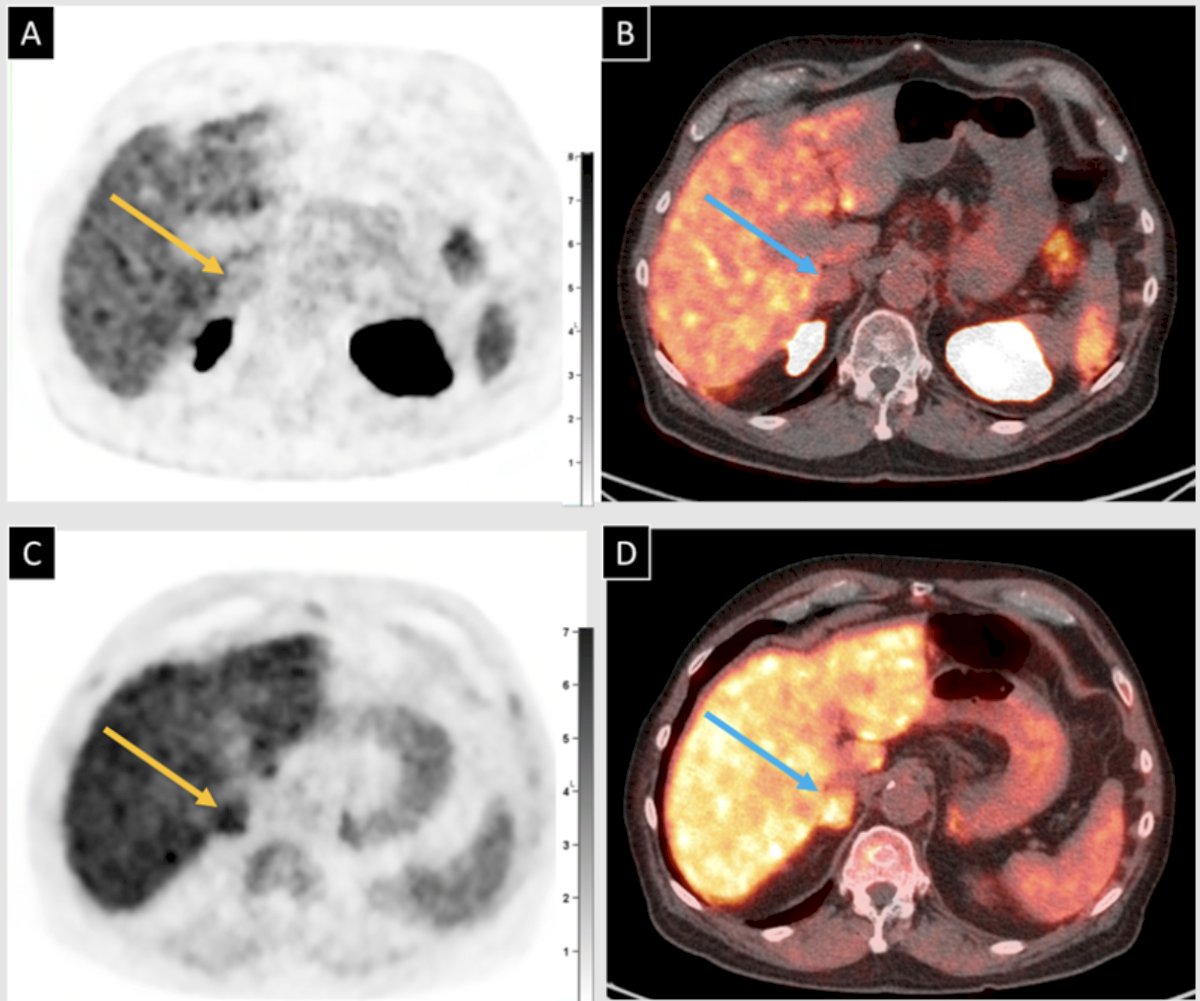
The PSA levels in patients with positive 18F-Fluciclovine scans ranged from 0.20 to 14.75 ng/mL (mean of 2.9 ng/mL and median of 0.53 ng/mL) and from 0.21 to 4.28 ng/mL (mean of 0.75 ng/mL and median of 0.41 ng/mL) in patients with negative 18F-Fluciclovine PET/CT, with no statistically significant difference between the two groups (p = 0.19 Wilcoxon rank sum test). The intended management questionnaires pre- and post-18F-Fluciclovine PET/CT were completed by the treating physician for 14/25 patients with positive PET/CTs, showing a change in management in 12 patients (85.7%). The questionnaires were completed for 13/21 patients with negative scans, with a change in management in 7 patients (53.8%):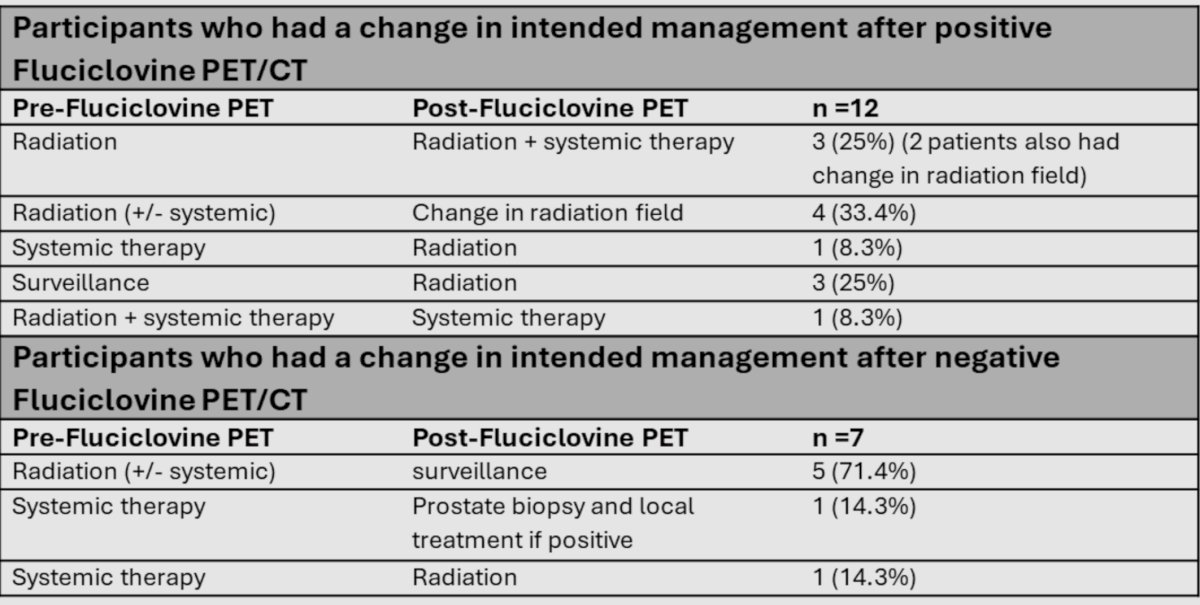
Dr. Mallak concluded her presentation discussing the role of 18F-fluciclovine PET/CT in patients with biochemical recurrence of prostate cancer and a negative PSMA PET/CT with the following take-home points:
- 18F-Fluciclovine PET detected disease in over half of the patients with biochemical recurrence and negative PSMA PET
- The 18F-Fluciclovine PET, after a negative PSMA PET, led to changes in the management for the majority of patients
Presented by: Nadine Mallak, MD, Oregon Health & Science University, Portland, OR
Written by: Zachary Klaassen, MD, MSc – Urologic Oncologist, Associate Professor of Urology, Georgia Cancer Center, Wellstar MCG Health, @zklaassen_md on Twitter during the Society of Nuclear Medicine and Molecular Imaging (SNMMI) 2025 Annual Meeting, New Orleans, LA, Sat, Jun 21 – Tues, Jun 24, 2025.