

(UroToday.com) The 2025 SNMMI annual meeting featured a radiotheranostics session and a presentation by Dr. Xuejen Wen discussing the development of PSMA targeting radioligand 161Tb-LNC1011 for prostate cancer theranostics. Targeting PSMA with radioligand has demonstrated remarkable therapeutic efficacy in metastatic castration-resistant prostate cancer (mCRPC) patients. 161Tb has similar chemical properties and physical decay characteristics to 177Lu; however, 161Tb emits a high proportion of conversion and low-energy Auger electrons, which are different from 177Lu. These electrons have an ultra-short tissue range (< 500 nm), resulting in a high linear energy transfer (4 - 26 keV/µm) and high local dose densities. At the 2025 SNMMI annual meeting, Dr. Wen and colleagues aimed to synthesize PSMA targeting peptide, LNC1011 (Dansyl-PSMA), and radiolabel it with 161Tb for prostate cancer therapy.
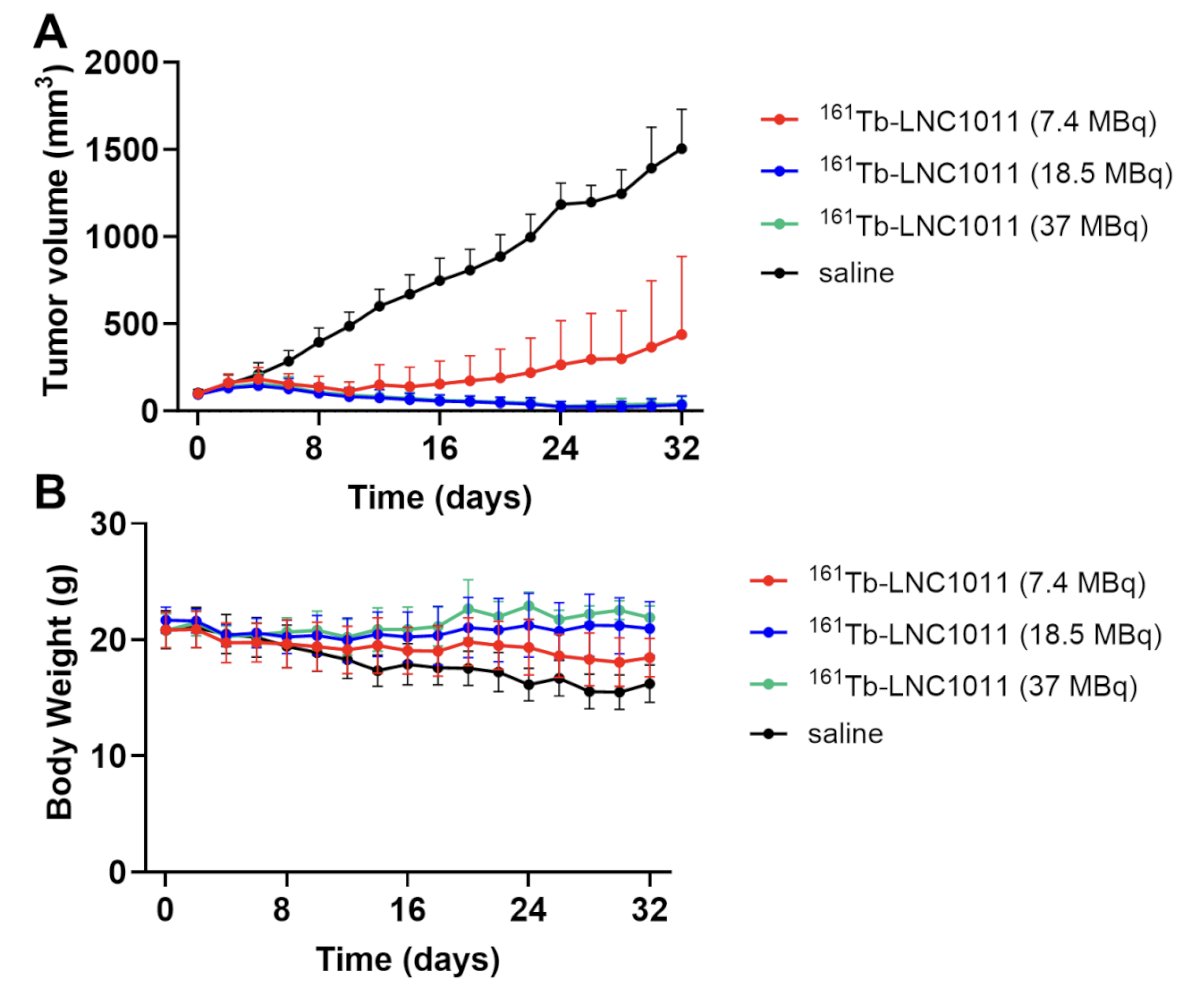
PSMA targeting ligand, LNC1011, was synthesized based on albumin binding dansyl moiety, PSMA targeting moiety, and DOTA chelator. Binding affinity and targeting specificity were verified through cell uptake and competition binding assay. SPECT/CT imaging and preclinical pharmacokinetics evaluation of 161Tb-LNC1011 were performed in the PC3-PIP xenograft model to identify the tumor uptake and ex vivo biodistribution. To verify the specificity in vivo, SPECT images of 161Tb-LNC1011 after blocked with PSMA617 were also performed in the PC3-PIP tumor model. In addition, antitumor efficacy of 161Tb-LNC1011 was assessed by administration of 7.4, 18.5, 37 MBq dosages for therapy study.
161Tb-LNC1011 had high radiochemical purity and stability in formulation liquid for storage at least 96 hours, and showed a favorable affinity and targeting specificity in vitro and in vivo. SPECT imaging of 161Tb-LNC1011 showed significantly high tumor uptake and retention until 96 hours, and it also exhibited high tumor-to-background ratios and low normal organs uptake from 4 hours to 96 hours post-injection:
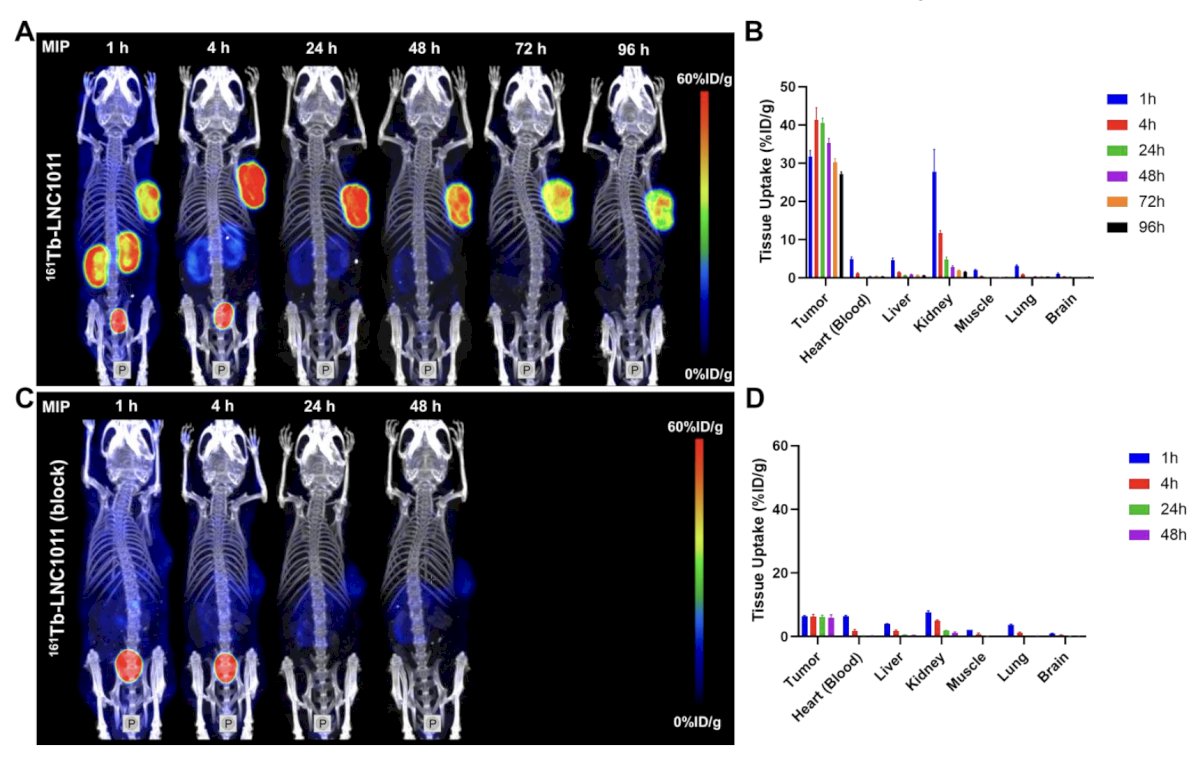
Tumor uptake could be blocked with PSMA617, which indicated the targeting specificity. Therapy assay results showed that 18.5 and 37 MBq of 161Tb-LNC1011 could completely inhibit PC3-PIP tumor growth and maintain normal body weight. Moreover, 7.4 MBq could inhibit tumor growth compared to the saline group, but was inferior to 18.5 MBq, which demonstrated the dose-dependent treatment efficacy:
Dr. Wen concluded this presentation discussing the development of PSMA targeting radioligand 161Tb-LNC1011 for prostate cancer theranostics with the following take home points:
- 161Tb-LNC1011 was successfully prepared with high radiochemical purity and stability
- With significantly high PSMA targeting affinity and specificity, 161Tb-LNC1011 showed prominent tumor uptake and slight normal tissue uptake, which also indicated a notable antitumor effect and promising clinical applicability for the treatment of mCRPC patients
Presented by: Xuejen Wen, National University of Singapore, Queenstown, Singapore
Written by: Zachary Klaassen, MD, MSc – Urologic Oncologist, Associate Professor of Urology, Georgia Cancer Center, Wellstar MCG Health, @zklaassen_md on Twitter during the 2025 Society of Nuclear Medicine and Molecular Imaging (SNMMI) Annual Meeting, New Orleans, LA, June 21st – 24th, 2025