

(UroToday.com) The 2025 Society of Nuclear Medicine and Molecular Imaging (SNMMI) Annual Meeting held in New Orleans, LA between June 21st and 24th, 2025, was host to a Data Sciences and Informatics session. Dr. Kevin Leung presented an artificial intelligence-based risk score for the prognostic evaluation of prostate cancer patients using PSMA PET/CT imaging.
Dr. Leung argued that improved survival prediction is an important unmet clinical need. Prostate cancer remains a leading cause of cancer death, and the presence of metastatic disease drives mortality. The quantification of tumor burden is relevant for survival estimation and treatment planning. Approaches that predict overall survival often employ semi-automated segmentation methods. An automated workflow to quantify whole-body tumor burden on PSMA PET/CT and accurately predict survival is needed. They employed a framework where they automatically segmented tumors on PSMA PET/CT scans and extracted whole body imaging measures such as molecular tumor volume, total lesion activity, total number of lesions, and SUVmean/SUVmax measures. These parameters were incorporated into an imaging-based risk score that ranged in value from 0 to 15 using a points-based system. The imaging-based risk score was then combined with other variables, including treatment status and baseline imaging findings, which yielded a prognostic index used to perform risk stratification and prediction of survival outcomes.

The overall and progression-free survivals by the imaging-based risk score tertiles are illustrated in the Kaplan Meier curves below. Patients with higher imaging-based risk scores (orange and yellow curves) had worse survival outcomes.

Patients in the higher risk tertile had higher PSA levels at PSMA PET and during follow-up.

When the predicted probabilities of death were plotted against the observed mortalities at 1-, 3-, and 5-years following imaging, Dr. Leung noted that most observed deaths (shaded circles) were observed in patients at high risk for an event.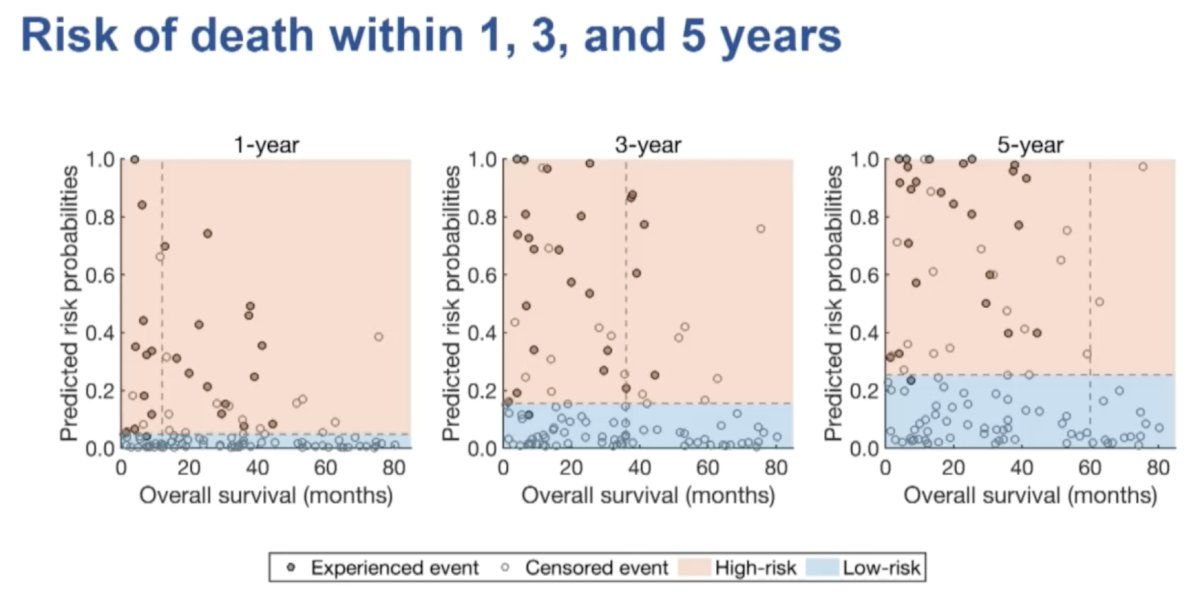
A similar trend was observed when the predicted risks of progression were plotted against the observed progression events, with most patients at high-risk experiencing disease progression.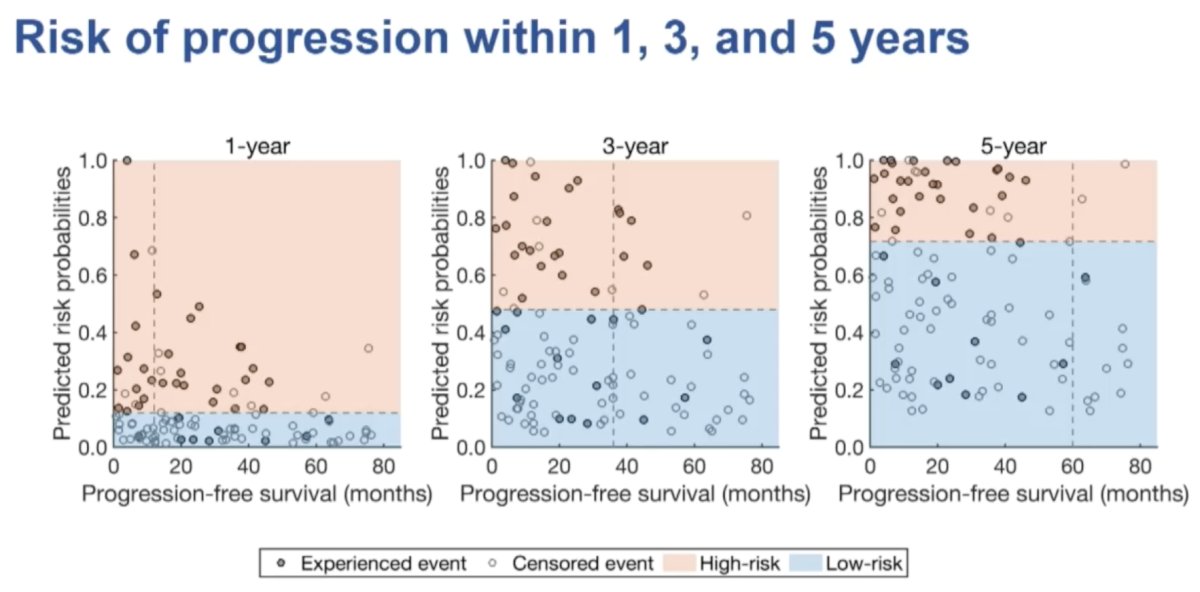
The predicted and observed risk probabilities were well-aligned on calibration plots.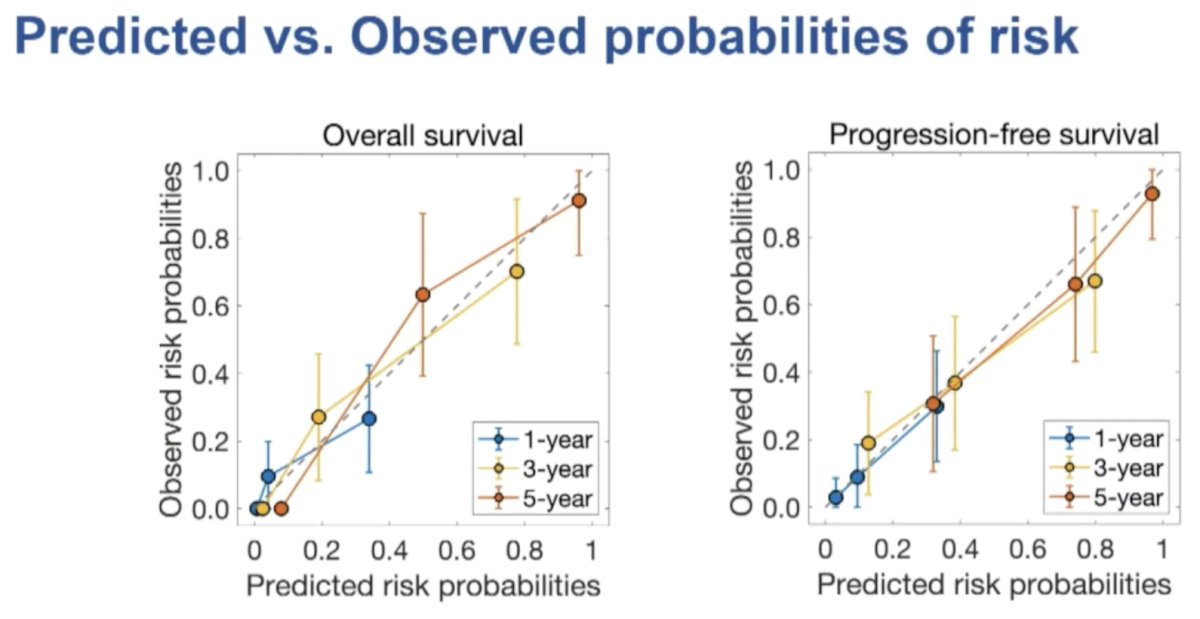
The observed survival curves ‘agreed’ with the predicted overall and progression-free survivals for patients when stratified by the imaging-based risk score.
Similarly, the observed survival curves ‘agreed’ with the predicted overall and progression-free survivals for patients stratified by the predicted risk groups.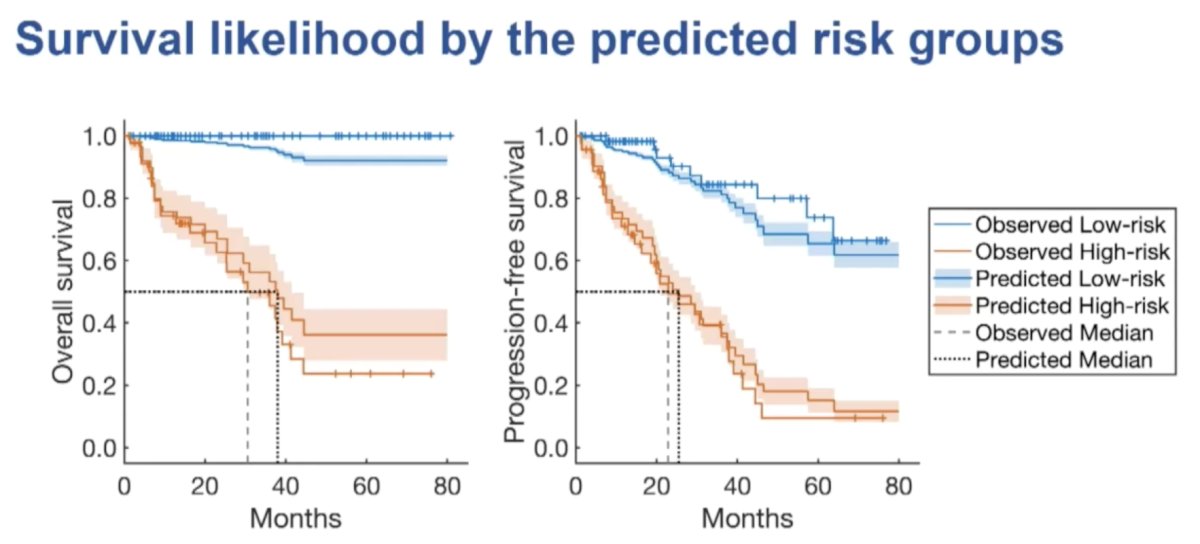
When survival outcomes were stratified by the post-PSMA PET/CT therapy received (local only low-risk patients, systemic androgen, or systemic cytotoxic), the study investigators noted strong agreements between the predicted and observed probabilities for both low- and high-risk patients.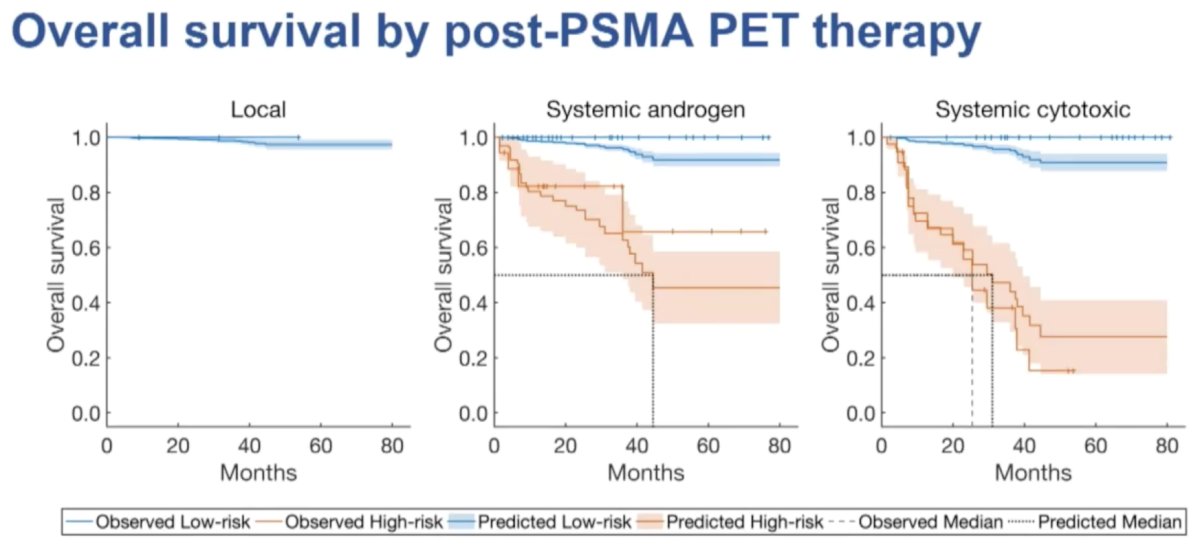
Dr. Leung concluded his presentation as follows:
- The study investigators were able to perform fully automated tumor quantification on PSMA PET/CT and integrate whole-body imaging biomarkers into an imaging-based risk score
- A prognostic index was developed and demonstrated accurate risk stratification and survival prediction in prostate cancer patients
- This risk score was able to accurately predict overall and progression-free survivals at 1, 3, and 5 years following PSMA PET imaging
- This risk score model is also able to accurately predict conditional survival probabilities based on different therapies for personalized treatment selection and patient management
Presented by: Kevin Leung, PhD, Instructor, Johns Hopkins University, Baltimore, MD
Written by: Rashid K. Sayyid, MD, MSc – Robotic Urologic Oncology Fellow at The University of Southern California, @rksayyid on Twitter during the 2025 Society of Nuclear Medicine and Molecular Imaging (SNMMI) Annual Meeting, New Orleans, LA, June 21st – 24th, 2025