

(UroToday.com) The 2025 Society of Nuclear Medicine and Molecular Imaging (SNMMI) Annual Meeting held in New Orleans, LA, between June 21st and 24th, 2025, was host to the Barry Siegel Award Lecture session. Dr. Andrei Iagaru discussed the use of whole-body SPECT/CT following 177Lu therapy.
The 1st SPECT/CT prototype was developed in 1992 by Bruce Hasegawa at UCSF, and this was later replaced by the Hawkeye-4 in 2006, which was in turn replaced in 2019.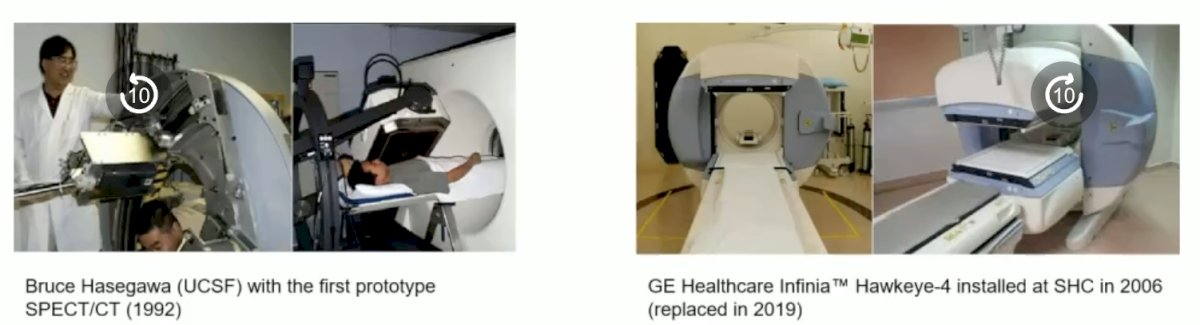
How can we use SPECT/CT in the post-177Lu therapy setting? Dr. Louise Emmett’s group has demonstrated that 177Lu-PSMA SPECT quantitation at 6 weeks (i.e., after 2nd dose) predicts short-term progression-free survival for patients undergoing 177Lu-PSMA-I&T therapy.1

Dr. Thomas Hope’s group has similarly demonstrated that post-treatment SPECT/CT has a significant impact on patient management during 177Lu-PSMA-617 radiopharmaceutical therapy. In a cohort of 122 patients, 49% of patients had a change in management due to findings on post-treatment SPECT.

What about the timing of post-therapy SPECT/CT? Twenty-four hours is the most common interval at which these scans have typically been performed. However, Dr. Iagaru noted that this has classically been an arbitrarily selected interval given that patients in many non-US centers get admitted for radionuclide therapy and undergo SPECT/CT imaging the following day while still inpatient. Performing same-day SPECT/CT (e.g., 4 hours post-therapy) may be a more convenient, cheaper alternative interval for patients who undergo such therapy on an outpatient basis, such as in the US. A recent study by Dr. Emmett’s group demonstrated that [177Lu]Lu-PSMA SPECT/CT at 4 hours after injection appears a promising alternative to 24-hour [177Lu]Lu-PSMA SPECT/CT for treatment response assessment, with improved patient convenience.3

What does the future of SPECT/CT look like? The novel StarGuide scanner was installed at Stanford University in 2021, and early results suggest that high quality images can be obtained at early time points (5 minutes) with low background noise. Importantly, this scanner allows for faster scanning times with comparable detection/targeting rates versus other SPECT/CT systems (e.g., Discovery 670 Pro) and comparable to PET imaging.4
These results have altered the clinical workflow at Dr. Iagaru’s institution where SPECT/CT is now performed same day after every 177Lu-PSMA infusion. Notably, the SPECT/CT only requires 12 minutes in this setting, which is comparable to 18F-DCFPyL PET/CT (10 minutes) in this setting.

These same-day, post-therapy whole-body digital SPECT?CT scans are able to assess treatment response to 177Lu-PSMA-617 therapy in mCRPC patients.5

SPECT/CT may also allow for the early identification of patients who may not benefit from continued radioligand therapy, as illustrated below:
Conversely, it may help identify patients who may benefit from earlier cessation of PSMA radioligand therapy due to a complete response.
The next frontier of SPECT/CT will enable a SPECT/CT-guided administration of radiopharmaceuticals to minimize the acute adverse effects with these theranostic agents.
Presented by: Andrei Iagaru, MD, FACNM, FSNMMI, Professor of Radiology, Department of Radiology and Nuclear Medicine, Stanford University Medical Center, Palo Alto, CA
Written by: Rashid K. Sayyid, MD, MSc – Robotic Urologic Oncology Fellow at The University of Southern California, @rksayyid on Twitter during the 2025 Society of Nuclear Medicine and Molecular Imaging (SNMMI) Annual Meeting, New Orleans, LA, June 21st – 24th, 2025
References:- John N, Pathmanandavel S, Crumbaker M, et al. 177Lu-PSMA SPECT Quantitation at 6 Weeks (Dose 2) Predicts Short Progression-Free Survival for Patients Undergoing 177Lu-PSMA-I&T Therapy. J Nucl Med. 2023; 64(3): 410-5.
- Yadav S, Lowery B, Tuchayi AM, et al. Impact of Posttreatment SPECT/CT on Patient Management During 177Lu-PSMA-617 Radiopharmaceutical Therapy. J Nucl Med. 2024; 65(9):1395-401.
- Swiha M, Pathmanandavel S, Papa N, et al. Comparison of posttherapy 4- and 24-hour 177LuPSMA SPECT/CT and pretherapy PSMA PET/CT in assessment of disease in men with metastatic castration resistant prostate cancer. J Nucl Med. 2024; 65(12): 1939-44.
- Song H, Ferri V, Duan H, et al. SPECT at the speed of PET: a feasibility study of CZT-based whole-body SPECT/CT in the post 177Lu-DOTATATE and 177Lu-PSMA617 setting. Eur J Nucl Med Mol Imaging. 2023; 50(8): 2250-7.
- Song H, Leonio MI, Ferri V, et al. Same-day post-therapy imaging with a new generation whole-body digital SPECT/CT in assessing treatment response to [177Lu]Lu-PSMA-617 in metastatic castration-resistant prostate cancer. Eur J Nucl Med Mol Imaging. 2024; 51(9): 2784-93.