

(UroToday.com) The 2025 SNMMI annual meeting featured a prostate cancer session and a presentation by Dr. Amir Iravani discussing a CONDOR sub-analysis of positive predictive value in the prostate/prostatic bed stratified by PSA. PSMA-targeted PET/CT has become a mainstay for imaging prostate cancer patients with biochemical recurrence. Given some of the high detection rates reported at low PSA (<0.5 ng/mL) levels, the potential for false positives in the prostate/prostatic bed in this patient population warrants further investigation. The objective of this study presented at the 2025 SNMMI annual meeting, was to determine and report the positive predictive value of 18F-piflufolastat PET/CT in the prostate/prostatic bed of patients with biochemical recurrence when stratified by PSA level at the time of imaging.
Men ≥18 years with biochemical recurrence after definitive therapy and negative or equivocal standard of care imaging (ie. CT/MRI, bone scintigraphy) were enrolled in the phase 3 CONDOR trial.1 A single 9 mCi (333 MBq) ± 20% dose of 18F-piflufolastat was injected, followed by PET/CT 1-2 hours later. Patients with a negative 18F-piflufolastat PET/CT scan for the prostate/prostatic bed at the time of initial local read were excluded from this analysis. Patients with positive 18F-piflufolastat PET/CT scans based on local interpretation were scheduled for subsequent follow up to verify suspected lesion(s) based on a composite standard of truth. The standard of truth consisted of, in descending priority:
- Histopathology
- Subsequent correlative imaging (18F-fluciclovine or 11C-choline PET, focused MRI, or CT) findings were reviewed by two central readers
- Post-radiation PSA response
Three independent, blinded central reviewers read the 18F-piflufolastat PET/CT scans. The diagnostic performance of 18F-piflufolastat PET/CT scans for each central reader was determined by calculating the region level positive predictive value (true positives/true positives + false positives). This included all patients with a positive scan in the prostate/prostatic bed region and an evaluable PSA value and was stratified by PSA levels at the time of imaging. PSA stratification levels were kept consistent with those established for the CONDOR study primary analysis.
There were 208 men with a median PSA of 0.8 ng/mL (range: 0.2 - 98.5 ng/mL) that underwent 18F-piflufolastat PET/CT. There were 47 men (median PSA 4.0, 4.3, and 4.1 ng/mL [range: 0.3 – 98.5 ng/mL] for readers 1-3, respectively) with at least one 18F-piflufolastat positive lesion in the prostate/prostatic bed anatomical region:
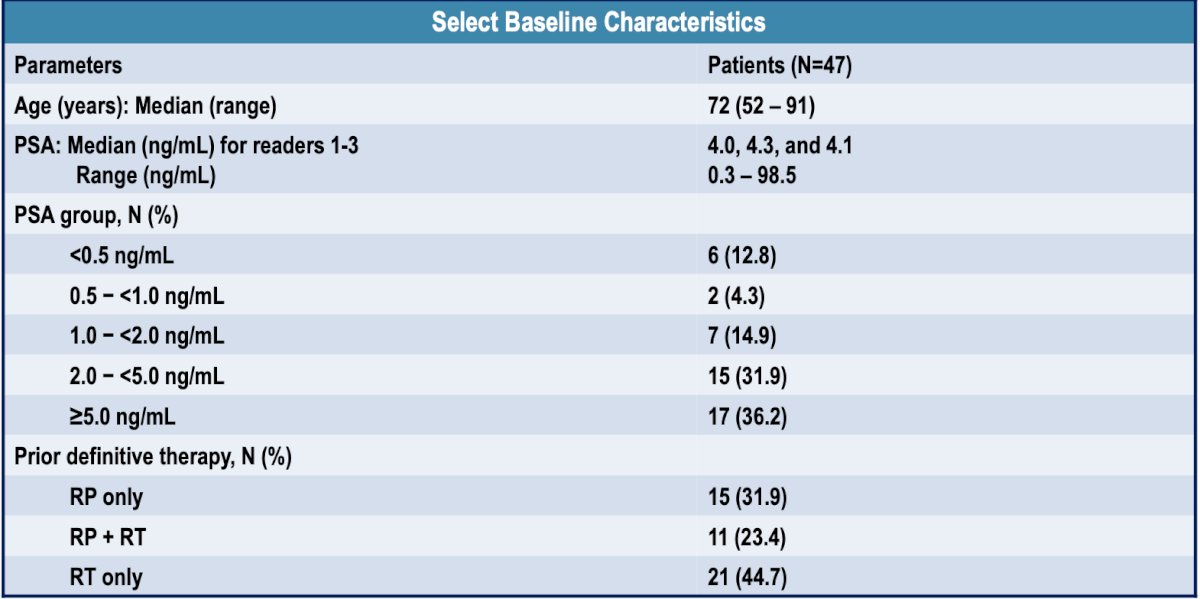
Historical definitive therapies were radical prostatectomy (n = 15; 31.9%), radical prostatectomy + radiation therapy (n = 11; 23.4%), and radiation therapy alone (n=21; 44.7%). The standard of truth consisted of histopathology (n= 16; 34.0%) and correlative imaging (n = 31; 66.0%):
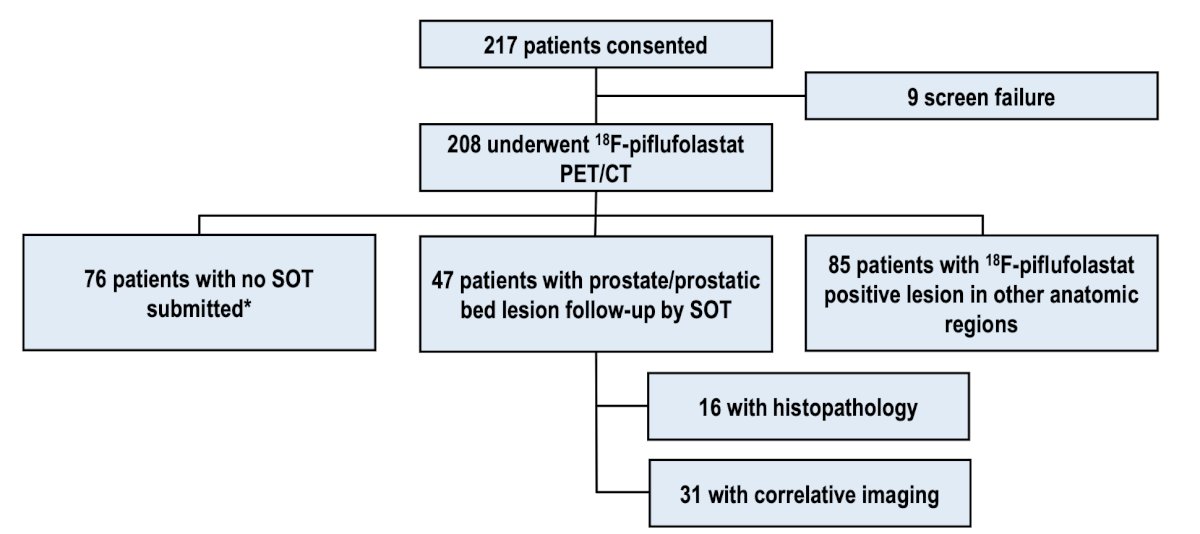
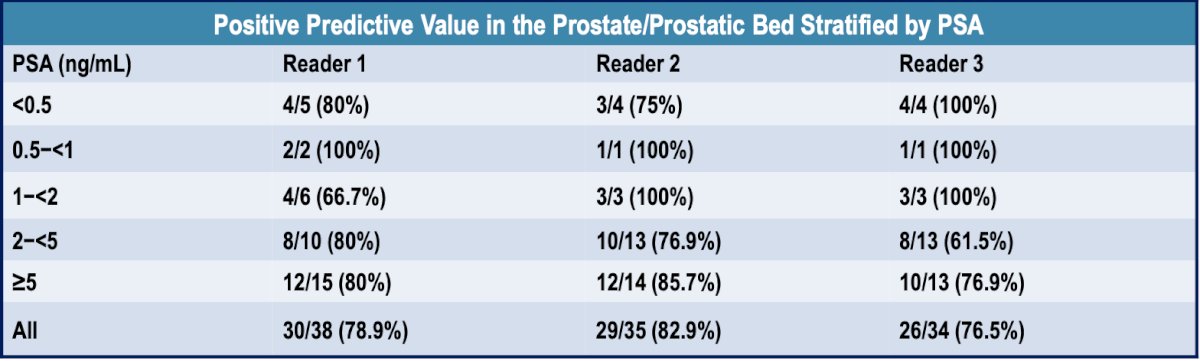
18F-piflufolastat detection rates for this subset of patients were 80.9% (38/47), 74.5% (35/47), 72.3% (34/47) for central readers 1-3, respectively. The positive predictive value of 18F-piflufolastat PET/CT ranged from 61-100% among the different PSA stratification levels. At the lowest PSA levels (<0.5 ng/mL), the positive predictive value remained high across all three independent central readers (4/5, 80%; 3/4, 75%; 4/4, 100%):
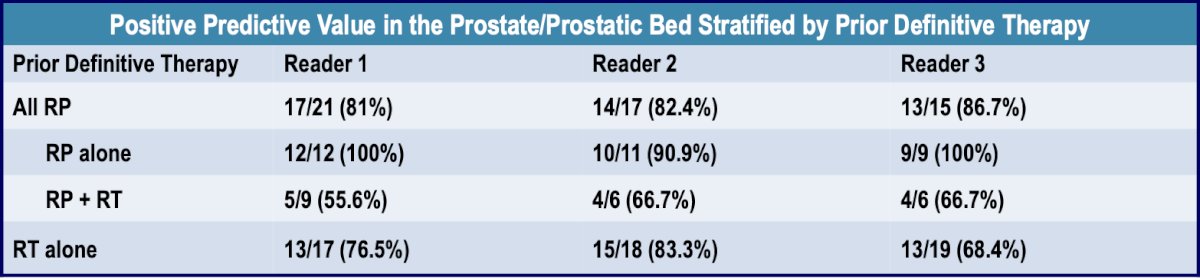
When stratified by prior definitive therapy, the positive predictive value among all readers ranged from 81.0% - 86.7% for all radical prostatectomy patients, and 68.4% - 76.5% for radiotherapy alone patients:
The following images depict 18F-piflufolastat PET/CT identifying a positive lesion in the prostatic bed:
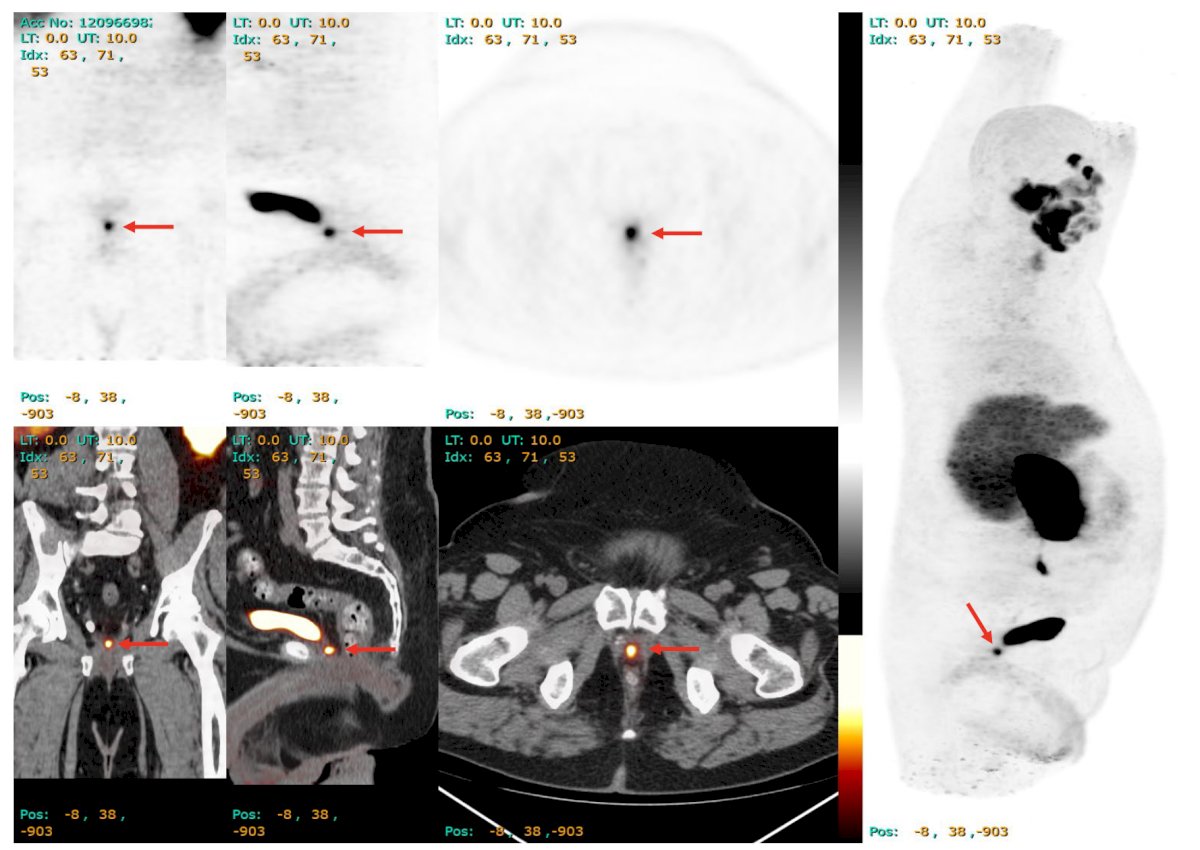
Additionally, the following images depict 18F-piflufolastat PET/CT identifying a positive lesion in the prostate:

Dr. Iravani concluded his presentation discussing a CONDOR sub-analysis of positive predictive value in the prostate/prostatic bed stratified by PSA with the following take home points:
- 18F-piflufolastat PET/CT demonstrated consistently high region-level positive predictive value in the prostate/prostatic bed among patients with biochemical recurrence after definitive therapy
- Positive predictive values ranged from 77% to 83% across all PSA strata, including at low PSA levels (<0.5 ng/mL). Notably, positive predictive values remained high in the radiotherapy alone group
- The high positive predictive value is expected to provide confidence in treatment recommendations for patients with locally recurrent prostate cancer
Presented by: Amir Iravani, MD, University of Washington, Seattle, WA
Written by: Zachary Klaassen, MD, MSc – Urologic Oncologist, Associate Professor of Urology, Georgia Cancer Center, Wellstar MCG Health, @zklaassen_md on Twitter during the 2025 Society of Nuclear Medicine and Molecular Imaging (SNMMI) Annual Meeting, New Orleans, LA, June 21st – 24th, 2025
References: