

(UroToday.com) The 2025 Society of Nuclear Medicine and Molecular Imaging (SNMMI) Annual Meeting held in New Orleans, LA, was host to a session on emerging, novel theranostic agents. Dr. Ashwin Parihar presented a study of the clinical utility of post-therapy SPECT/CT following the 1st cycle of 177Lu-PSMA-617 therapy for detecting interim disease progression, compared to pre-therapy PSMA PET/CT.
177Lu-PSMA-617 is approved by the US Food and Drug Administration (FDA) for the treatment of metastatic castration-resistant prostate cancer (mCRPC) patients who have been treated with an androgen receptor pathway inhibitor (ARPI) and taxane-based chemotherapy (VISION and TheraP)1 or are considered appropriate to delay taxane-based chemotherapy (PSMAfore).2 Currently, a baseline PSMA-PET/CT is used to determine eligibility for 177Lu-PSMA therapy in clinical practice, assessing the ‘adequacy’ and homogeneity of PSMA expression at the disease sites.

SPECT/CT in the post-therapy setting has been proposed given its utility for dosimetry estimations, prediction of treatment outcomes, and potential ability to provide new/emergent clinically relevant information. The disease burden, PSMA expression profile, and tumor characteristics can change with increasing time from baseline PET/CT to the 1st cycle of 177Lu-PSMA-617. Current guidelines recommend the use of PSMA imaging-based response criteria to guide further treatment decision-making. The 2023 SNMMI consensus guidelines recommend repeat imaging within 3 months of treatment or at the time of disease progression on therapy. Of note, repeat PET imaging was performed within ~4 weeks in both VISION and TheraP.3,4
The study outcomes were as follows:
- Primary: Rate of discordance between the 1st post-therapy SPECT/CT and the baseline PSMA-PET/CT
- Secondary :
- The association between the time from PET/CT to therapy and discordance rates
- Patterns of discordance
- Frequency of adjuvant findings on SPECT/CT impacting patient management
This was a retrospective review of mCRPC patients who were treated with 177Lu-PSMA-617 and received a whole-body SPECT/CT after the 1st treatment cycle. Discordant findings were defined by ≥1 of the following:
- Unequivocal appearance of new lesions (nodal, visceral, or bone) on the SPECT/CT
- Increase in size of the previous lesions (≥30% in a single dimension for lymph nodes or visceral lesions)
- Appearance of additional findings that would necessitate additional management
The study investigators recorded the time between the baseline PSMA-PET and the first treatment cycle, as well as the time from therapy administration to performance of the SPECT/CT. Other patient demographics, such as age, date of initial diagnosis, serum PSA at PSMA-PET, and prior lines of therapy, were recorded.
The study investigators identified 138 mCRPC patients who were treated with 177Lu-PSMA-617 between January 2023 and December 2024. Of these, 79 men had evaluable baseline PSMA PET/CT and post-1st cycle of therapy SPECT/CT images. The median time from the baseline PSMA-PET/CT to the 1st cycle of therapy was 49 days. 6/51 patients had the SPECT/CT performed between 2-6 hours after therapy, while the remaining patients (45/51) had the SPECT/CT performed 24 hours post-therapy.
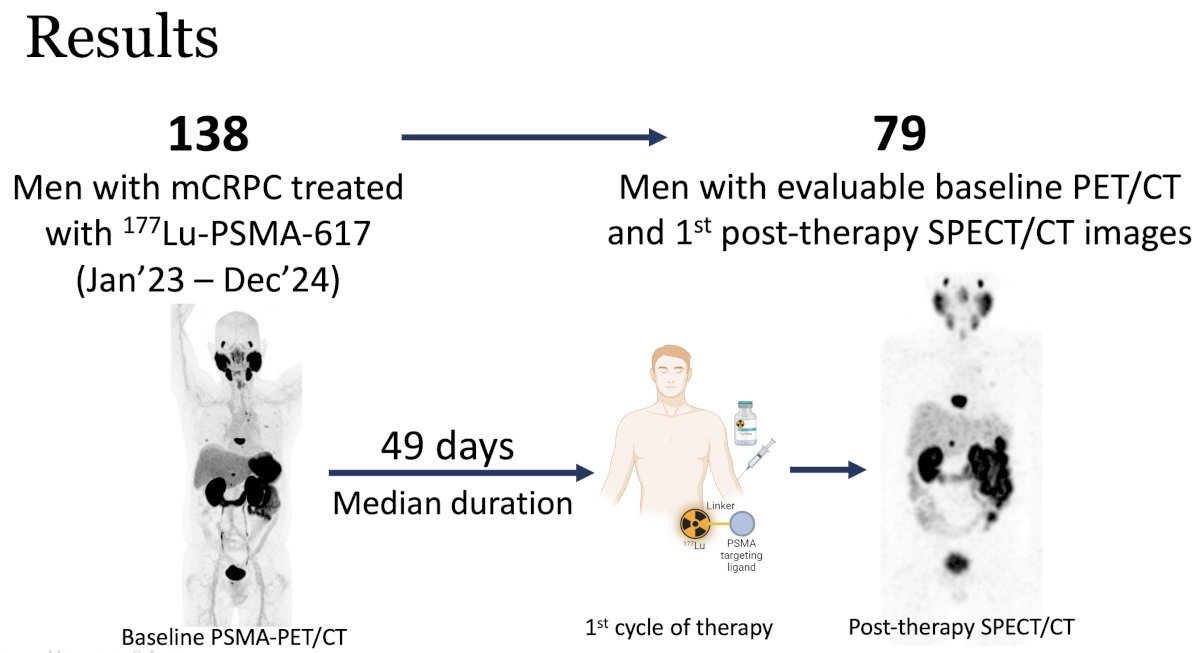
Discordant SPECT/CT and PET/CT findings were observed in 30/79 (38%) patients. The patterns of discordance were as follows:
- Only enlarging lesions: 12
- Exclusively new lesions: 8
- Both new and enlarging lesions: 10
- New, moderate hydronephrosis: 2
- New spinal cord compression: 1

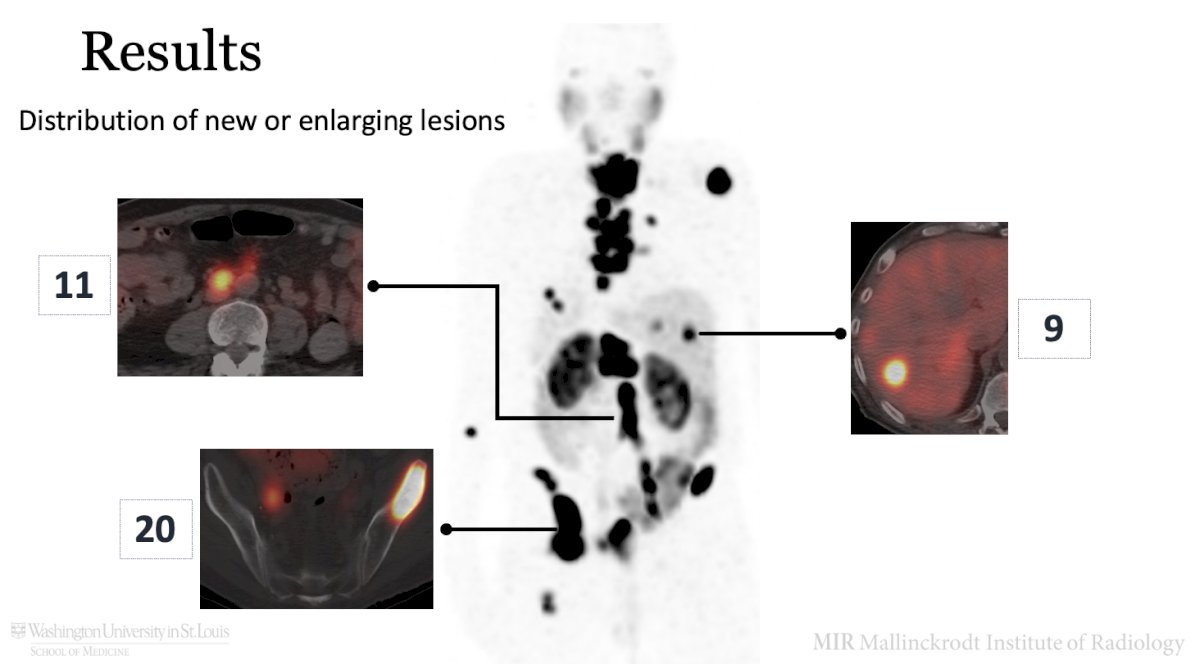
The anatomic distribution of the new or enlarging lesions (n=40) was as follows:
- Nodal: 11
- Bone: 20
- Visceral: 9
Among patients with discordant findings, the median duration from baseline PSMA-PET/CT to post-therapy SPECT/CT was 88 days, compared to 40 days for those with concordant findings.

Dr. Parihar concluded as follows:
- 38% of patients had discordant SPECT/CT findings, especially for those who had the SPECT/CT performed >30 days after treatment
- 93.3% of discordances were found in patients who had their SPECT/CT performed >30 days after treatment initiation
- Post-therapy SPECT/CT is crucial
- This study demonstrates the value of performing post-therapy SPECT/CT in patients being treated with 177Lu-PSMA therapy, especially with the incorporation of PSMA-imaging based response criteria in clinical practice
- SPECT/CT can serve as a more accurate baseline for subsequent assessments
Presented by: Ashwin Singh Parihar, MD, Assistant Professor of Radiology, Department of Radiology, Washington University, St Louis, MO
Written by: Rashid K. Sayyid, MD, MSc – Robotic Urologic Oncology Fellow at The University of Southern California, @rksayyid on Twitter during the 2025 Society of Nuclear Medicine and Molecular Imaging (SNMMI) Annual Meeting, New Orleans, LA, June 21st – 24th, 2025
References:
- U.S. Food and Drug Administration. FDA approves Pluvicto for metastatic castration-resistant prostate cancer. 2022 Mar 23. Accessed 2025 Jun 22. https://www.fda.gov/drugs/resources-information-approved-drugs/fda-approves-pluvicto-metastatic-castration-resistant-prostate-cancer
- U.S. Food and Drug Administration. FDA expands Pluvicto’s metastatic castration-resistant prostate cancer indication. 2025 Mar 28. Accessed 2025 Jun 2. https://www.fda.gov/drugs/resources-information-approved-drugs/fda-expands-pluvictos-metastatic-castration-resistant-prostate-cancer-indication
- Hofman MS, Emmett L, Sandhu S, et al. [(177)Lu]Lu-PSMA-617 versus cabazitaxel in patients with metastatic castration-resistant prostate cancer (TheraP): A randomized, open-label, phase 2 trial. Lancet. 2021; 397(10276):797-804.
- Sartor O, de Bono J, Chi KN et al. Lutetium-177-PSMA-617 for Metastatic Castration-Resistant Prostate Cancer. N Engl J Med. 2021; 385(12):1091-1103.