

(UroToday.com) The 2025 SESAUA annual meeting featured a prostate cancer session and a presentation by Dr. Abhi Moolupuri discussing a PET/CT supplemented approach to omission of pelvic lymph node dissection. The National Comprehensive Cancer Network (NCCN) panel recommends considering pelvic lymph node dissection in favorable intermediate risk localized prostate cancer and performing pelvic lymph node dissection in unfavorable intermediate risk and subsequent risk tiers.
The Memorial Sloan Kettering Cancer Center (MSKCC) nomogram considers characteristics such as (i) pretreatment PSA, (ii) clinical stage, and (iii) Gleason sum, and is the most widely accepted preoperative nomogram tool for preoperative lymph node metastasis suspicion. The NCCN recommended 2% nomogram threshold; pelvic lymph node dissection could be avoided in 22.3% of patients with missed lymph node metastasis in 3%. The favorable detection of micro-metastatic disease via PSMA/PET imaging offers the opportunity to contemporize pre-operative lymph node metastasis suspicion.
The study was a retrospective analysis of 107 patients with clinically localized prostate cancer confirmed on MRI cognitive fusion biopsy. Patients with localized prostate cancer treated with radical prostatectomy with pelvic lymph node dissection, with preoperative PSMA PET imaging were selected, and patients with evidence of metastasis on nuclear imaging were excluded. Diagnostic test descriptors, namely negative predictive value, negative likelihood ratio, and overall concordance, investigated the diagnostic accuracy of PET/CT. Due to the smaller sample size of separate NCCN risk strata, concordance values were also calculated to identify trends toward comparative significance. Each patient was also assessed using the MSKCC nomogram and assigned a calculated risk.
Using only PSMA PET for predictive assessment of nodal metastases yielded an overall sensitivity of 85.7%, specificity of 87.1%, PPV of 33.3%, and NPV of 98.0%. NLR was 0.17, and PSMA PET showed a concordance rate of 0.87. The sole use of the MSKCC nomogram for predictive risk assessment yielded an overall sensitivity of 100%, specificity of 28.8%, PPV of 9.5%, and NPV of 100%. The NLR was 0, and concordance rate was 0.64: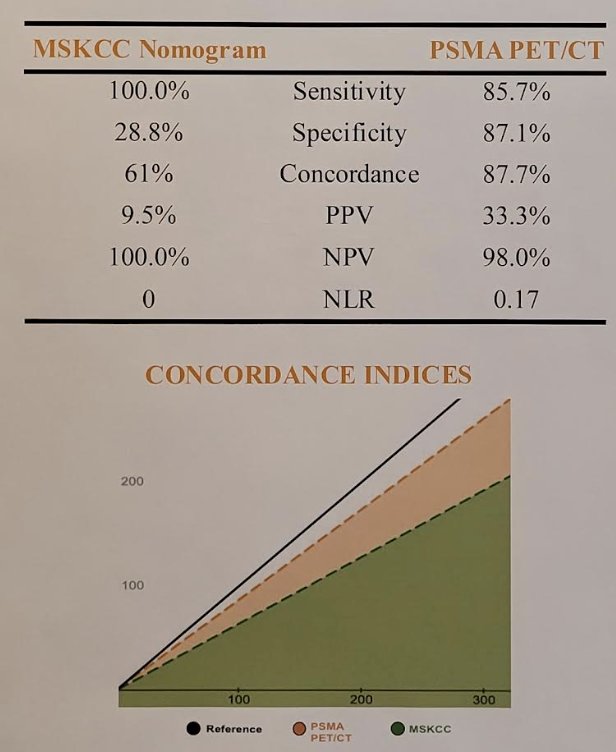
Standard Chi-square favors PSMA/PET with a Pearson chi-square value of 2.303 (p < 0.001) compared to MSKCC value of 1.019 (p = 0.09).
Dr. Moolupuri concluded his presentation discussing a PET/CT supplemented approach to omission of pelvic lymph node dissection with the following take-home points:
- Use of PSMA PET/CT imaging is characterized by a similar NPV and NLR to the MSKCC nomogram
- PSMA PET/CT displays a stronger concordance index
- The higher concordance, along with strong diagnostic qualities of preoperative PSMA PET/CT, offers a chance for a more individualized approach to pelvic lymph node dissection and assessing lymph node metastasis risk
Presented by: Abhi Moolupuri, MD, Department of Urology, UT Knoxville, Knoxville, TN
Written by: Zachary Klaassen, MD, MSc – Urologic Oncologist, Associate Professor of Urology, Georgia Cancer Center, Wellstar MCG Health, @zklaassen_md on Twitter during the Southeastern Section of the American Urological Association (SESAUA) 2025 Annual Meeting, Nashville, TN, Wed, Mar 12 – Sat, Mar 15, 2025.