

(UroToday.com) The 2025 South Central AUA annual meeting included a session on prostate cancer, featuring a presentation from Dr. Hunter Kraus discussing the impact of incidental prostate lesions on FDG PET/CT and prostate cancer risk. Overall, 1-3% of patients without known prostate cancer who undergo FDG PET/CT will be found to have an incidental, FDG-avid lesion in the prostate, of which 10-20% of patients are subsequently found to have prostate cancer. The indication for prostate biopsy is typically based on digital rectal exam, PSA levels, family history, and shared-decision making. However, there are limited studies evaluating the utility of prostate MRI in patients with incidental FDG-positive lesions in the prostate. At the 2025 South Central AUA annual meeting, Dr. Kraus and colleagues presented an institutional experience regarding the work up of incidental prostate lesions on FDG PET/CT and the role of prostate MRI in the decision-making process.
This was a retrospective study, performed to identify patients who had an incidental lesion in the prostate on a FDG PET/CT for other indications from January 2019 to July 2024. Demographic and clinical factors were obtained, including FDG PET findings, pre- and post-PET PSA, urologic consultation, prostate MRI findings, and biopsy pathology results.
A total of 4,483 FDG PET/CTs were performed during the study period, of which 112 (2.5%) FDG PET/CTs incidentally revealed a FDG avid prostate lesion. There were 105 unique patients with incidental prostate lesions:
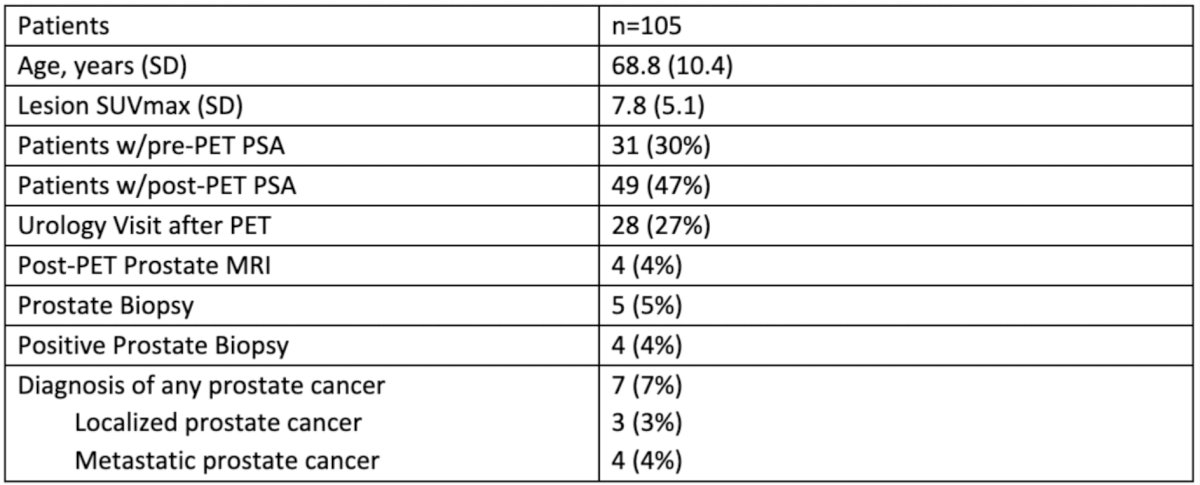
Of the 105 patients identified, 49 (47%) had additional work up with a PSA, and 28 patients (27%) saw a urologist after the FDG PET. Seven patients (7%) were diagnosed with prostate cancer, three with localized disease and four with metastatic disease. Four patients (4%) underwent prostate MRI, and three had concordant MRI and FDG PET imaging. These three patients had subsequent prostate biopsies, all of which showed clinically significant prostate cancer:

Dr. Kraus concluded his presentation discussing the impact of incidental prostate lesions on FDG PET/CT and prostate cancer risk with the following take home points:
- Incidental prostate lesions on FDG PET/CT are rare but have a reported 10-20% risk of identifying a clinically significant prostate cancer when present
- This institutional experience showed a rate of 7%
- Only 47% of patients received a post-PET PSA and fewer patients (27%) saw a urologist
- The initial experience with prostate MRI in a subset of these patients shows it to be a particularly useful diagnostic test independent of other clinical variables
- Incidental FDG lesions with corresponding positive findings on MRI were found to be malignant on MRI-ultrasound fusion biopsy
- Additional studies are needed to better define the utility of prostate MRI in this setting
Presented by: Hunter Kraus, MD, University of Missouri, Columbia, MO
Written by: Zachary Klaassen, MD, MSc – Urologic Oncologist, Associate Professor of Urology, Georgia Cancer Center, Wellstar MCG Health, @zklaassen_md on Twitter during the 2025 South Central American Urological Association (AUA) Annual Meeting, Orlando, FL, Wed, Sept 10 – Sat, Sept 13, 2025.