

(UroToday.com) The 2025 South Central AUA annual meeting included a session on prostate cancer, featuring a presentation from Dr. Carlos Alexis Gonzalez-Martinez discussing the impact of 177Lutetium-PSMA therapy on SUVmax values in advanced prostate cancer. 177Lutetium has emerged as an important therapeutic radioisotope in oncology, particularly for metastatic castration-resistant prostate cancer based on the VISION and PSMAfore clinical trials.1,2 This treatment employs theranostics technology where Lu-177 binds to PSMA ligands. The objective of this study, presented at the 2025 South Central AUA annual meeting, was to evaluate the impact of lutetium therapy on the SUVmax of PSMA PET.
This retrospective study analyzed 19 patients with advanced prostate cancer treated with 177Lutetium-PSMA at a Mexican tertiary care center (2016-2024). Inclusion criteria included: (i) histologically confirmed prostate adenocarcinoma, (ii) progression after conventional therapies, and (iii) at least one dose of 177Lutetium-PSMA. Patients received 1-6 treatment cycles (median: 4) at 6-8 week intervals, and SUVmax values were obtained from 68Ga-PSMA PET/CT scans before and after therapy. Metabolic response categories included:
- Significant (≥30% SUVmax reduction)
- Moderate (10-30% reduction)
- Stable (±10% change)
- Progression (>10% increase)
Paired t-tests compared pre/post-treatment SUVmax values (p < 0.05 significance).
Of 19 patients with a mean age of 77.5 years (range: 62-93), 13 (68.4%) had complete SUVmax data. The mean pre-treatment SUVmax was 21.1 (2.5-59.5), decreasing to 11.0 (2.9-25.05) post-treatment. The mean initial PSA was 299.6 ng/mL (range: 0.16-5000 ng/mL), and the mean of the last recorded PSA was 0.89 ng/mL (0.00 - 1.00) without statistical significance (p < 0.10). However, a statistically significant reduction in post-treatment SUVmax was observed (mean change: -36.47%, 95% CI: -57.65% to -15.29%; p < 0.05). Among evaluable patients, 84.6% showed metabolic response: 8 patients (61.5%) with significant response, 3 (23.1%) with moderate response, and 2 (15.4%) with progression:
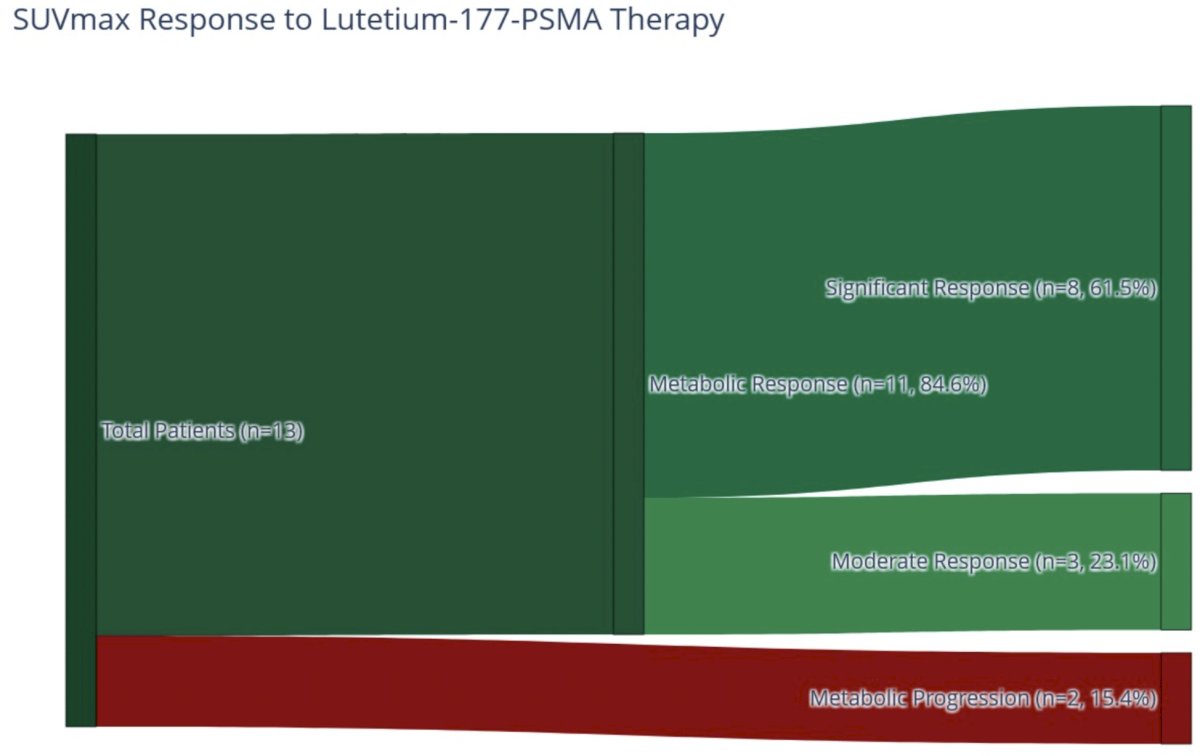
Response magnitude varied considerably (range: -87.50% to +57.75%). Favorable metabolic responses occurred across different treatment lines (2nd to 5th), suggesting efficacy even in advanced disease. However, these metabolic improvements did not consistently translate into sustained clinical benefit, indicating a complex relationship between metabolic response and clinical outcomes.
Dr. Gonzalez-Martinez concluded his presentation discussing the impact of 177Lutetium-PSMA therapy on SUVmax values in advanced prostate cancer with the following take home messages:
- 177Lutetium-PSMA therapy produces significant reductions in SUVmax values in advanced prostate cancer patients, demonstrating a meaningful metabolic response
- The disconnect between favorable metabolic changes and continued clinical progression highlights the complexity of treatment response assessment in metastatic prostate cancer
Written by: Zachary Klaassen, MD, MSc – Urologic Oncologist, Associate Professor of Urology, Georgia Cancer Center, Wellstar MCG Health, @zklaassen_md on Twitter during the 2025 South Central American Urological Association (AUA) Annual Meeting, Orlando, FL, Wed, Sept 10 – Sat, Sept 13, 2025.
References:
- Sartor O, de Bono J, Chi KN et al. Lutetium-177-PSMA-617 for Metastatic Castration-Resistant Prostate Cancer. N Engl J Med. 2021 Sep 16;385(12):1091-1103.
- Morris MJ, Castellano D, Herrmann K, et al. 177Lu-PSMA-617 versus a change of androgen receptor pathway inhibitor therapy for taxane-naïve patients with progressive metastatic castration-resistant prostate cancer (PSMAfore): A phase 3, randomized, controlled trial. Lancet 2024 Sep 28;404(10459):1227-1239.