

(UroToday.com) The 2026 ASTRO Multidisciplinary Radiopharmaceutical Therapy Symposium featured a plenary session and a presentation by Dr. Mustafa Basree discussing personalized multi-timepoint voxel-level dosimetry in patients with metastatic castration resistant prostate cancer (mCRPC) treated with 177Lu-PSMA-617 therapy. Radiopharmaceutical therapy has grown rapidly, though standard dosing across agents (ie. 200 mCi) remains unchanged. Prior studies have shown correlations between absorbed dose, toxicity, and treatment response.
As such, Dr. Basree and colleagues evaluated patient-specific dosimetry, its relationship to outcomes, and potential for treatment personalization using voxel-level dose parameters in patients treated with 177Lu-PSMA-617 with dosimetry obtained as part of standard clinical care. An example of personalized dosimetry at his institution is as follows:
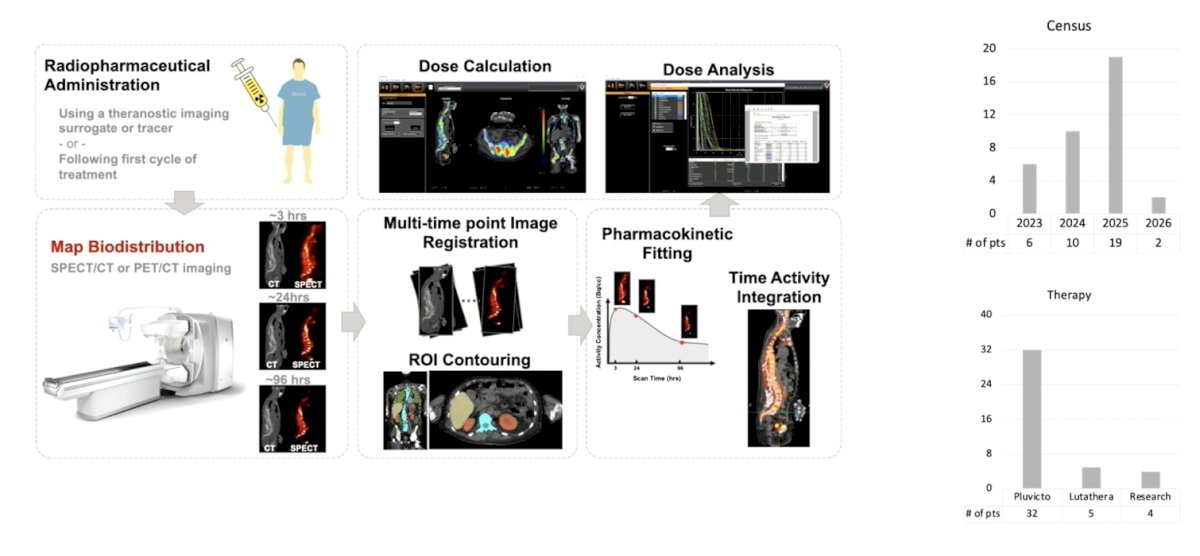
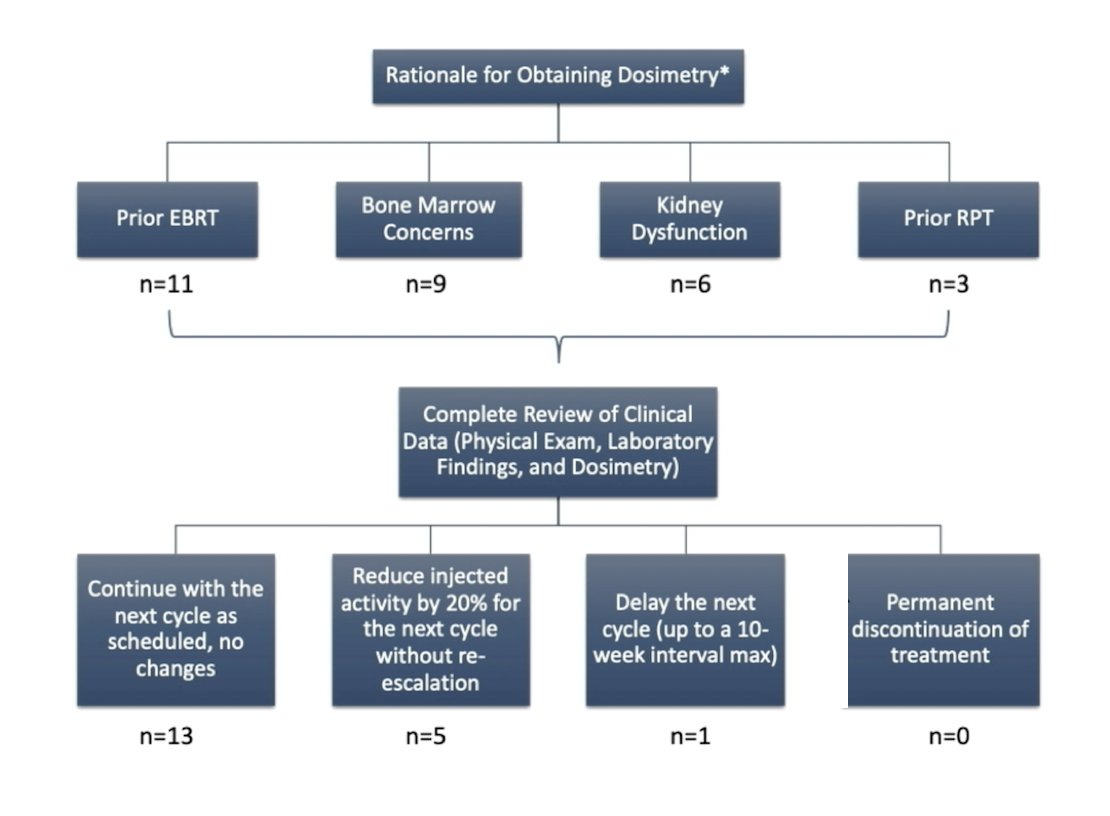
Nineteen patients were included in this series, treated between July 2023 and May 2025, who had evaluable post-cycle 1 dosimetry and received at least 1 cycle of therapy. The median age of included patients was 74 years (range: 58 – 94). Among these patients, voxel-level Monte Carlo dosimetry was performed using the Torch radiopharmaceutical therapy dosimetry platform (Voximetry). SPECT/CT imaging was acquired at three time points following the first treatment cycle: 3 ± 2 hours, 24 ± 4 hours, and 96 ± 24 hours. Mean absorbed doses from cycle 1 were extrapolated across six cycles to approximate the cumulative dose. Institutional organ at risk constraints were defined as kidney mean dose (D_mean) < 24 Gy, salivary gland D_mean < 20 Gy, and bone marrow D_mean <12 Gy for a full course of therapy. After cycle 1 dosimetry, physicians could continue therapy as planned, delay subsequent cycles, reduce injected activity by 20%, or discontinue treatment.
Reasons for obtaining patient dosimetry included prior external beam radiotherapy (n = 11; 57.9%), bone marrow toxicity concerns (n = 9; 47.4%), kidney dysfunction (n = 6; 31.6%), prior radiopharmaceutical therapy (n = 3; 15.7%), or a combination of these (n = 7; 36.8%). Compared with VISION phase III trial data [1], mean absorbed doses to key organs at risk (heart, kidneys, liver, lungs, salivary glands, spleen) were not substantially different. Assuming consistent dosimetry across six cycles, cumulative mean kidney and salivary gland doses were 17.7 Gy (range, 5.8-27.5) and 15.9 Gy (range, 3.0-32.2), respectively. Other organ at risk mean doses included bowel 7.9 Gy (range, 0.4-20.8) and bone marrow 9.4 Gy (range, 1.2-24.3). Tumor volumes received a mean absorbed dose of 91.3 Gy (range, 9.6-273.4). Personalized dosimetry, combined with clinical context, guided safe continuation of 177Lu-PSMA-617 in most patients (n = 13; 68.4%), while a smaller number of patients were recommended to discontinue treatment early (n = 5; 26.3%) or delay cycle administration (n = 1; 5.3%):
Based on kidney dose limits after cycle 1, 15/19 patients (79.0%) could have safely received a seventh cycle. Based on salivary gland limits, 8/15 patients (53.3%) could have received an additional cycle.
Dr. Basree concluded his presentation discussing personalized multi-timepoint voxel-level dosimetry in patients with mCRPC treated with 177Lu-PSMA-617 therapy with the following take-home points:
- Multi-timepoint personalized radiopharmaceutical therapy dosimetry is feasible and can be integrated into routine clinical workflows
- There is limited/no consensus on patient selection criteria and how best to integrate dosimetry metrics in clinical decision making
- The full therapeutic potential of radiopharmaceuticals will only be realized when treatment is guided by quantitative, patient-specific dosimetric data
Presented by: Mustafa Basree, DO, University of Wisconsin Hospitals and Clinics, Madison, WI
Written by: Zachary Klaassen, MD, MSc – Urologic Oncologist, Associate Professor of Urology, Georgia Cancer Center, Wellstar MCG Health, @zklaassen_md on Twitter during the 2026 American Society for Radiation Oncology (ASTRO) Multidisciplinary Radiopharmaceutical Therapy Symposium, Palm Desert, CA, Tues, Feb 17 – Wed, Feb 18, 2026.
Reference:
- Sartor O, de Bono J, Chi KN et al. Lutetium-177-PSMA-617 for Metastatic Castration-Resistant Prostate Cancer. N Engl J Med. 2021 Sep 16;385(12):1091-1103.