

From January 2013 to March 2019, all patients with non-hereditary, non-dialysis small renal masses presenting to a single urologic oncologist at a National Comprehensive Cancer Network institute were recommended active surveillance if predefined progression criteria for intervention were absent. Progression criteria for intervention was defined prospectively as:
- Any small renal mass-related symptoms
- Unfavorable biopsy histology
- cT3a stage, or
- Either of the following without benign neoplastic biopsy histology: longest tumor diameter >4 cm; growth rate >5 mm/year for longest tumor diameter ≤3 cm or >3 mm/year for longest tumor diameter >3 cm
Among 90 consecutive small renal mass patients with life expectancy >20 years (median age 57, IQR 47-61), 89 (99%) patients (101 small renal masses) did not meet progression criteria for intervention at presentation and underwent active surveillance:

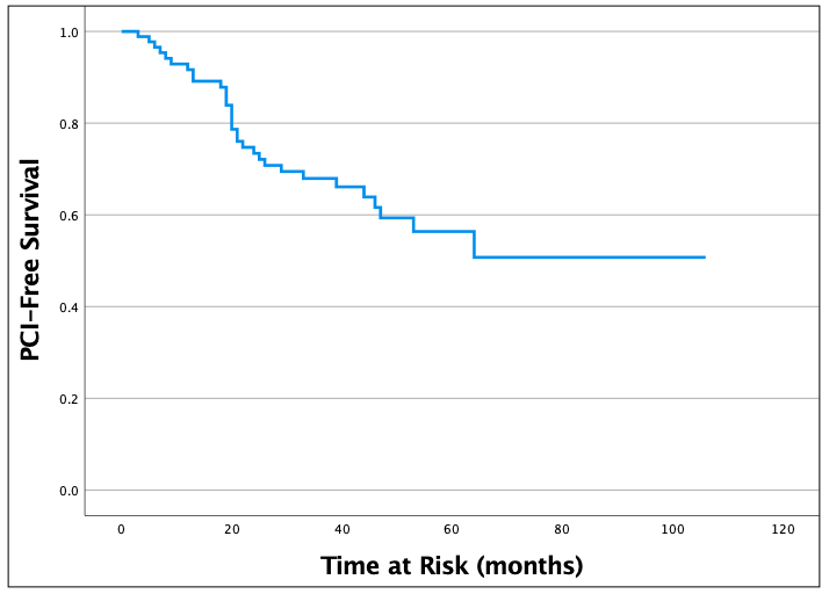
The 89 active surveillance patients showed unique clinical features for an active surveillance cohort due to very good overall health, including relatively young age, excellent renal function, and median Charlson score of 0. Biopsy was performed in 62% of patients, with 72.7% having RCC. After a median follow-up of 44 months, progression criteria for intervention were met by a minority (35%) of active surveillance patients. Compliance with conversion to delayed intervention in progressing patients was 68%; one patient converted to treatment without progression criteria for intervention (anxiety). Partial nephrectomy was performed in all but one of the treated patients. Resected tumors had a 100% rate of malignancy and were enriched for adverse pathology, with most (57%) being pT3 and/or high grade. The vast majority (81%) of AS patients who progressed to delayed surgical treatment had clear cell RCC subtype. There were no metastases/cancer-specific deaths and 9 patients (10%) died of other causes. The 3- and 5-year progression criteria for intervention-free rates were 68% and 56%, respectively:
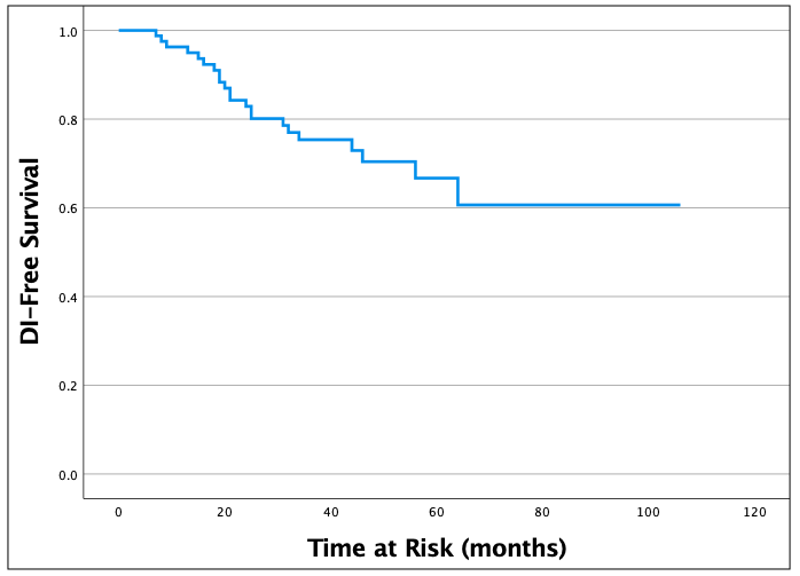
The 3- and 5-year delayed intervention-free rates were 75% and 67%, respectively:
Dr. Altok concluded his presentation discussing outcomes of active surveillance for young and healthy patients with small renal masses with the following concluding statements:
- Active surveillance using predefined progression criteria for intervention in otherwise unselected small renal mass patients is well tolerated and allows most small renal mass patients with >20 years life expectancy to avoid treatment over 5 years
- Progression criteria for intervention-free rates identified in this study may be useful to counsel active surveillance patient candidates and inform active surveillance research trial design
- Long-term delayed intervention rates and oncologic safety require further study
Written by: Zachary Klaassen, MD, MSc – Urologic Oncologist, Assistant Professor of Urology, Georgia Cancer Center, Augusta University/Medical College of Georgia, @zklaassen_md on Twitter during the 2022 International Kidney Cancer Symposium (IKCS) North America, November 4-5, Austin, Texas, USA