

(UroToday.com) The 2025 ESMO annual meeting featured a prostate cancer trials in progress session and a presentation by Dr. Tanja Van Dijk discussing DAROTAXEL, a randomized, multicenter, phase II trial of docetaxel or cabazitaxel with or without darolutamide in patients with metastatic castration-resistant prostate cancer (mCRPC). The efficacy of taxanes in mCRPC is limited due to development of resistance. Preclinical studies have demonstrated that addition of an androgen receptor pathway inhibitor enhances taxane efficacy, even in castration- and androgen receptor pathway inhibitor-resistant models of prostate cancer. Combining docetaxel with the androgen receptor pathway inhibitor darolutamide improved outcomes across various models, including organoids and patient-derived xenografts.1 Given that both docetaxel and cabazitaxel disrupt microtubule dynamics, it is expected that combining darolutamide with either agent could potentiate their antitumor effects through a taxane class-effect. These findings highlight the need to evaluate whether androgen receptor pathway inhibitor addition to taxane treatment in mCRPC can enhance clinical efficacy and delay resistance, a persistent therapeutic challenge in this setting.
DAROTAXEL is a phase II, multicenter, open-label randomized trial conducted in the Netherlands. A total of 245 mCRPC patients with prior progression on at least one androgen receptor pathway inhibitor are randomized (1:1) to receive (i) docetaxel 75 mg/m2 or cabazitaxel 20 mg/m2 every 3 weeks; or (ii) docetaxel 75 mg/m2 or cabazitaxel 20 mg/m2 every 3 weeks + darolutamide 600 mg BID, for up to 10 cycles:
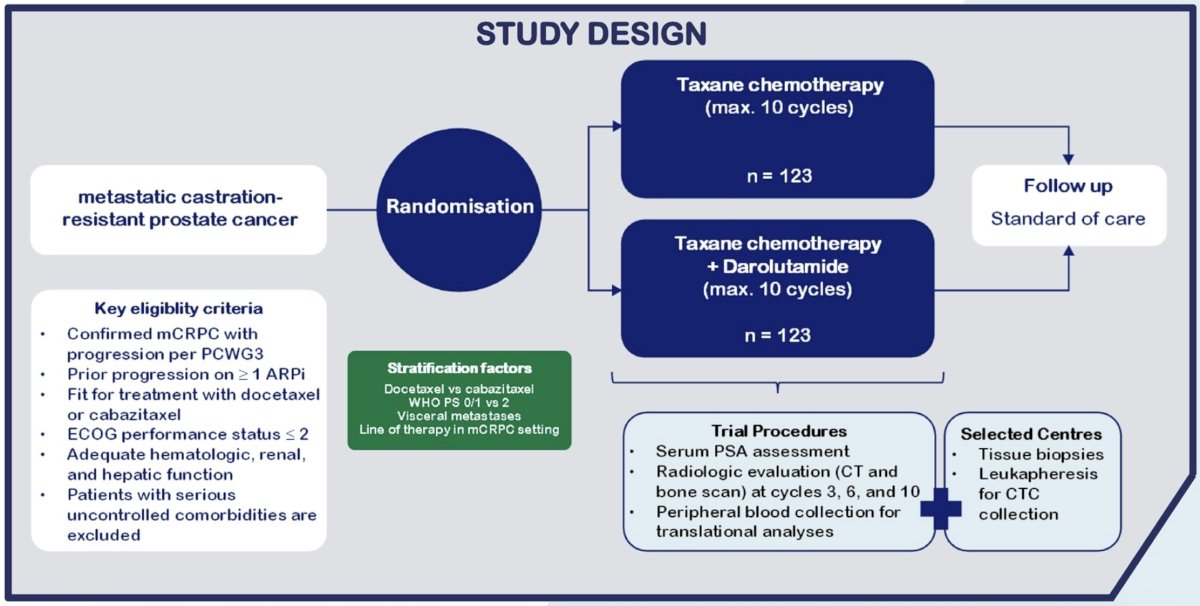
The choice of taxane is based on prior treatments. Stratification factors encompass taxane type, ECOG performance status (0 or 1 versus 2), presence of visceral metastases, and line of therapy in the mCRPC setting. The primary endpoint is progression free survival, defined as time from randomization to radiological, biochemical, or pain progression, or death from any cause, according to PCWG3 criteria. Secondary endpoints include overall survival, adverse event frequency and severity, as well as a series of translational analyses such as genomic and transcriptomic profiling of liquid and tissue biopsies aimed at elucidating the mechanisms of action of the combined treatment.
The DAROTAXEL trial was initiated by the Erasmus MC Center Institute in collaboration with the Dutch Uro-Oncology Study group (DUOS) and has 15 participating sites across the Netherlands. The trial commenced in November 2023, with 120 patients enrolled at the time of poster submission. Primary outcome results are expected in 2027.
Clinical trial identification: NCT05762536
Presented by: Tanja C. Van Dijk, Erasmus MC Cancer Institute, Rotterdam, Netherlands
Written by: Zachary Klaassen, MD, MSc – Urologic Oncologist, Associate Professor of Urology, Georgia Cancer Center, Wellstar MCG Health, @zklaassen_md on Twitter during the 2025 European Society for Medical Oncology (ESMO) Annual Congress, Berlin, Germany, October 17–21, 2025
References:
- Buck SAJ, van Hemelryk A, de Ridder C, et al. Darolutamide added to docetaxel augments antitumor effect in models of prostate cancer through cell cycle arrest at the G1-S transition. Mol Cancer Ther. 2024 May 2;23(5):711-720.