

(UroToday.com) The 2025 ESMO annual meeting featured a prostate cancer session and a presentation by Dr. Alice Bernard-Tessier discussing a phase 1/2 study of gedatolisib in combination with darolutamide in metastatic castration-resistant prostate cancer (mCRPC). Preclinical studies demonstrated interaction between the androgen receptor and PI3K-protein kinase B (AKT)- mTOR pathways through reciprocal negative feedback, whereby inhibition of one pathway cross-activates the other.
Furthermore, elevated androgen levels upregulate the PI3K-AKT-mTOR (PAM) pathway, with oncogenic activation associated with resistance to ADT, disease progression, and poor outcomes in prostate cancer. These data suggest that combining a PAM inhibitor with an androgen receptor pathway inhibitor may induce a synergistic antitumor effect in mCRPC patients, including those whose disease progressed on prior androgen receptor pathway inhibitor treatment. Preliminary clinical data further support this hypothesis.1 Gedatolisib, a potent pan-PI3K, mTORC1/2 inhibitor that comprehensively blockades the PAM pathway, is being studied in combination with the androgen receptor pathway inhibitor, darolutamide, in an ongoing phase 1/2 clinical trial.
In the phase 1 portion of the trial, two doses of gedatolisib were administered IV on an intermittent schedule (Days 1, 8, 15 of each 28-day cycle) at 120 mg (Arm 1; n = 19) and 180 mg (Arm 2; n = 19), along with darolutamide 600 mg daily:

Study objectives include safety, recommended phase 2 dose, pharmacokinetics, landmark progression-free survival at 6, 9, and 12 months, overall response rate, and overall survival.
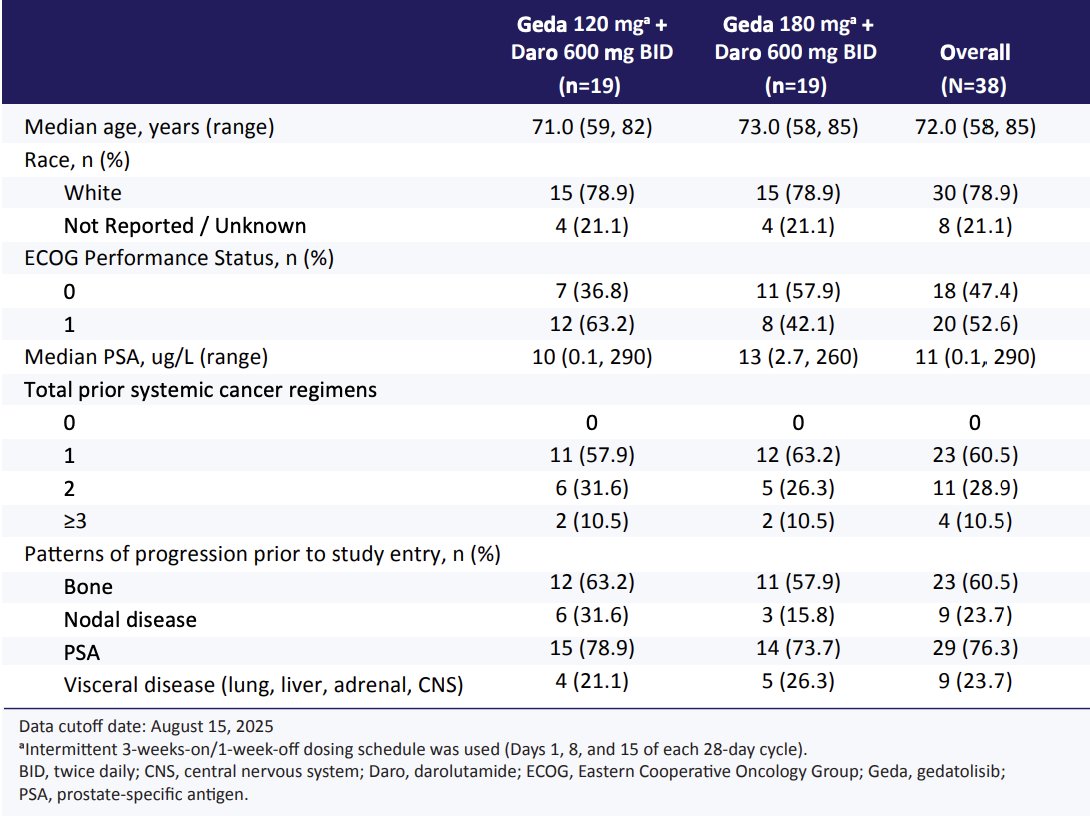
There were 19 patients included in the gedatolisib 120 mg arm, and 19 patients in the 180 mg arm in combination with darolutamide, with the following demographics and baseline characteristics:
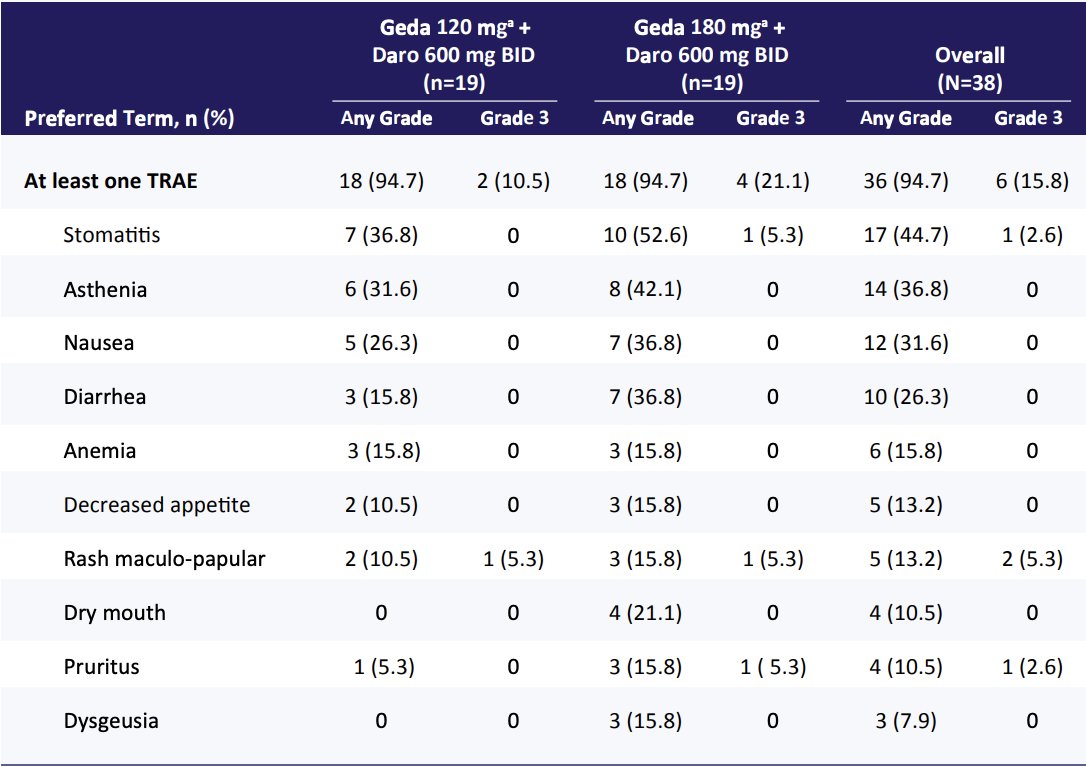
Stomatitis was the most frequent treatment-related adverse event, mostly grade 1, with only one (n=1) grade 3 adverse event. Prophylactic use of a steroid-containing “swish and spit” regimen was mandated, and oral non-sedating antihistamine therapy was recommended for patients:
No grade 4/5 treatment-related adverse events were observed:
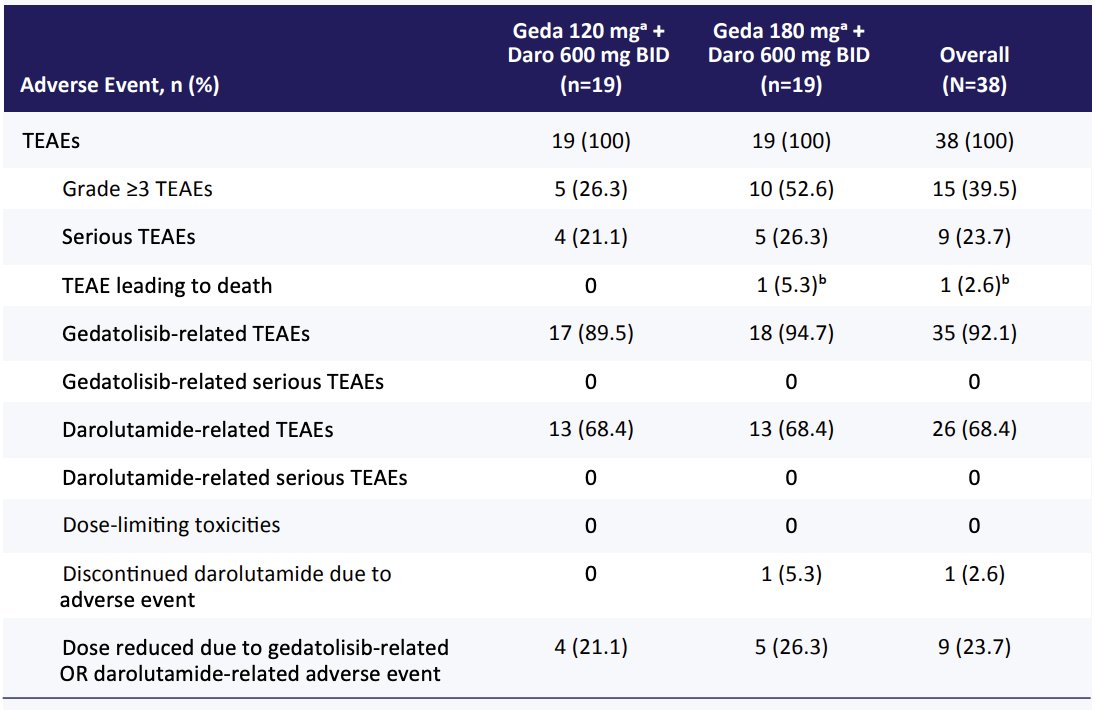
Overall, 23.7% of patients had at least one treatment-emergent serious adverse event:

The median radiological progression-free survival by investigator assessment was 9.5 months (95% CI 5.6- not reached) in the 120 mg gedatolisib arm versus 7.4 months (95% CI 3.7-10.4) in the 180 mg gedatolisib arm:

Dr. Bernard-Tessier concluded her presentation discussing a phase 1/2 study of gedatolisib in combination with darolutamide mCRPC with the following take-home points:
- The combination of gedatolisib and darolutamide was safe and well-tolerated across both dose levels evaluated
– No dose-limiting toxicities were observed
– No grade 4 or 5 treatment-related adverse events were reported
– No treatment-related serious adverse events occurred
– No treatment-related adverse events led to treatment discontinuation of the combination regimen - Preliminary efficacy was favorable, with a median progression-free survival of 9.1 months and a 6-month radiographic progression-free survival rate of 67.1%
- The favorable safety profile supports evaluation of higher gedatolisib and darolutamide dose levels to determine the optimal biologic dose
- The study protocol has been amended to include two additional dose levels and a randomized Phase 1b expansion to inform the recommended Phase 2 dose
Presented by: Alice Bernard-Tessier, MD, Medical Oncologist, Gustave Roussy, Villejuif, France
Written by: Zachary Klaassen, MD, MSc – Urologic Oncologist, Associate Professor of Urology, Georgia Cancer Center, Wellstar MCG Health, @zklaassen_md on Twitter during the 2025 European Society of Medical Oncology (ESMO) Annual Meeting, Berlin, Germany, Fri, Oct 17 – Tues, Oct 21, 2025.
Reference:
- Sweeney CJ, Percent IJ, Babu S, et al. Phase Ib/II study of enzalutamide with samotolisib (LY3023414) or placebo in patients with metastatic castration-resistant prostate cancer. Clin Cancer Res. 2022 Jun 1;28(11):2237-2247.