

(UroToday.com) The 2025 European Society for Medical Oncology (ESMO) Annual Congress held in Berlin, Germany, was host to a prostate cancer poster session. Dr. Soon Yu Yang presented a study of early docetaxel addition to enzalutamide in patients with metastatic hormone-sensitive prostate cancer (mHSPC) using a trial emulation approach based on the ENZAMET trial.
Randomized controlled trials (RCTs) have demonstrated that adding docetaxel or novel androgen receptor pathway inhibitors (ARPls) to androgen deprivation therapy (ADT) improved overall survival (OS) in mHSPC.1,2 However, no trial has directly tested the addition of early docetaxel to a doublet regimen of an ARPI and ADT in mHSPC.
The study objective was to evaluate the effect of combining docetaxel with enzalutamide versus enzalutamide alone on OS in mHSPC and assess whether this effect varied by disease volume.
Specification of the Target TrialA hypothetical 2×2 factorial trial was conceptualized to evaluate the efficacy of combination systemic therapy in mHSPC patients. Eligibility criteria mirrored those of the ENZAMET trial, ensuring inclusion of patients suitable for ADT with or without early docetaxel and/or enzalutamide.
Participants were categorized into four treatment strategies based on docetaxel and enzalutamide exposure:
- ADT + docetaxel + enzalutamide
- ADT + enzalutamide (no docetaxel)
- ADT + docetaxel + non-steroidal antiandrogen (NSAA)
- ADT + NSAA (no docetaxel, no enzalutamide)
All regimens incorporated standard ADT (testosterone suppression). For those not receiving enzalutamide, NSAA served as the comparator arm. The primary endpoint was OS, defined as the time from randomization to death from any cause.
Emulation of the Target TrialTo emulate this target trial, a calibration process was undertaken to account for treatment selection bias and to achieve balance across treatment groups.
- Identification of confounders: Clinical expertise was used to identify baseline variables associated with both planned early docetaxel administration and OS.
- Variable selection: The group least absolute shrinkage and selection operator (LASSO) method was applied to further refine the set of covariates associated with planned early docetaxel use.
- Adjustment for confounding: Propensity score matching and weighting techniques were then used iteratively to balance baseline characteristics across treatment groups.
Emulation success was predefined based on the following criteria:
- Covariate balance: Achieving absolute standardized mean differences ≤0.1 between treatment groups.
- Internal validation: Replication of the CHAARTED trial key findings among patients not receiving enzalutamide.
- External validation: Replication of the ENZAMET trial overall survival results in the corresponding comparison group.
This approach ensured that the emulated analysis closely reflected the design and outcomes of the reference randomized trials while leveraging real-world data for external validity.
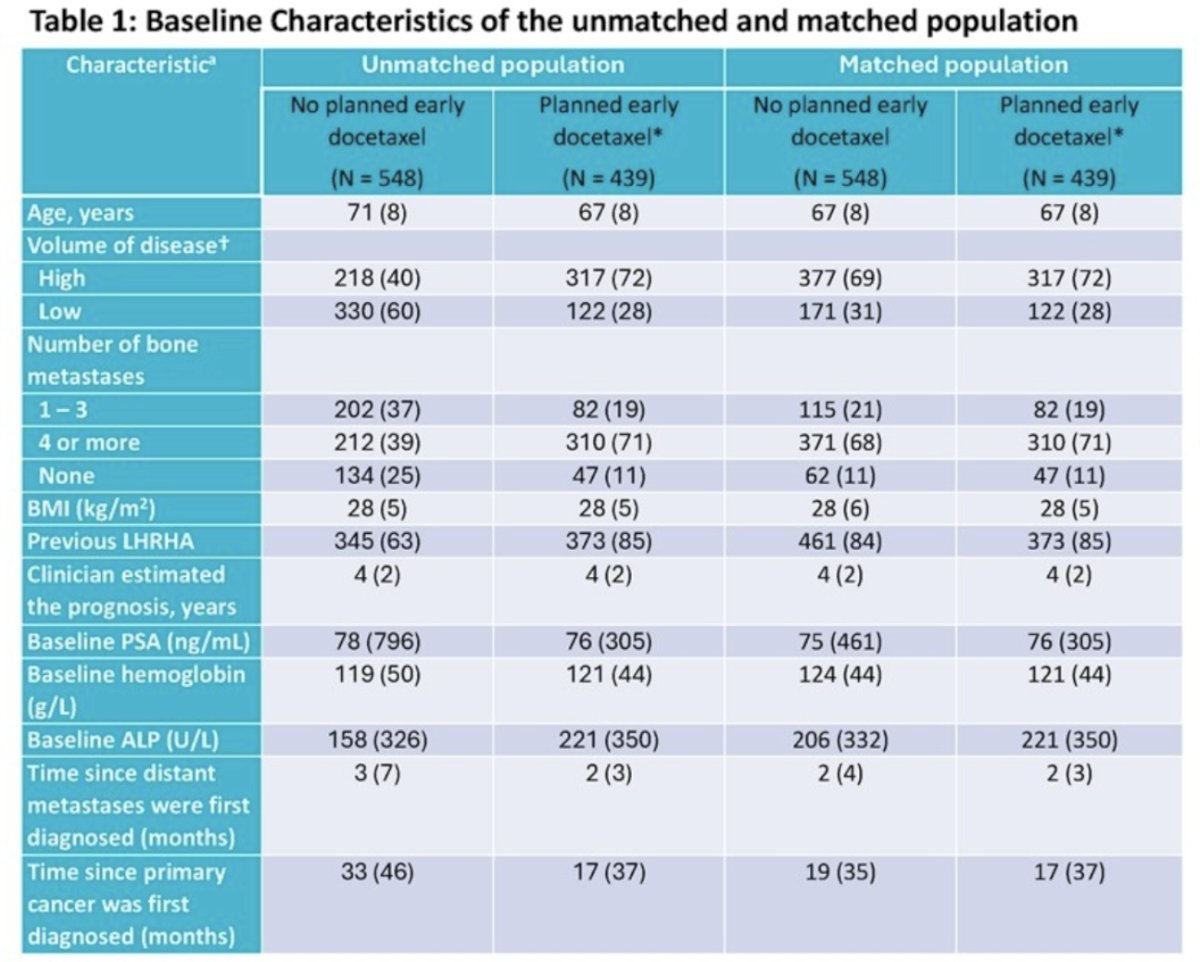
This study included 987 participants with complete baseline characteristics data:
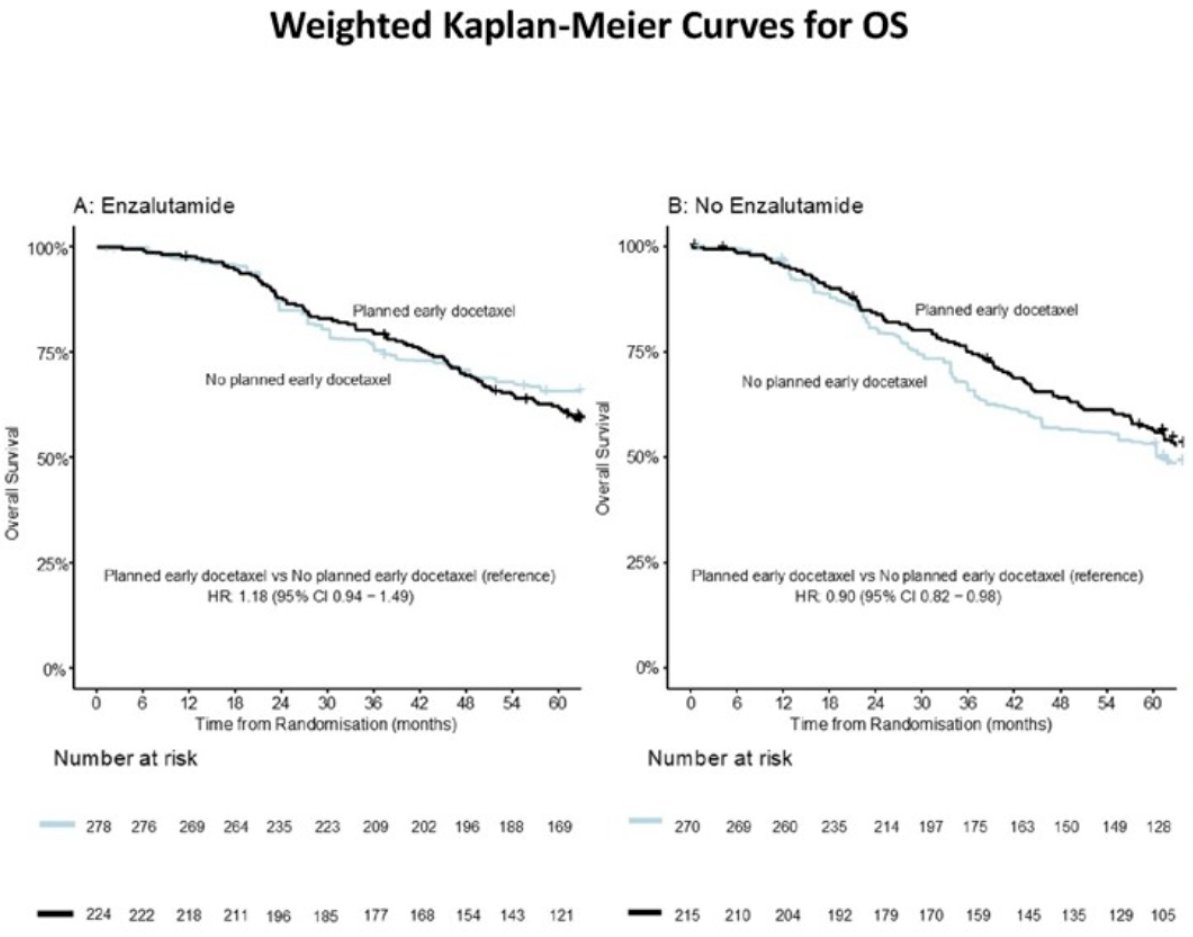
The study investigators found that the addition of docetaxel to the doublet regimen of ADT + enzalutamide did not significantly improve OS (HR: 1.18, 95% CI: 0.94–1.49). Conversely, we see in panel B below that the planned early use of docetaxel significantly improved OS in the group of patients that did not receive enzalutamide (ADT alone; HR: 0.90, 95% CI: 0.92–0.98).
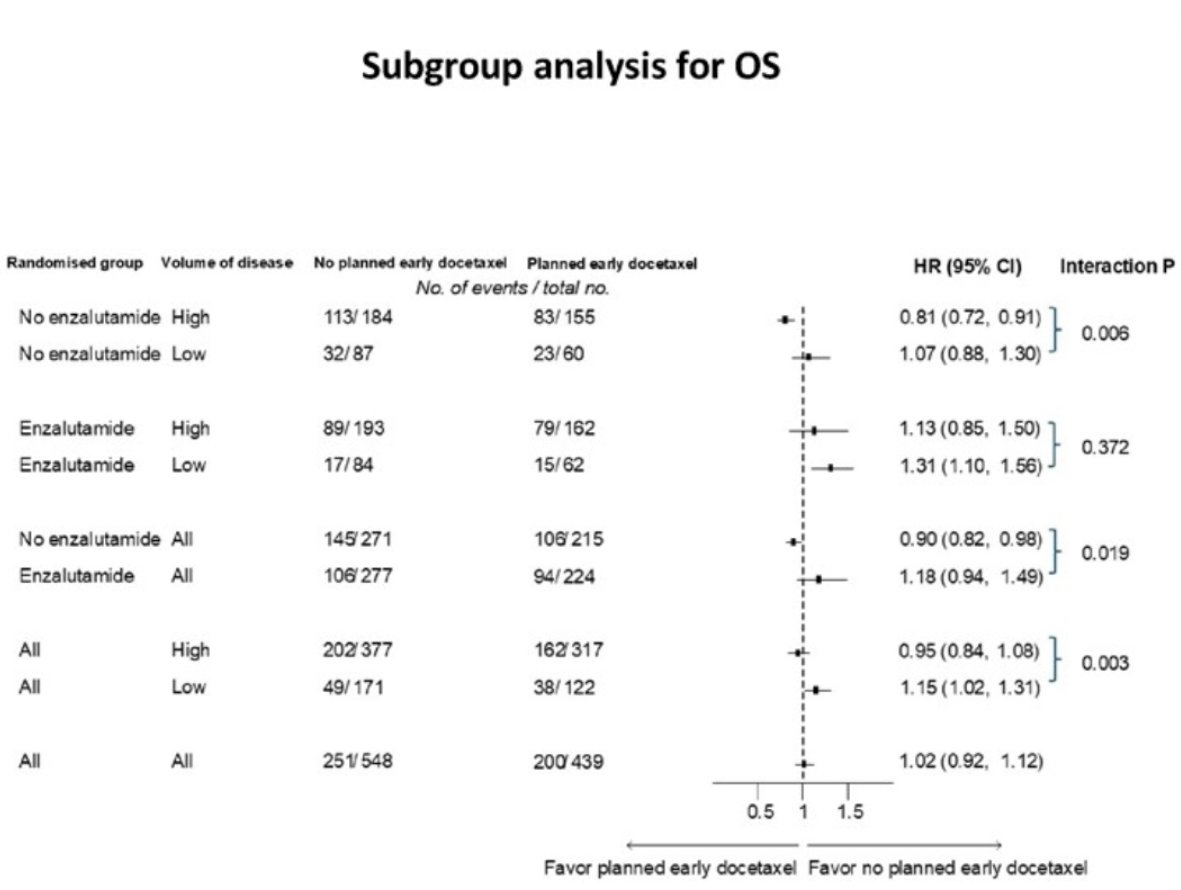
On subgroup analysis of OS, the planned early use of docetaxel by concurrent enzalutamide use and disease volume was as follows (significant findings highlighted in bold):
- No enzalutamide and high-volume disease: HR=0.81, 95% CI 0.72–0.91
- No enzalutamide and low-volume disease: HR=1.07, 95% CI 0.88–1.30
- Enzalutamide and high-volume disease: HR=1.13, 95% CI 0.85–1.50
- Enzalutamide and low-volume disease: HR=1.31, 95% CI 1.10-1.56
Dr. Soon concluded as follows:
- Adding early docetaxel to enzalutamide did not appear to extend OS in unselected mHSPC, regardless of disease volume.
- Conversely, among those not assigned enzalutamide, early docetaxel was associated with longer survival, particularly in cases of high-volume disease.
- These findings do not support the routine use of early docetaxel with enzalutamide
Presented by: Yu Yang Soon, BSc, MBBS, MSc, FRANZCR, Consultant, Department of Radiation Oncology, National University Cancer Institute, Singapore
Written by: Rashid K. Sayyid, MD, MSc, Assistant Professor, Urologic Oncologist, Department of Urology at The University of Arizona and Banner University Medical Center – Tucson, AZ, @rksayyid on X during the 2025 European Society for Medical Oncology (ESMO) Annual Congress, Berlin, Germany, October 17–21, 2025
References:
- Davis ID, Martin AJ, Stockler MR, et al. Enzalutamide with Standard First-Line Therapy in Metastatic Prostate Cancer. N Engl J Med. 2019; 381(2):121-131.
- Sweeney CJ, Martin AJ, Stockler MR, et al. Testosterone suppression plus enzalutamide versus testosterone suppression plus standard antiandrogen therapy for metastatic hormone-sensitive prostate cancer (ENZAMET): An international, open-label, randomized, phase 3 trial. Lancet Oncol. 2023; 24(4):323-334.