

(UroToday.com) The 2025 ESMO annual meeting featured a prostate cancer session and a presentation by Dr. Marina Schnauss discussing the predictive value of Decipher and MRI for upgrading of prostate cancer patients on active surveillance. Identifying patients at risk of prostate cancer progression on active surveillance or adverse pathology on radical prostatectomy remains a key challenge in optimizing management. The Decipher Genomic Classifier is a 22 marker RNA expression-based assay that has been shown to be independently prognostic of prostate cancer outcomes which considering clinical and pathologic features. The ability of Decipher to prognosticate outcomes of men on active surveillance in the context of other tools, such as MRI, has not been thoroughly explored.
This study identified patients on active surveillance within an 11-hospital health system (Northwestern Medicine, Chicago, IL) who had received a biopsy with Decipher testing and an mpMRI within a year of the biopsy. Patients also had to have eventually undergone radical prostatectomy with Decipher testing on a biopsy preceding radical prostatectomy by ≤2 years. Adverse pathology was defined as ≥pT3b, pN1, or Grade Group ≥3. MpMRI were done within a year of Decipher testing. Univariable and multivariable logistic regression analyses were conducted to identify factors significantly associated with predicting upgrading or adverse pathology.
There were 139 patients that met the inclusion criteria for upgrading prediction, 47 of whom were upgraded at their subsequent biopsy:
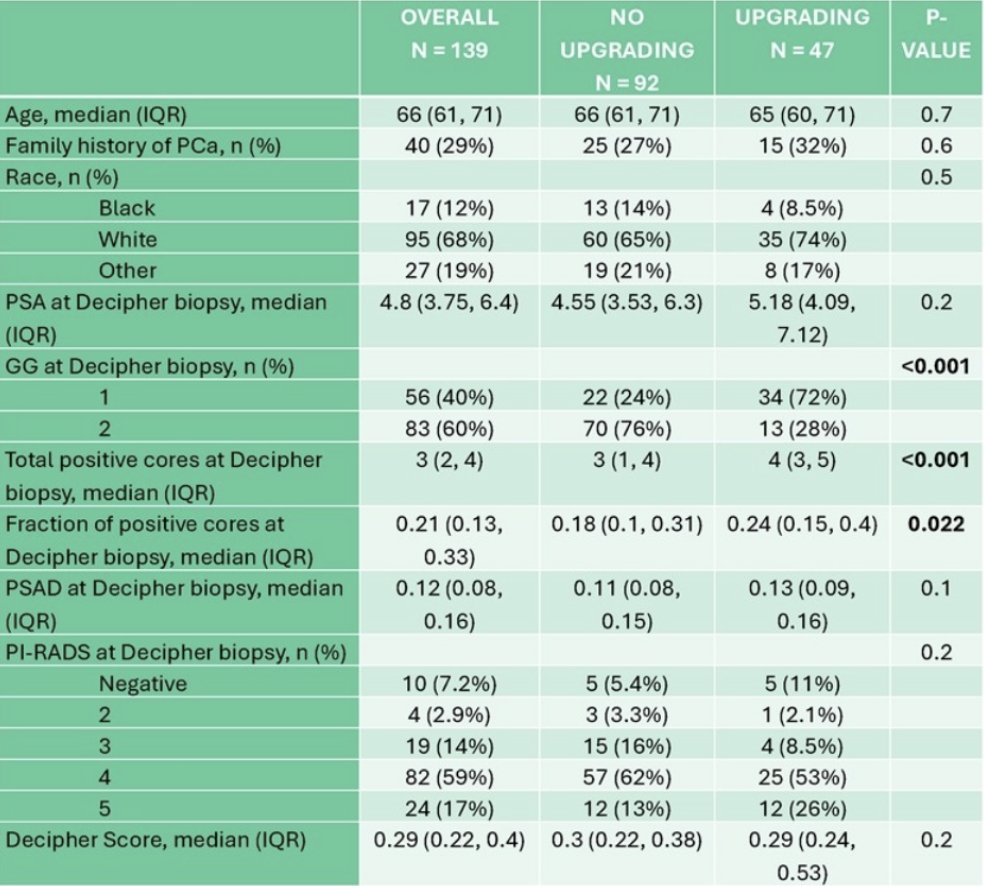
On multivariate analysis adjusted for Grade Group, PI-RADS scores, logPSAD and Decipher score, Grade Group 2 (OR 0.097, 95% CI 0.039, 0.244, p<0.001) and Decipher score (OR 1.326, 95% CI 1.020, 1.722, p = 0.035) correlated with future upgrading, while PI-RADS 4-5 (OR 1.766, 95% CI 0.588, 5.304, p = 0.30) and logPSAD (OR 2.289, 95% CI 0.879, 5.958, p = 0.09) were not significant predictors:

With a median active surveillance follow up of 1.55 years (IQR 1.16-2.34), 63 patients on active surveillance underwent radical prostatectomy, 17 of which were found to have adverse pathology. Among patients who progressed to treatment and underwent radical prostatectomy, patients with adverse pathology had significantly higher Decipher scores on prior biopsies (0.61 versus 0.39, p = 0.009):
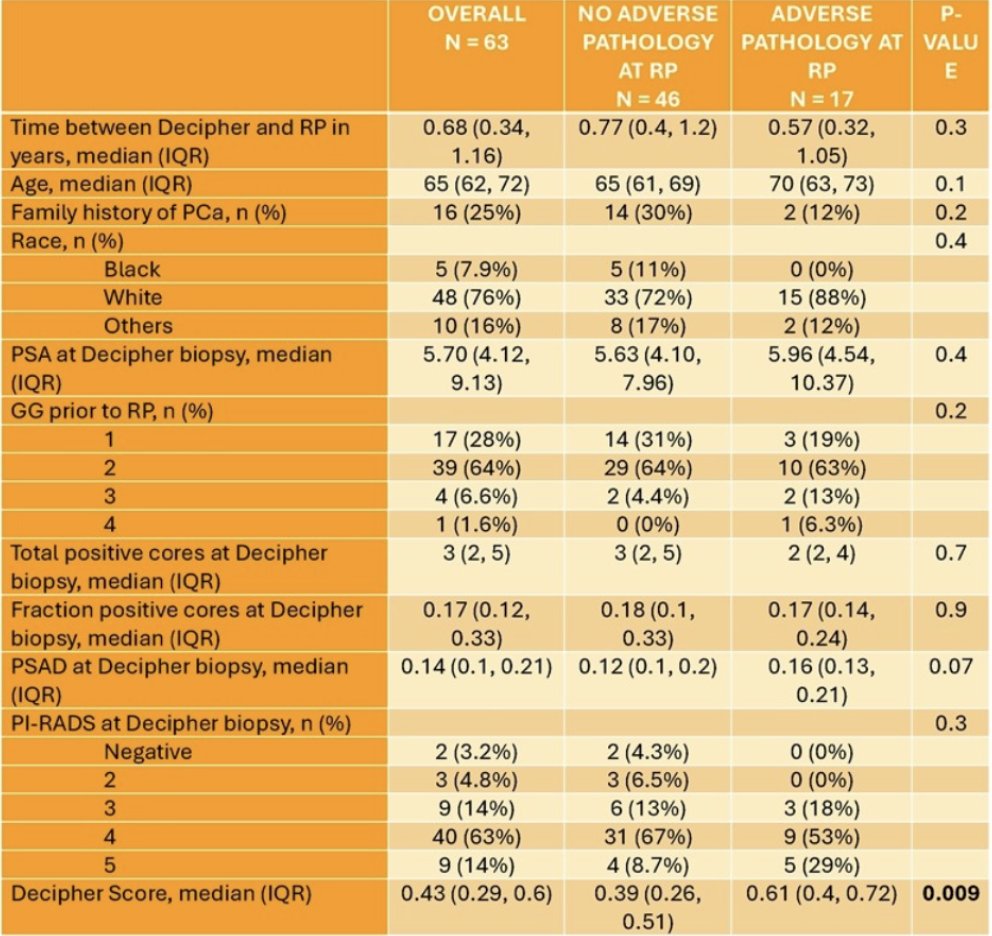
On multivariable regression scaled Decipher scores (OR 1.42, 95% CI 1.06-1.91, p = 0.018) were significantly associated with adverse pathology on radical prostatectomy, while PI-RADS 4-5 was not (OR 1.43, 95% CI 0.32-6.48, p = 0.60):

Dr. Schnauss concluded her presentation discussing the predictive value of Decipher and MRI for upgrading of prostate cancer patients on active surveillance by highlighting that among men on active surveillance who had undergone mpMRI of the prostate, Decipher score and Grade Group were predictors of future upgrading and adverse pathology for those men who progressed and underwent prostatectomy.
Presented by: Marina Schnauss, Northwestern University Feinberg School of Medicine, Chicago, IL
Written by: Zachary Klaassen, MD, MSc – Urologic Oncologist, Associate Professor of Urology, Georgia Cancer Center, Wellstar MCG Health, @zklaassen_md on Twitter during the 2025 European Society for Medical Oncology (ESMO) Annual Congress, Berlin, Germany, October 17–21, 2025