

(UroToday.com) The 2025 ESMO annual meeting featured a prostate cancer session and a presentation by Dr. Megan Crumbaker discussing circulating tumor cell (CTC) characteristics associated with survival outcomes in metastatic castration-resistant prostate cancer (mCRPC) in the randomized trial of enzalutamide with or without 177Lu-PSMA-617 in ENZA-p. The randomized phase II ENZA-p trial demonstrated that the addition of 177Lu-PSMA-617 to enzalutamide improved PSA-progression free survival and overall survival compared with enzalutamide monotherapy in first-line mCRPC.1
Enzalutamide and 177Lu-PSMA-617 have distinct mechanisms of action and resistance, and therefore, predictive biomarkers for this combination may differ from those relevant to either therapy alone. Previous studies examining 177Lu-PSMA-617 in combination with other treatments, such as olaparib (LuPARP) and pembrolizumab (PRINCE) in mCRPC, have suggested that CTC features may be associated with PSMA PET volume and PSA responses to treatment. At ESMO 2025, Dr. Crumbaker and colleagues presented findings from the CTC translational sub-study of the ENZA-p trial, which assessed CTC features using the Epic Sciences Assay to identify potential biomarkers of response to enzalutamide ± 177Lu-PSMA-617.
Participants with mCRPC were randomized 1:1 to enzalutamide alone or enzalutamide + 177Lu-PSMA-617, with CTC samples were collected at baseline. CK+ CD45- CTCs were enumerated from whole blood and characterized for PSMA and AR-V7 status to calculate numbers of CTCs per mL (CTC/mL) and the proportion of CTCs expressing PSMA (PSMA+ CTC fraction). Associations of these baseline biomarkers with PSA progression-free survival and overall survival were assessed by Cox regression with effect modification by treatment arm, evaluated by adding an interaction term.
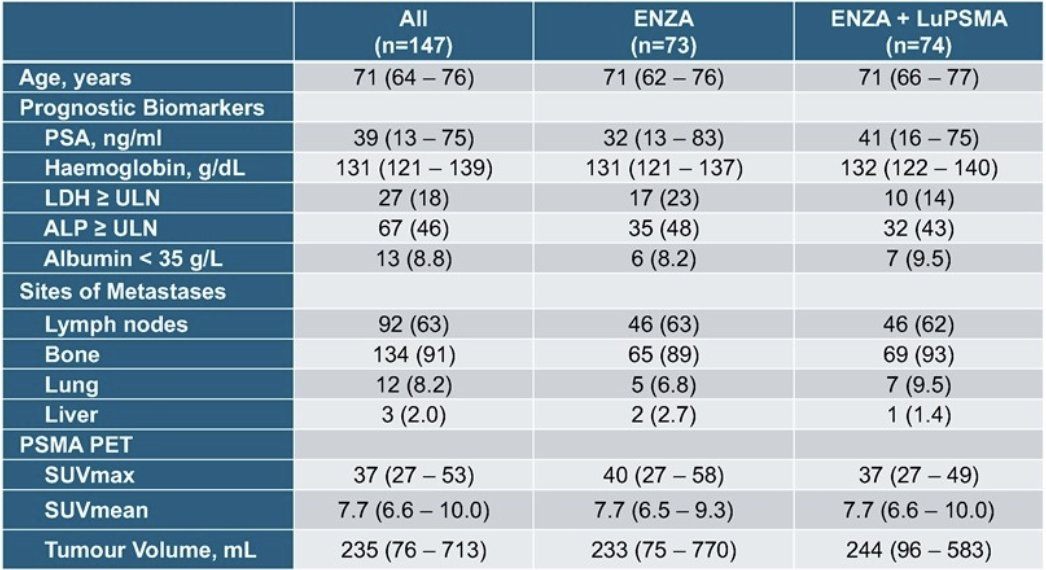
CTCs were measured at baseline in 147/160 (92%) participants who received their allocated treatment in the ENZA-p study, and 136 (85%) and 69 (43%) patients at Day 92 and progression, respectively:
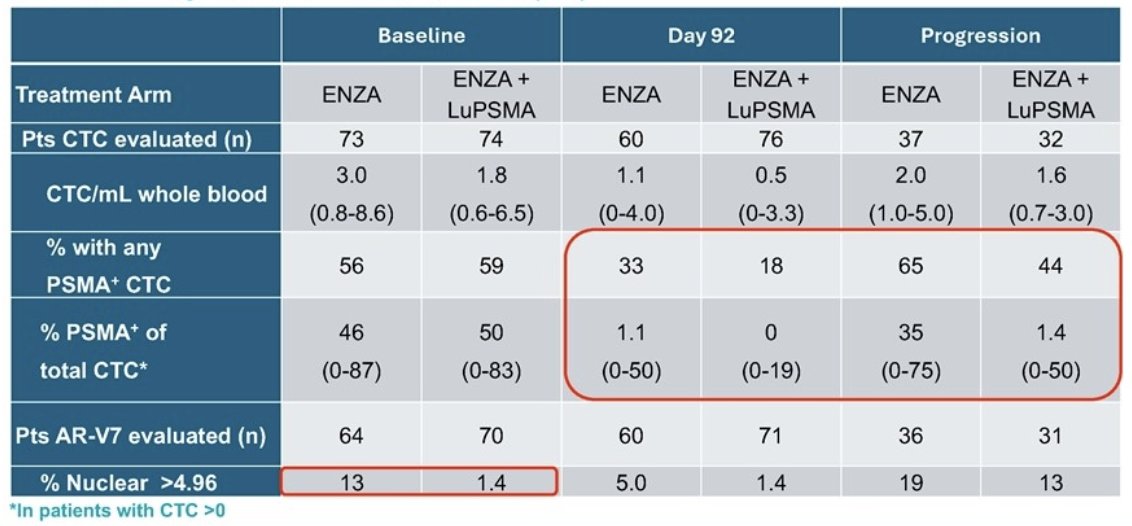
CTC characteristics were similar between the treatment groups at baseline, except for AR-V7 positivity, which was higher in the enzalutamide alone arm (13% versus 1.4% with nuclear N/C ratio > 4.96). Median CTC/mL and the proportion of PSMA+ CTCs decreased at Day 92 in both arms, with most CTCs being PSMA- at Day 92. These trends were more notable in the enzalutamide + 177Lu-PSMA-617 arm. At first progression, the proportion of PSMA-positive CTCs remained low in the enzalutamide + 177Lu-PSMA-617 arm compared to the enzalutamide alone arm (1.4% versus 35% of total CTCs):
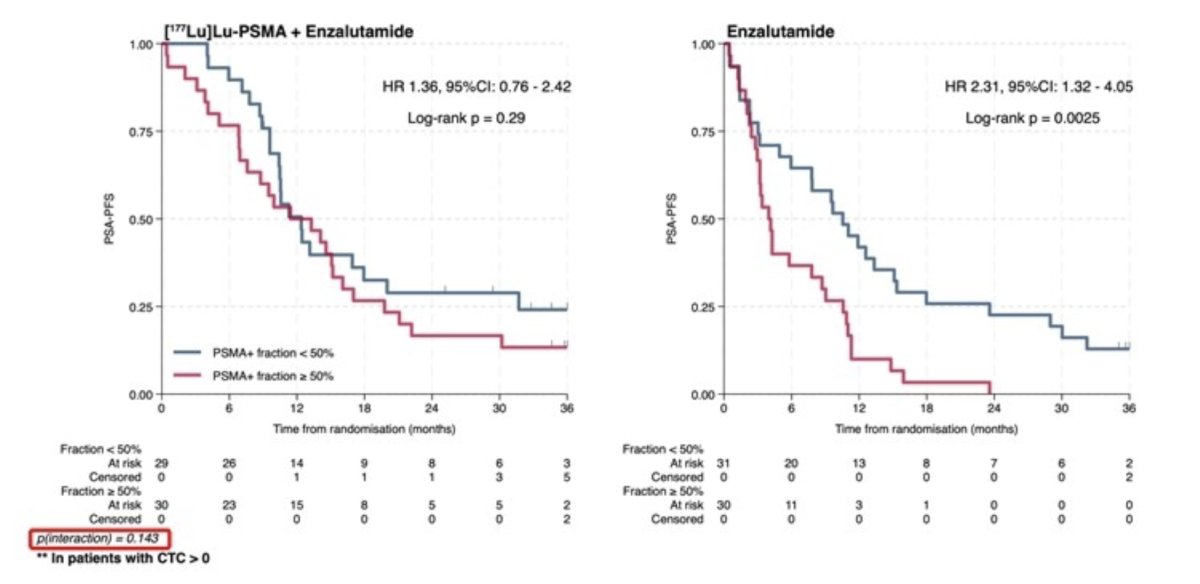
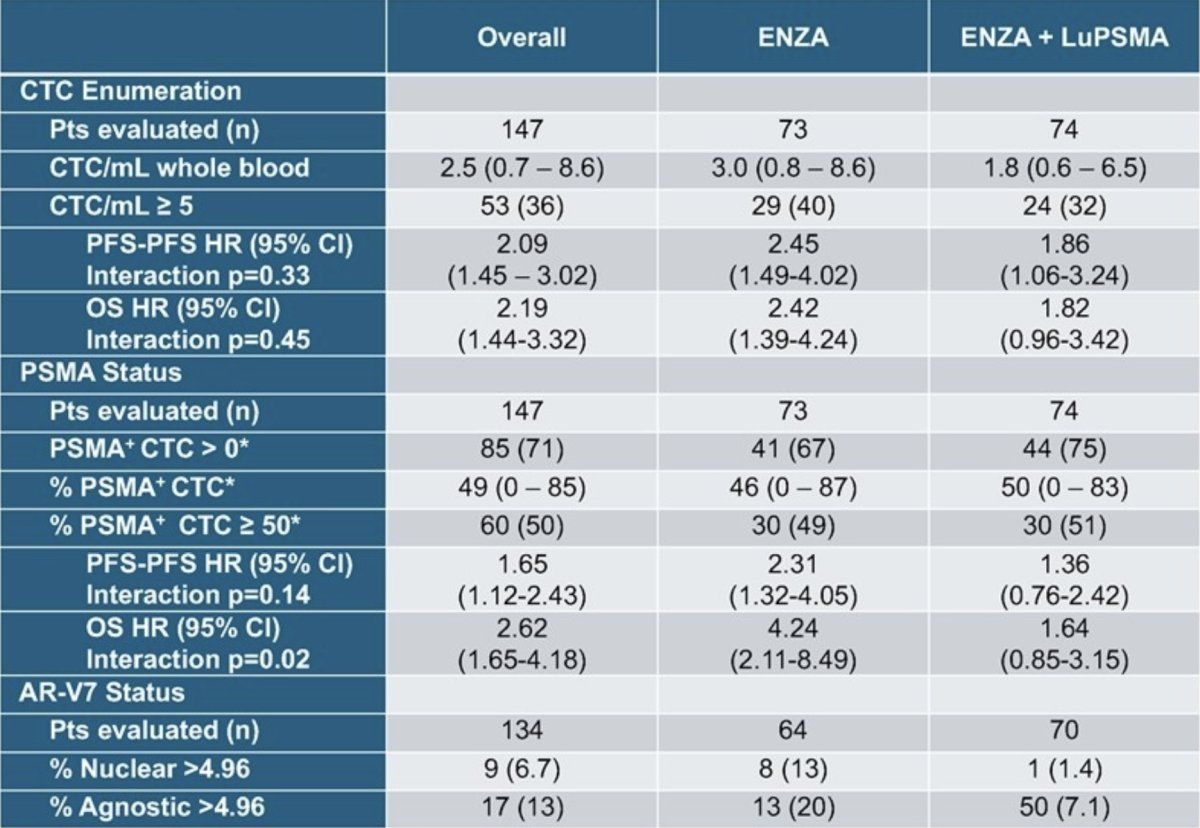
Rates of nuclear AR-V7 positivity were low overall, precluding further meaningful analysis, and there were no associations with treatment outcomes were seen for Day 92 or progression analyses. There were 122 PSA progression events that occurred (69 enzalutamide, 53 enzalutamide + 177Lu-PSMA-617 arm) at a median follow-up of 34 months (95% CI 32-36). Median PSA progression-free survival was 11 (95% CI 9-11), 8 (95% CI 4-10), and 13 months (95% CI 11-17) for the overall survival analysis, in the enzalutamide, and enzalutamide + 177Lu-PSMA-617 arms, respectively. In patients with detectable CTCs, a PSMA+ fraction ≥ 50% versus <50% was associated with shorter PSA progression free survival in the enzalutamide arm (HR 2.31, 95% CI 1.32-4.02), but was not demonstrated in the enzalutamide + 177Lu-PSMA-617 arm (HR 1.36, 95% CI 0.76-2.42), indicating the effect of high PSMA+ CTC fraction is modified by the addition of 177Lu-PSMA-617:
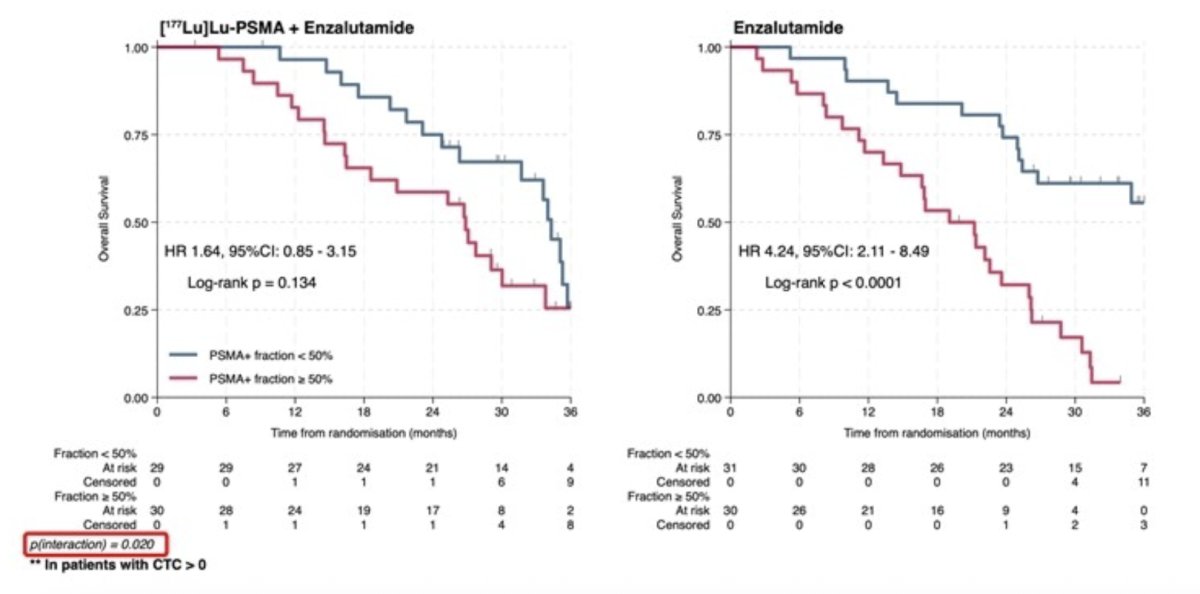
There were 91 deaths that occurred (50 in the enzalutamide arm, 41 in the enzalutamide + 177Lu-PSMA-617 arm), with a median overall survival of 26 months (95% CI 22-31) and 33 months (95% CI 27-35) in the enzalutamide and enzalutamide + 177Lu-PSMA-617 arms, respectively. In patients with detectable CTCs, a PSMA+ fraction ≥ 50% versus <50% was associated with shorter overall survival in the enzalutamide arm (HR 4.24, 95% CI 2.11-8.49), but was not demonstrated in the enzalutamide + 177Lu-PSMA-617 arm (HR 1.64, 95% CI 0.85-3.15), indicating the effect of high PSMA+ CTC fraction is modified by the addition of 177Lu-PSMA-617:
Baseline CTC characteristics and outcome associations are highlighted in the following table:
Dr. Crumbaker concluded her presentation discussing CTC characteristics associated with survival outcomes in ENZA-p with the following take-home points:
- Baseline CTC/mL ≥ 5 versus <5 was prognostic for overall survival and progression-free survival, independent of treatment group
- A PSMA+ CTC fraction ≥50% versus <50% was prognostic for overall survival and progression-free survival in the enzalutamide alone arm, but this effect was smaller in the enzalutamide + 177Lu-PSMA-617 arm
- These data suggest that PSMA+ CTC fraction ≥ 50% may be predictive of a benefit for adding 177Lu-PSMA-617 to enzalutamide in patients with detectable CTCs
- Further analyses with molecular imaging parameters and ctDNA are underway to assess if further liquid biopsy characterization has additive predictive value to PET imaging biomarkers
Presented by: Megan Crumbaker, MD, The Kinghorn Cancer Centre, St. Vincent’s Hospital, Sydney, Australia
Written by: Zachary Klaassen, MD, MSc – Urologic Oncologist, Associate Professor of Urology, Georgia Cancer Center, Wellstar MCG Health, @zklaassen_md on Twitter during the 2025 European Society of Medical Oncology (ESMO) Annual Meeting, Berlin, Germany, Fri, Oct 17 – Tues, Oct 21, 2025.
Reference: