

(UroToday.com) The 2025 European Society for Medical Oncology (ESMO) Annual Congress held in Berlin, Germany, was host to a prostate cancer poster session. Dr. Ugo De Giorgi presented a study evaluating a machine learning model for predicting the risk of anemia development in metastatic castration-resistant prostate cancer (mCRPC) patients treated with talazoparib + enzalutamide.
The treatment of patients with mCRPC using the combination of a poly(ADP-ribose) polymerase (PARP) inhibitor with or without an androgen receptor pathway inhibitor frequently leads to hematologic adverse events (AEs), such as anemia.1 TALAPRO-2 (NCT03395197), a randomized, international, double-blind, phase III trial, demonstrated significantly improved radiographic progression-free survival and overall survival with first-line talazoparib 0.5 mg (or 0.35 mg in patients with moderate renal impairment) plus enzalutamide 160 mg versus placebo plus enzalutamide in patients with mCRPC with or without homologous recombination repair (HRR) gene alterations.2-5
Anemia was the most common treatment-emergent AE (TEAE; in 65–66% of patients in cohorts 1 and 2) and grade ≥3 TEAE in patients receiving talazoparib plus enzalutamide in TALAPRO-2.2,3 Herein, Dr. De Giorgi presented the results of machine learning models developed to predict the likelihood of patients developing grade ≥3 anemia, based on >100 parameters, while receiving talazoparib plus enzalutamide.
Data were from the TALAPRO-2 primary data cutoff for cohort 1 (August 16, 2022) and cohort 2 (October 3, 2022). Three types of machine learning models commonly used for time-to-event prediction were created:
- Least absolute shrinkage and selection operator (LASSO) Cox regression
- Extreme gradient boosting (XGB)
- Survival support vector machine (SVM)
Baseline models were created from baseline patient and disease characteristics collected before talazoparib initiation to predict grade ≥3 anemia status at Weeks 2, 4, 8, 12, and 16 after talazoparib initiation (Figure 1).
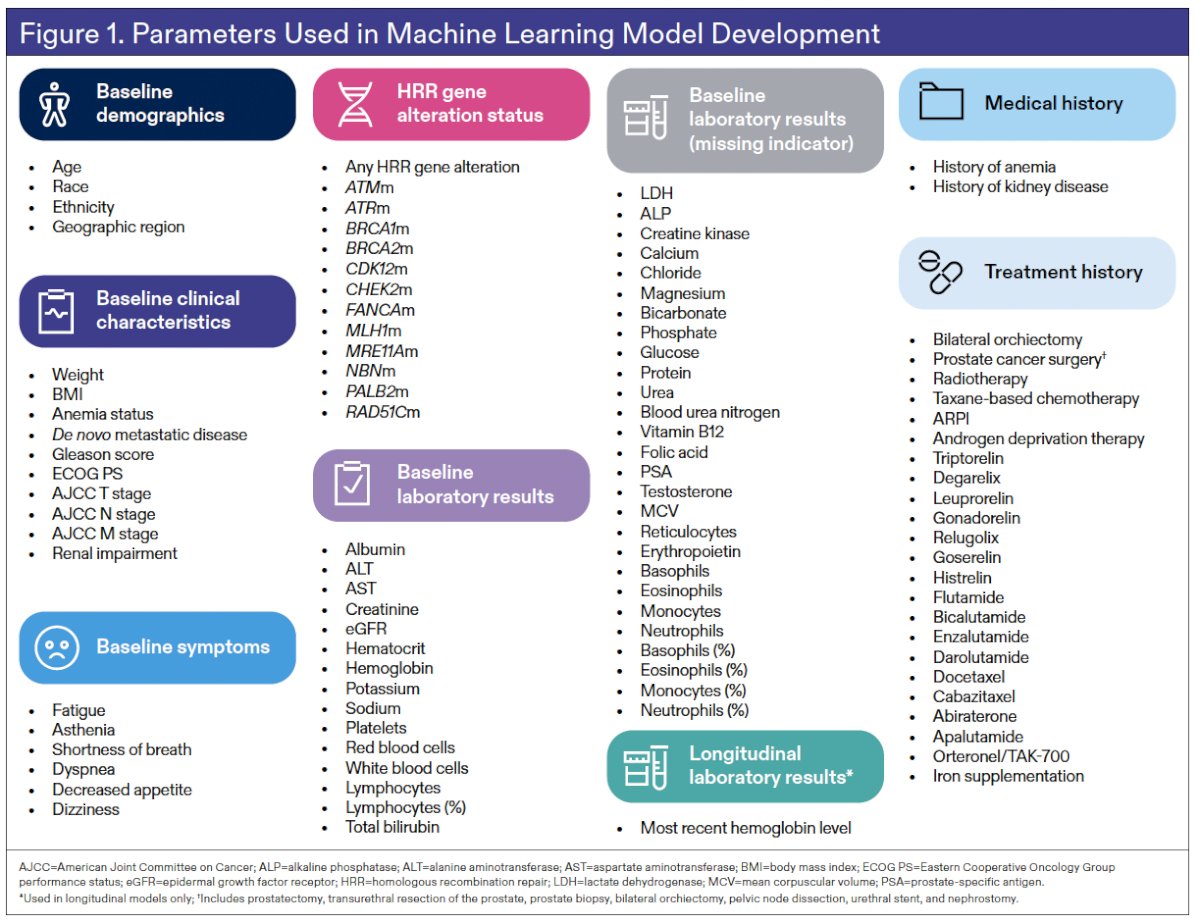
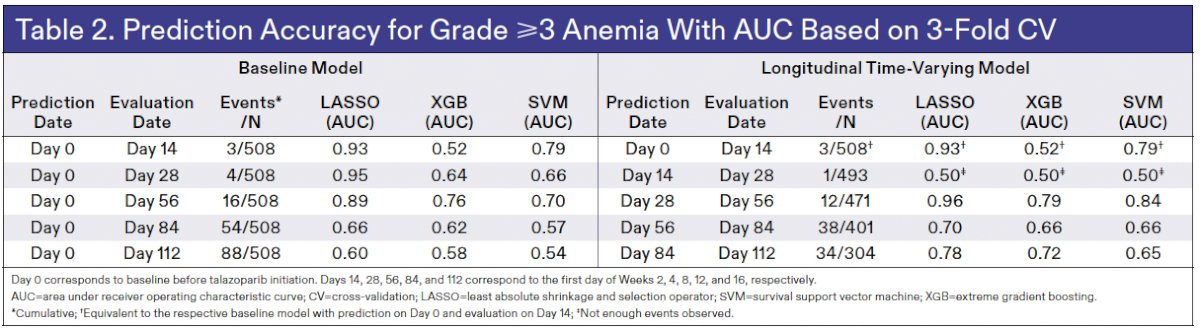
Longitudinal time-varying models were created to predict grade ≥3 anemia status at Weeks 4, 8, 12, and 16 in patients without grade ≥3 anemia by Weeks 2, 4, 8, and 12, respectively, after talazoparib initiation. These models used baseline data and each patient’s most recently measured hemoglobin level before the follow-up week (for which timing varies by patient). The accuracy between models was compared using area under receiver operating characteristic curve (AUC) based on 3-fold cross-validation (CV). Data were truncated at the first of any of the following:
- Red blood cell transfusion (RBCT)
- Dose modification
- Initiation of subsequent antineoplastic therapy
- Date of last contact, death, or data cutoff
To remove the influence of anemia management methods on model outcomes, grade ≥3 anemia events observed after dose modifications or blood transfusions were not modeled
This analysis included 508 patients who received treatment with talazoparib plus enzalutamide across both cohorts of TALAPRO-2. Baseline demographics and clinical characteristics are shown in Table 1 below:
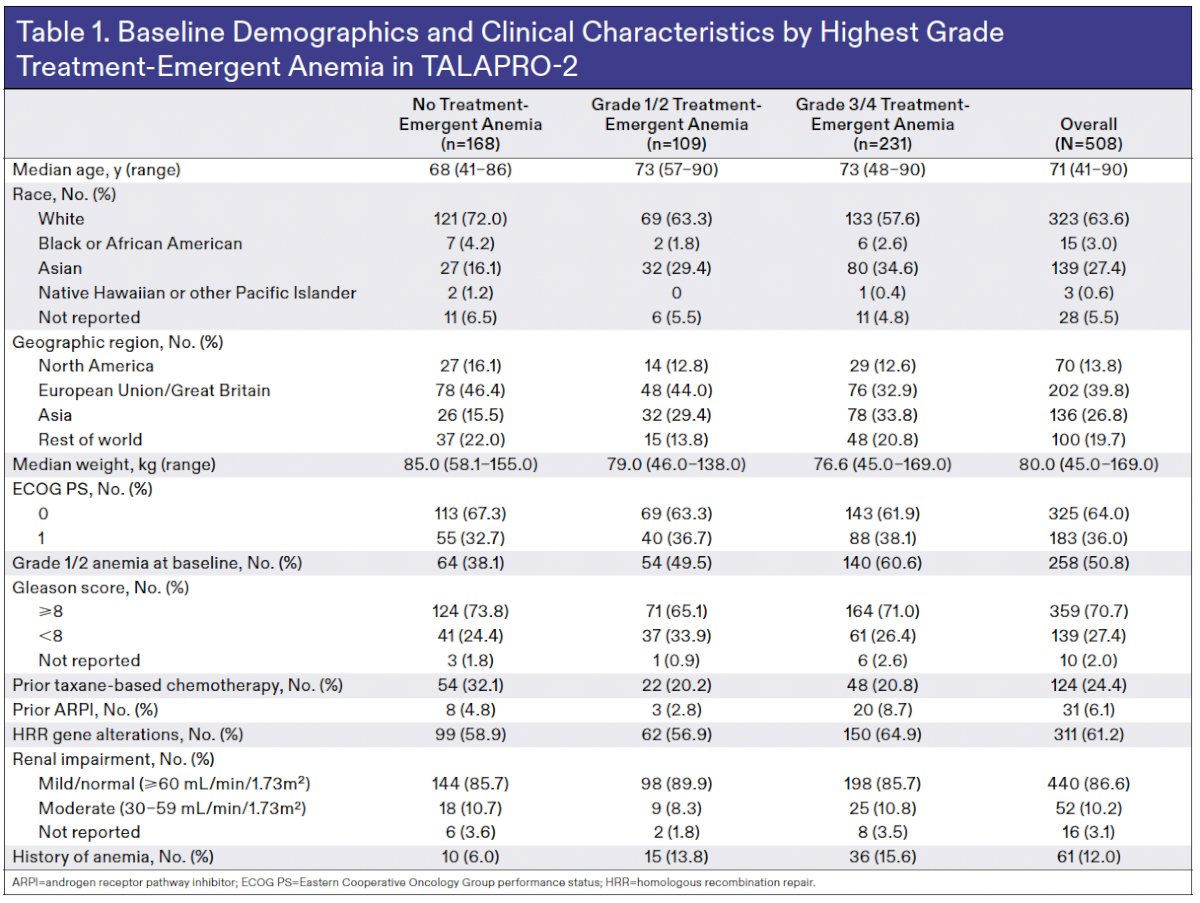
Among the 508 patients, 231 (45.5%) experienced grade ≥3 anemia during the study period (regardless of whether anemia was preceded by dose modification or RBCT). In 88 (17.3%) patients, grade ≥3 anemia occurred within 16 weeks of treatment and before dose modification and RBCT.
The LASSO model showed the highest predictive accuracy for both the baseline and longitudinal models. The accuracy of the baseline model (AUC) was higher than that of the longitudinal time-varying model at the initial 4 weeks of treatment (0.93–0.95 vs 0.50–0.93) but lower at 8–16 weeks (0.60–0.89 vs 0.70–0.96; Table 2).
Baseline LASSO model top predictors of grade ≥3 anemia included older age, Asian race, and lower body weight (Figure 2). Longitudinal model top predictors further included lower recent hemoglobin level.

Dr. De Giorgi concluded as follows:
- This analysis of TALAPRO-2 showed that machine learning models can predict the incidence of grade ≥3 anemia in the initial months of treatment with talazoparib plus enzalutamide
- The top predictors of grade ≥3 anemia were older age, Asian race, and lower body weight in the baseline model, and included lower recent hemoglobin level in the longitudinal model
- Predictive machine learning models such as these may help clinicians adopt more individualized patient care by preemptively reducing the dose of talazoparib before the emergence of grade ≥3 anemia and potentially avoid the need for dose interruption, RBC transfusions, or permanent treatment discontinuation
Presented by: Ugo De Giorgi, MD, PhD, IRCCS Istituto Romagnolo per lo Studio dei Tumori (IRST), Dino Amadori, Via Piero Maroncelli, 40, 47014 Meldola FC, Italy
Written by: Rashid K. Sayyid, MD, MSc, Assistant Professor, Urologic Oncologist, Department of Urology at The University of Arizona and Banner University Medical Center – Tucson, AZ, @rksayyid on X during the 2025 European Society for Medical Oncology (ESMO) Annual Congress, Berlin, Germany, October 17–21, 2025
References:
- Maiorano BA, De Giorgi U, Verzoni E, et al. Hematological toxicity of PARP inhibitors in metastatic prostate cancer patients with mutations of BRCA or HRR genes: a systematic review and safety metaanalysis. Target Oncol. 2024;19(1):1-11.
- Fizazi K, Azad AA, Matsubara N, et al. First-line talazoparib with enzalutamide in HRR-deficient metastatic castration-resistant prostate cancer: the phase 3 TALAPRO-2 trial. Nat Med. 2024; 30(1):257-264.
- Agarwal N, Azad AA, Carles J, et al. Talazoparib plus enzalutamide in men with first-line metastatic castration-resistant prostate cancer (TALAPRO-2): a randomised, placebo-controlled, phase 3 trial. Lancet. 2023; 402(10398):291-303.
- Agarwal N, Azad AA, Carles J, et al. Talazoparib plus enzalutamide in men with metastatic castration-resistant prostate cancer: final overall survival results from the randomised, placebo-controlled, phase 3 TALAPRO-2 trial. Lancet. 2025; 406(10502):447-460.
- Fizazi K, Azad AA, Matsubara N, et al. Talazoparib plus enzalutamide in men with HRR-deficient metastatic castration-resistant prostate cancer: final overall survival results from the randomised, placebo-controlled, phase 3 TALAPRO-2 trial. Lancet. 2025; 406(10502):461-474.