

(UroToday.com) The 2025 European Society for Medical Oncology (ESMO) Annual Congress held in Berlin, Germany was host to a prostate cancer poster session. Dr. Omar El-Taji presented the results of a pooled analysis of major adverse cardiovascular events (MACE) in high-risk, localized, and metastatic hormone sensitive prostate cancer (mHSPC) from four phase III STAMPEDE platform protocol trials.
Dr. El-Taji noted that androgen deprivation therapy (ADT) remains the backbone of treatment for mHSPC, with early intensification associated with improved survival outcomes. However, concerns remain that adding androgen receptor pathway inhibitors (ARPI) may increase cardiovascular (CV) toxicity, as MACEs account for up to one-fifth of deaths in advanced prostate cancer.1
Using linked health systems data, Dr. El-Taji and colleagues examined long-term MACE risk across treatment intensification strategies within four STAMPEDE trials and evaluated SCORE22 to identify patients who might benefit from treatment de-intensification.
The STAMPEDE multi-arm, multi-stage trial (NCT00268476) enrolled men from 126 UK centers (2005–2023), with outcomes captured through English Hospital Episode Statistics (HES) and Civil Registrations of Death (CRD). All patients had histologically confirmed prostate cancer and were to start ADT as part of their treatment for newly diagnosed M1 or M0 disease.
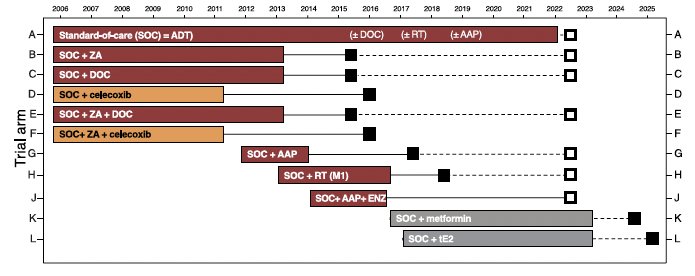
The treatment comparisons were as follows: standard ADT versus intensification with:
- Docetaxel
- Zoledronic acid
- Abiraterone acetate + prednisone +/- enzalutamide
- Radiotherapy
The primary outcome was the cumulative incidence of MACEs at 5 and 10 years, with a MACE defined as one of:
- Non-fatal MI
- Non-fatal stroke
- Heart failure admission
- Coronary/vascular revascularization procedure
- Cardiovascular death
Secondary outcomes were as follows:
- Performance of SCORE2-OP2
- Effect modification by age, hypertension, history of cardiovascular disease, and SCORE2
The statistical analysis was performed on an intention-to-treat basis using Fine–Gray competing-risks models (non-cardiovascular death as a competing risk), adjusted for age, WHO performance status, BMI, PSA, Gleason grade group, NSAID use, and treatment allocation, with SCORE2 and SCORE2-OP discrimination (10-year AUC) assessed in the trial population.
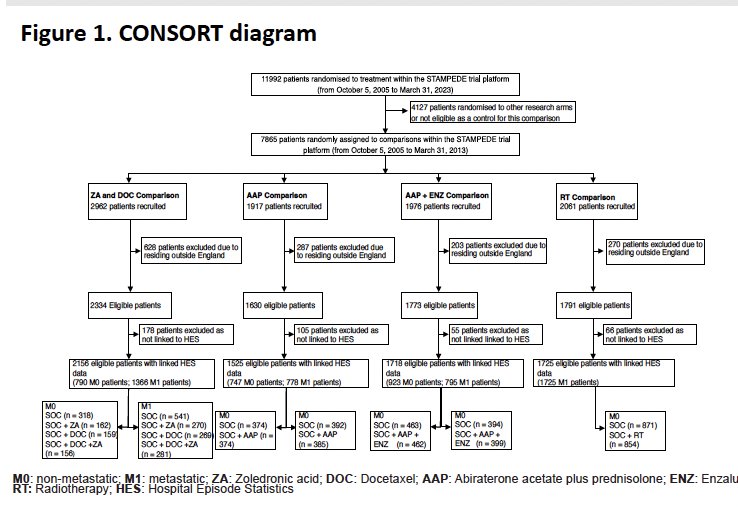
The CONSORT diagram is illustrated below:
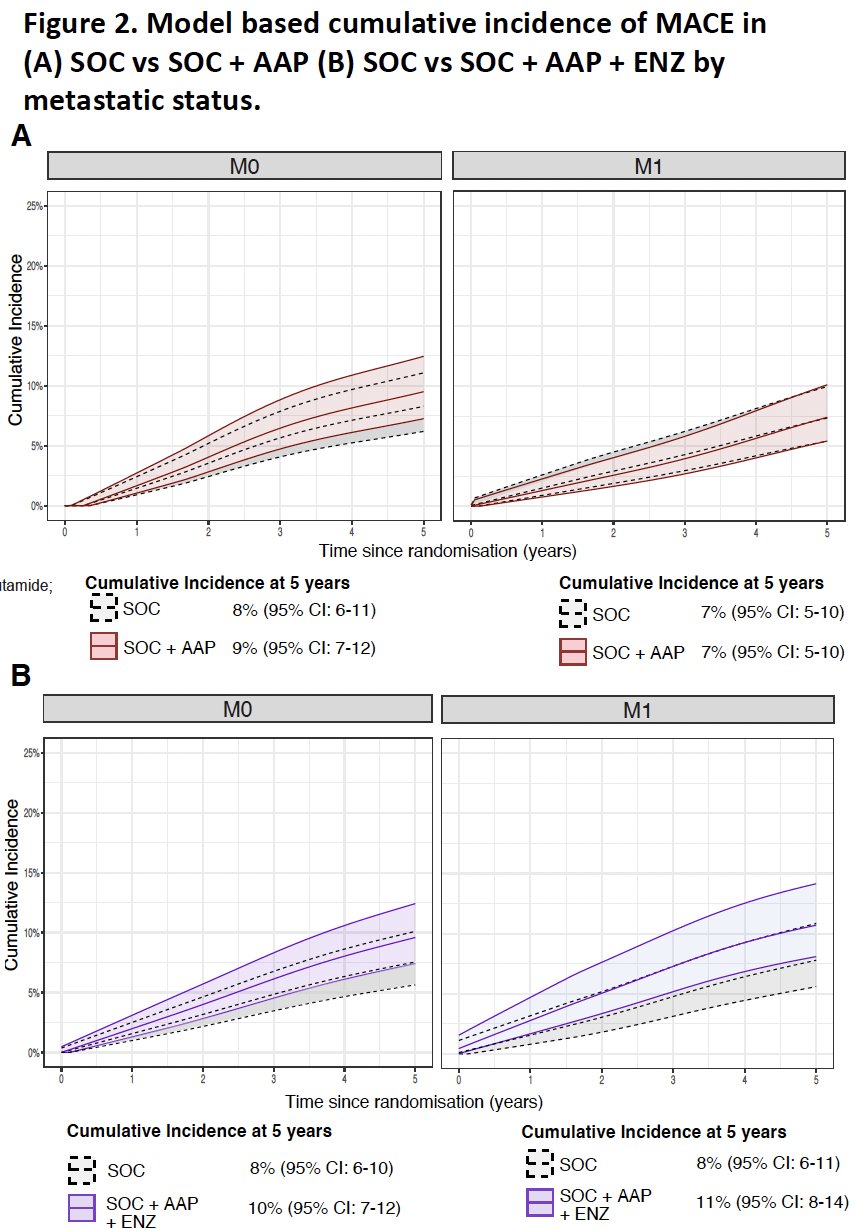
The cumulative incidence curves below in Figure 2 demonstrate that treatment intensification with abiraterone acetate + prednisone +/- enzalutamide in both the M0 and M1 disease states did not significantly increase the incidence of MACEs.
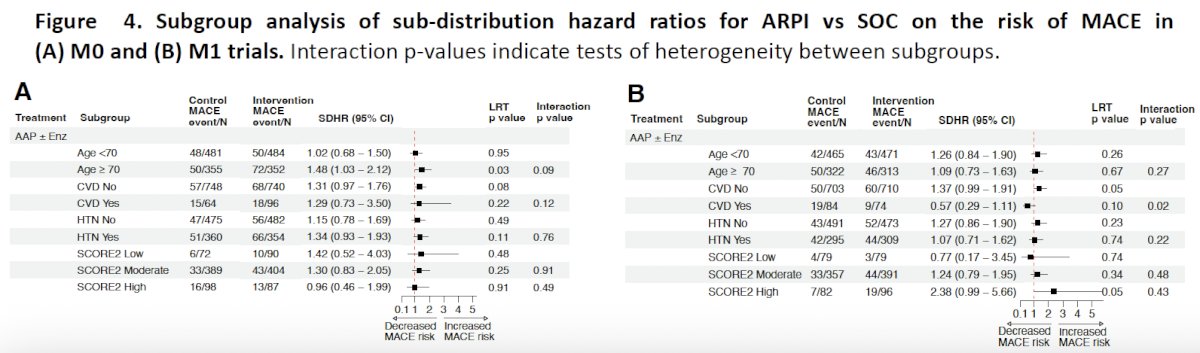
The addition of an ARPI did not significantly modify MACE risk in any key clinical subgroup:
They demonstrated that SCORE2 underestimates the absolute risk of MACE, but still stratifies patients effectively:

Dr. El-Taji concluded as follows:
- Treatment intensification with docetaxel, abiraterone acetate + prednisone +/- enzalutamide, or prostate radiotherapy did not significantly increase the rate of MACEs
- The addition of an ARPI to ADT did not modify the MACE risk across subgroups.
- A trend towards higher MACE events was observed with ARPI intensification (ADT + enzalutamide)
- M1 patients in the SCORE2 high-risk category showed higher MACE event rates.
- SCORE2 identifies patients at increased MACE risk and is a useful triage tool, yet it underestimates the absolute risk of MACE in prostate cancer. Thus, further development in a prostate cancer population is necessary.
Presented by: Omar El-Taji, MBChB, MRes, MRCS (Eng), Uro-Oncology Fellow, The University of Manchester, The Christie NHS, Manchester, England
Written by: Rashid K. Sayyid, MD, MSc, Assistant Professor, Urologic Oncologist, Department of Urology at The University of Arizona and Banner University Medical Center – Tucson, AZ, @rksayyid on X during the 2025 European Society for Medical Oncology (ESMO) Annual Congress, Berlin, Germany, October 17–21, 2025
References:
- El-Taji O, Fang F, Agarwal N, et al. Cardiovascular events and androgen receptor signaling inhibitors in advanced prostate cancer: a systematic review and meta-analysis. JAMA Oncol. 2024; 10(7):874-884.
- SCORE2 Working Group and ESC Cardiovascular Risk Collaboration. SCORE2 risk prediction algorithms: new models to estimate 10-year risk of cardiovascular disease in Europe. Eur Heart J. 2021; 42(25):2439-2454.