

(UroToday.com) The 2025 European Society of Medical Oncology (ESMO) Annual Congress held in Berlin, Germany, was host to the Poster Session. Dr. Constance Thibault presented the poster Avelumab first-line maintenance (1LM) treatment for advanced urothelial carcinoma (aUC) in France: conditional survival and long-term safety in patients (pts) treated for ≥1 or ≥2 yrs in the AVENANCE real-world study.
Dr. Thibault began by revisiting the pivotal JAVELIN Bladder 100 trial, which demonstrated that avelumab first-line (1L) maintenance plus best supportive care (BSC) significantly prolonged overall survival (OS) and progression-free survival (PFS) compared to BSC alone in patients with advanced urothelial carcinoma (UC) who had not progressed following platinum-based chemotherapy. With more than two years of follow-up, median OS was 23.8 vs 15.0 months (HR 0.76; 95% CI 0.63–0.91; p=0.0036), establishing avelumab 1L maintenance as a global standard of care and a guideline-recommended therapy.1
He highlighted that post hoc analyses from JAVELIN Bladder 100 showed that patients completing 1 or 2 years of avelumab maintained a high probability of prolonged benefit—those treated for 1 year had a 93.2% chance of surviving an additional year and 79.6% at 2 years, while those treated for 2 years had 95.8% and 90.3% probabilities of surviving an additional 1 and 1.5 years, respectively.
Dr. Thibault noted that these findings have been reinforced in real-world settings, citing the AVENANCE study—a large French non-interventional cohort of 595 patients—which confirmed the effectiveness and safety of avelumab maintenance, showing a median OS of 21.3 months (95% CI 17.6–24.6) and a median PFS of 5.7 months (95% CI 5.2–6.5). The current analysis focused on post hoc outcomes assessing the probability of continued survival and safety among patients treated with avelumab for ≥1 or ≥2 years.
The AVENANCE study (NCT04822350) is a multicenter, noninterventional, ambispective (retrospective and prospective) study conducted across France. Eligible patients had locally advanced or metastatic urothelial carcinoma that had not progressed following first-line platinum-based chemotherapy, defined as ongoing complete response, partial response, or stable disease, and had received, were receiving, or were planned to receive avelumab as first-line maintenance treatment.
Data collection began in July 2021, with follow-up ongoing at the time of this analysis. The study required no protocol-specific visits, and all assessments were performed according to standard clinical practice. The primary endpoint was overall survival (OS) from the start of avelumab treatment. The effectiveness population included all patients who received at least one dose of avelumab and met eligibility criteria, while the safety population included all patients who received at least one dose.
In this post hoc analysis, outcomes were examined in subgroups of patients treated with avelumab for at least one or two years. Conditional survival was evaluated using Kaplan-Meier analysis, and adverse events were summarized descriptively.
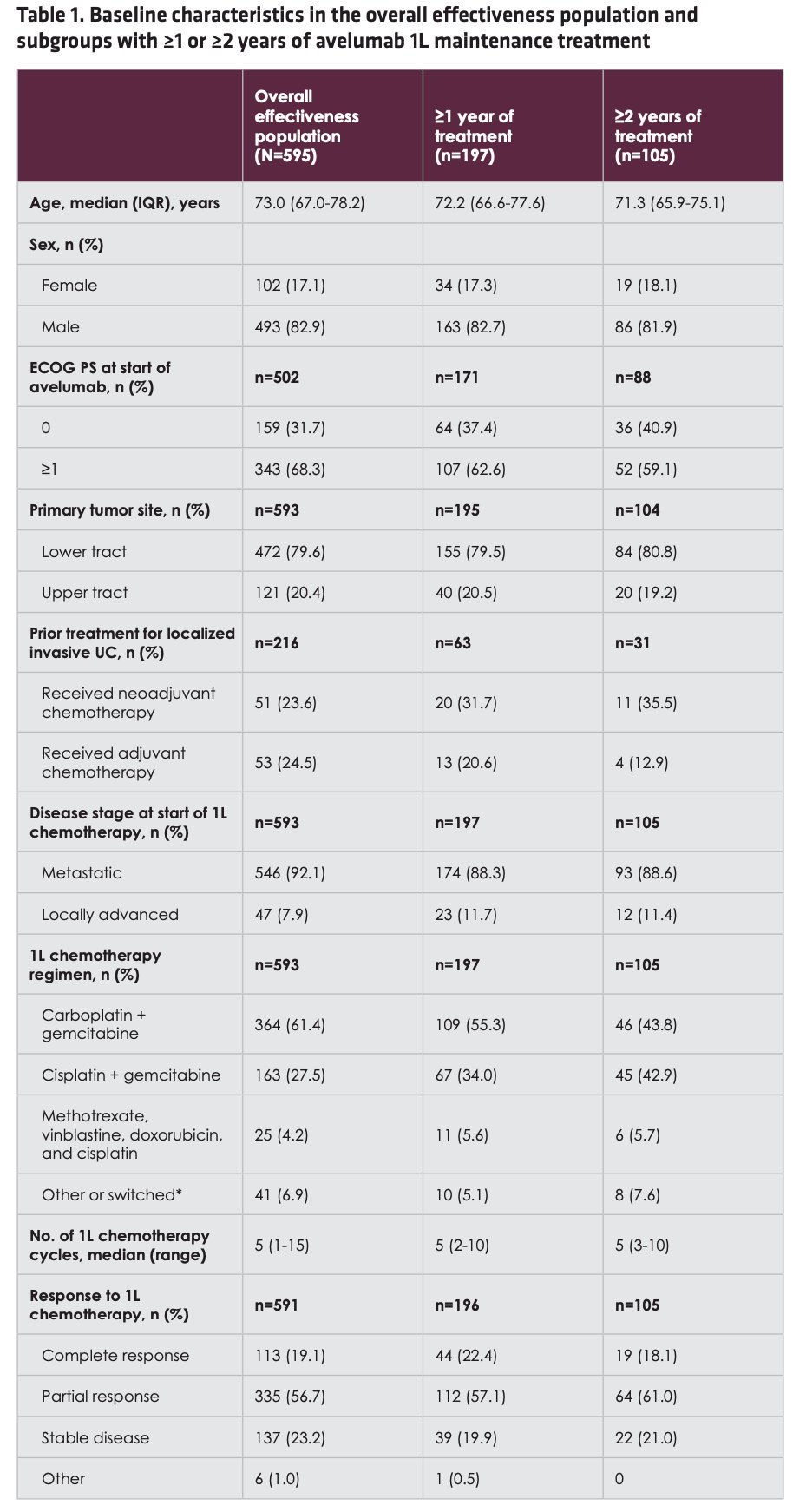
Of 604 screened patients, 595 were included in the effectiveness population and 596 in the safety population. At the data cutoff (December 2, 2024), the median follow-up from the start of avelumab was 33.2 months (95% CI, 31.7–34.0). Avelumab treatment lasted for at least one year in 197 patients (33.1%) and for at least two years in 105 patients (17.6%). Compared with the overall effectiveness population, those who received treatment for two years or more were more likely to have undergone prior neoadjuvant chemotherapy (35.5% vs 23.6%), had a baseline ECOG performance status of 0 (40.9% vs 31.7%), and were more frequently treated with first-line cisplatin plus gemcitabine (42.9% vs 27.5%).
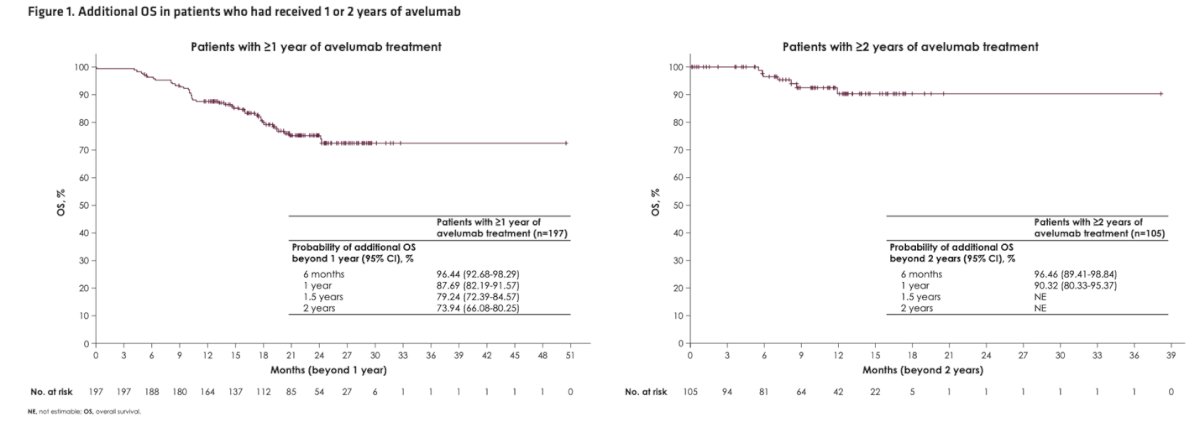
In patients who received one year of avelumab maintenance, the probability of achieving an additional one or two years of overall survival (OS) was 87.7% and 73.9%, respectively. In patients with 2 years of avelumab treatment, the probability of an additional 1 or 2 years of OS was 90.32% and NE, respectively.
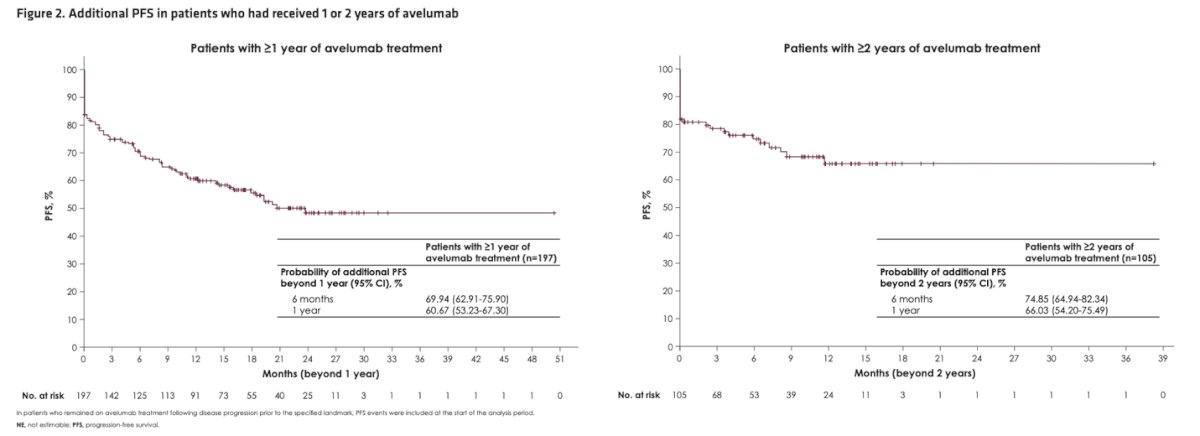
Similarly, the probability of remaining progression-free for an additional six months or one year was 69.9% and 60.7%, respectively. Moreover, in patients with greater or equal than 2 years of Avelumab, the probability of an additional 6 months or 1 year of PFS was 74.85% and 66.03%, respectively
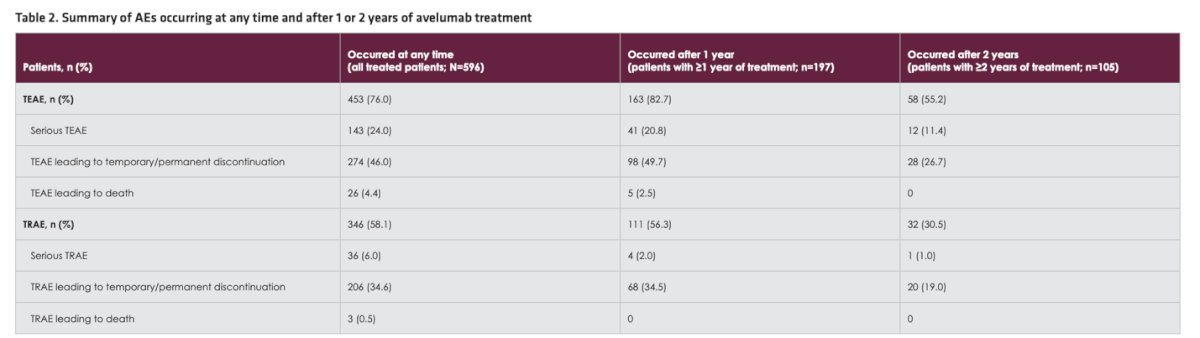
Lastly, among patients who received avelumab for at least one or two years, treatment-related adverse events (TRAEs) occurred in 56.3% and 30.5% of patients, respectively. Serious TRAEs were uncommon, reported in only 2.0% of patients after one year and 1.0% after two years of treatment, underscoring the favorable long-term safety profile of avelumab maintenance therapy.
Dr. Thibault concluded their presentation with the following key points:
- Post hoc analyses from the AVENANCE real-world study evaluated the probability of additional overall survival (OS), progression-free survival (PFS), and long-term safety in patients with advanced urothelial carcinoma (UC) who did not progress on first-line platinum-based chemotherapy and received ≥1 or ≥2 years of avelumab 1L maintenance.
- Among patients treated for 1 year (197/595; 33.1%), the probability of an additional 1 or 2 years of OS was 87.69% and 73.94%, respectively.
- Among patients treated for 2 years (105/595; 17.6%), the probability of an additional 1 or 2 years of OS was 90.32% and not estimable (NE), respectively.
- The probability of remaining progression-free for an additional year was 60.67% in those treated for 1 year and 66.03% in those treated for 2 years.
- No new safety signals were observed with prolonged avelumab therapy.
- These real-world findings are consistent with those observed in the phase 3 JAVELIN Bladder 100 trial and provide valuable prognostic insights for patients receiving avelumab 1L maintenance in clinical practice.
Presented by: Constance Thibault, MD, Medical Oncology, Hôpital Européen Georges-Pompidou (Hôpitaux Universitaires Paris-Ouest), Paris, France
Written by: Julian Chavarriaga, MD – Urologic Oncologist at Cancer Treatment and Research Center (CTIC) via Society of Urologic Oncology (SUO) Fellow at The University of Toronto. @chavarriagaj on Twitter during the 2025 European Society for Medical Oncology (ESMO) Annual Congress, Berlin, Germany, October 17–21, 2025
Reference: