

(UroToday.com) The 2023 European Society of Medical Oncology (ESMO) Annual Congress held in Madrid, Spain between October 20th and 24th, 2023 was host to a prostate cancer abstracts poster session. Dr. Joanna Dodkins presented the results of an analysis evaluating the utilization rates of treatment intensification for metastatic hormone-sensitive prostate cancer (mHSPC) patients in England.
Treatment intensification with doublet therapy (ADT + androgen receptor pathway inhibitor [ARPI]) or triplet therapy (ADT + ARPI + docetaxel) are currently guideline-approved for the 1st line treatment of the majority of mHPSC patients following the publication of numerous trials in this disease space showing a clinically meaningful overall survival benefit. However, the dissemination and subsequent application of guideline-concordant care is often lagging in clinical practice, with a clinical implementation gap of at least several years. The objective of this study was to evaluate the national utilization trends of treatment intensification in England, UK and the determinants of variation.
This was a national population-based study using data from the National Prostate Cancer Audit (NPCA) of all patients with newly diagnosed mHSPC in the English National Health Service (NHS) between 2018 and 2021. Patients receiving docetaxel, enzalutamide, abiraterone, or apalutamide within 6 months of diagnosis were identified using the Systemic Anti-Cancer Dataset (SACT). Treatment patterns were studied in the overall population and additionally stratified by age, ethnicity, deprivation, and co-morbidity.
Of the 13,820 men diagnosed with mHSPC in England between 2018 and 2021, 5,346 (39%) received ‘treatment intensification’ with either docetaxel, enzalutamide, abiraterone or apalutamide. The most used agent was docetaxel (24.5%), followed by enzalutamide (12.6%), abiraterone (1.2%), and apalutamide (0.4%).
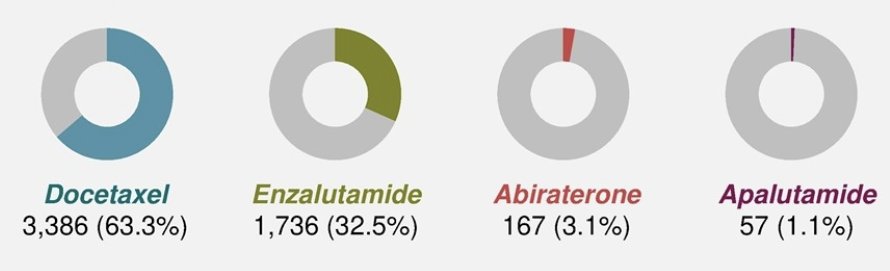
The utilisation of docetaxel peaked in 2018, with the utilisation of enzalutamide steadily increasing from 0.2% in 2018 to 28.3% in 2020. Abiraterone and Apalutamide utilisation have also increased during the study period (Table below):

Predictors of increased odds of treatment intensification were:
- Younger age
- Residence in ‘least deprived’ areas
- Lesser comorbidity burden
There was no evidence of variation in utilisation according to patient ethnicity.
Dr. Dodkins concluded that this study demonstrates the underutilisation of treatment intensification for mHSPC in England, particularly amongst certain patient groups. Further studies are needed to understand the reasons for underutilisation of intensified treatments in this setting.
Presented by: Joanna Dodkins, MBChB, MRCP, Guy's and St Thomas' NHS Foundation Trust, London, UK
Written by: Rashid K. Sayyid, MD, MSc – Society of Urologic Oncology (SUO) Clinical Fellow at The University of Toronto, @rksayyid on Twitter during the 2023 European Society of Medical Oncology (ESMO) Annual Meeting, Madrid, Spain, Fri, Oct 20 – Tues, Oct 24, 2023.