

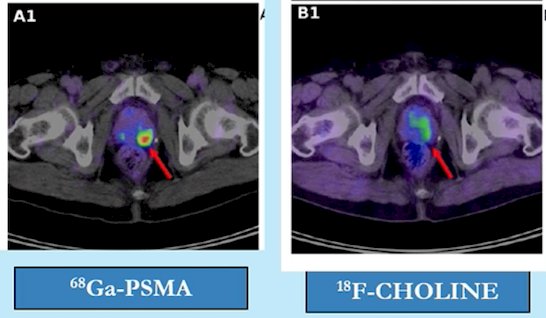
(UroToday.com) The 2022 EAU annual meeting featured a joint session of the EAU, EANM, ESMO, and ESTRO societies examining modern diagnostic and therapeutic approaches in prostate cancer, including a presentation by Dr. Stefano Fanti discussing PSMA in staging of recurrent prostate cancer. Dr. Fanti started his presentation by emphasizing that PSMA PET represents the current pinnacle of modern imaging. In 2012, one of the first studies was published assessing 68Ga-labelled PSMA ligand as a superior PET tracer for the diagnosis of prostate cancer compared to 18F-choline PET:
Subsequently, Afshar-Oromich et al. [1] assessed the influence of several variables with possible influence on PSMA ligand uptake in a large cohort. Overall, 1,007 consecutive patients were scanned with 68Ga-PSMA-11 PET/CT (1 hour after injection) to detect recurrent disease. The possible effects of different variables including PSA level and PSA doubling time, PSA velocity, Gleason score, ongoing ADT, patient age, and amount of injected activity were evaluated. In 79.5% of patients, at least one lesion with characteristics suggestive of recurrent prostate cancer was detected. A pathological (positive) PET/CT scan was only associated with PSA level and use of ADT.
The 2019 EAU prostate cancer guidelines suggested that (i) PSMA PET/CT (if available) can be performed, otherwise fluciclovine PET/CT or choline PET/CT imaging for men with a PSA >=1 ng/mL after radical prostatectomy (level of evidence 2b; weak recommendation), and (ii) PSMA PET/CT (if available) can be performed, otherwise fluciclovine PET/CT or choline PET/CT imaging for men who may benefit from curative salvage treatment after PSA recurrence following radiotherapy (level of evidence 2b; strong recommendation). With the most recent 2022 EAU prostate cancer guidelines, these recommendations have been updated to:
- PSA recurrence after radical prostatectomy: (i) Perform PSMA PET/CT if the PSA level is > 0.2 ng/mL and if the results will influence subsequent treatment decisions (weak recommendation); (ii) In case PSMA PET/CT is not available, and the PSA level is >= 1 ng/mL, perform fluciclovine PET/CT or choline PET/CT imaging if the results will influence subsequent treatment decisions (weak recommendation)
- PSA recurrence after radiotherapy: Perform PSMA PET/CT (if available) or fluciclovine PET/CT or choline PET/CT in patients fit for curative salvage treatment (strong recommendation).
Dr. Fanti notes that the reason the PSMA PET/CT recommendations for PSA recurrence after radical prostatectomy are still weak recommendations is because even though next-generation imaging changes management in 50-60% of cases, we do not have long-term data to confirm clinically meaningful benefit. He further notes that PSMA PET/CT offers an all-in-one imaging approach (whole body PET + CT), with better accuracy and the potential for theranostics.
A 2019 systematic review from Dr. Fanti’s group assessed the role of imaging in early recurrent prostate cancer [2]. Among 98 studies included in this systematic review, several notable findings include:
- CT and bone scan were not sufficiently sensitive in the early recurrence setting
- For the detection of local recurrence, TRUS or mpMRI can be used, however at the lowest PSA levels, few data were available, only after radical prostatectomy, showing a wide range of positivity
- TRUS or mpMRI need to be combined with PET/CT to assess distant disease, but new techniques such as whole body MRI, PET/MRI, or PET/CT allow for an all-in-one approach
- At recurrent PSA levels <0.5ng/ml, detection rates up to 31.3% were reported using 11C choline PET/CT and up to 65.0% using 68Ga PSMA-11 PET/CT
- At recurrent PSA levels <0.2ng/ml, detection rates of 68Ga PSMA-11 PET/CT ranged from 11.3% to as high as 58.3%
With the potential of theranostics, improved accuracy, and ability to change management for patients, Dr. Fanti concluded that PSMA PET/CT is a game changer in the recurrent prostate cancer disease setting. Since 2012, >2400 articles have been published on PSMA PET/CT, it has been included in all major guidelines, and has also been incorporated into randomized clinical trials.
Presented by: Stefano Fanti, MD, Nuclear Medicine Division, IRCCS AOU Bologna, Bologna, Italy
Written by: Zachary Klaassen, MD, MSc – Urologic Oncologist, Assistant Professor of Urology, Georgia Cancer Center, Augusta University/Medical College of Georgia, @zklaassen_md on Twitter during the 2022 European Association of Urology (EAU) Annual Hybrid Meeting, Amsterdam, NL, Fri, July 1 – Mon, July 4, 2022.
References:
- Afshar-Oromich A, Holland-Letz T, Kratochwil C, et al. Diagnostic performance of 68Ga-PSMA-11 (HBED-CC) PET/CT in patients with recurrent prostate cancer: Evaluation in 1007 patients. Eur J Nucl Med Mol Imaging. 2017 Aug;44(8):1258-1268.
- De Visschere PJL, Standaert C, Futterer J, et al. A Systematic Review on the Role of Imaging in Early Recurrent Prostate Cancer. Eur Urol Oncol. 2019 Feb;2(1):47-76.