

(UroToday.com) The 2026 European Association of Urology (EAU) annual meeting featured a biochemical recurrence and persistent PSA after local treatment of prostate cancer session and a presentation by Dr. Michele Brancaccio discussing validation of the EAU favorable and unfavorable intermediate-risk prognostic groups for predicting biochemical recurrence after radical prostatectomy in contemporary prostate cancer patients. Historically, D’Amico risk stratification has subdivided intermediate risk prostate cancer into favorable and unfavorable groups. However, this classification was developed in pre-MRI era, when staging relied on digital rectal examination and systematic biopsies, and it may not reflect contemporary prostate cancer patients undergoing MRI and targeted biopsies. Dr. Brancaccio aimed to evaluate whether the integration of MRI features could refine current risk stratification, leading to patient reclassification and improved selection for conservative management.
This study identified 2,026 patients with intermediate-risk prostate cancer who underwent MRI, systematic biopsies + targeted biopsies, and radical prostatectomy between 2012 and 2024 at a single center. The outcome was biochemical recurrence (two consecutive PSA ≥ 0.2 ng/mL). Multivariable Cox model included MRI stage (organ-confined versus extracapsular extension versus seminal vesicle invasion), diameter of index lesion (<10 versus 10–20 versus >20 mm), targeted biopsies ISUP (1–2 versus 3), and PSA (<5 versus 5–10 versus >10 ng/mL). Based on Cox-derived coefficients, a weighted score was assigned to each variable, and patients were stratified into favorable (score 1–4) and unfavorable (score >4) groups (MRI groups). The C-index compared the models’ discrimination.
According to EAU classification, 1,261 (62%) and 765 (38%) patients were categorized as intermediate-favorable and unfavorable, respectively. At multivariable Cox regression, the strongest predictors of biochemical recurrence were lesion diameter >20 mm (HR 5.2, p < 0.01), ISUP 3 (HR 1.8, p < 0.01), PSA >10 ng/mL (HR 1.72, p < 0.01), and seminal vesicle invasion at mpMRI (HR 1.2, p = 0.048). In the new MRI-groups, 614 patients (30%) were reclassified, resulting in 1,463 (72%) intermediate-favorable and 563 (28%) intermediate-unfavorable cases:
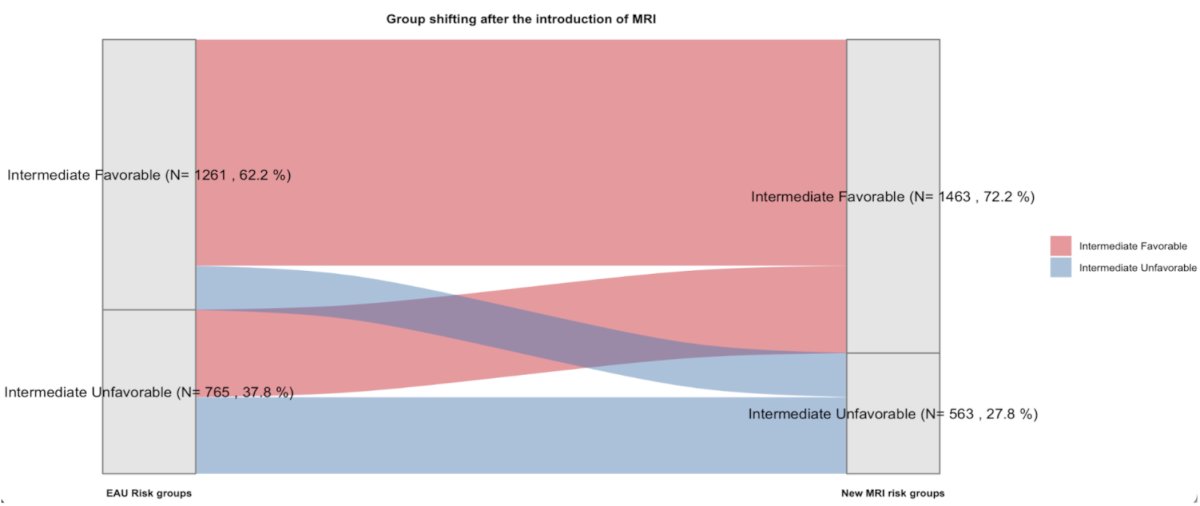
Specifically, 206 (10%) patients were reclassified from favorable to unfavorable, while 408 (20%) moved from unfavorable to favorable. Within EAU-groups, the 24- and 48-month biochemical recurrence free survival rates were 93% and 86% for favorable risk versus 81% and 69% for unfavorable risk patients, respectively. In MRI-groups, the 24- and 48-month biochemical recurrence free survival rates was 95% and 88% for favorable risk, versus 74% and 60% for unfavorable risk patients:
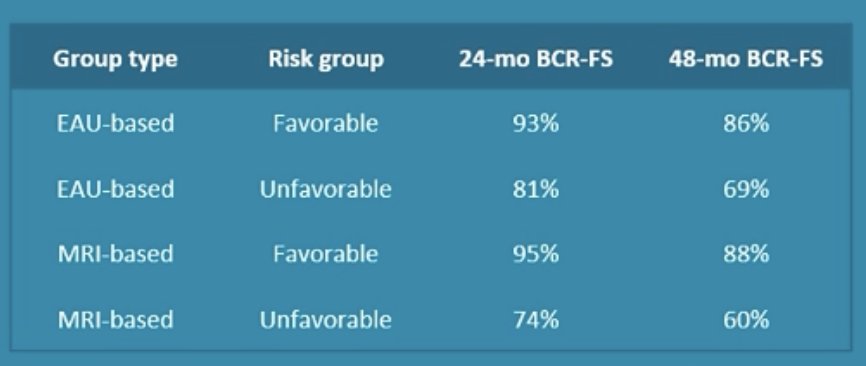
The C-index of MRI-groups was higher than EAU-groups (70% versus 61%).
Dr. Brancaccio concluded this presentation discussing validation of the EAU favorable and unfavorable intermediate-risk prognostic groups for predicting biochemical recurrence after radical prostatectomy in contemporary prostate cancer patients by emphasizing that ~1/3 of patients were reclassified after integrating MRI features into stratification of intermediate-risk prostate cancer, leading to improved risk discrimination.
Presented by: Michele Brancaccio, IRCCS San Raffaele Scientific Institute, Milan, Italy
Written by: Zachary Klaassen, MD, MSc – Urologic Oncologist, Associate Professor of Urology, Georgia Cancer Center, Wellstar MCG Health, @zklaassen_md on Twitter during the 2026 European Association of Urology (EAU) Annual Meeting, London, United Kingdom, Fri, Mar 13 – Mon, Mar 16, 2026.