

(UroToday.com) The 2026 European Association of Urology (EAU) annual meeting featured a urology trials in bladder and prostate cancer session and a presentation by Dr. Yi-Jun Shen discussing HERO, a phase III, randomized, open-label trial of disitamab vedotin + BCG in BCG-naïve patients with HER2-expressing high-risk non muscle invasive bladder cancer. BCG remains the standard adjuvant therapy for high risk non muscle invasive bladder cancer following TURBT. However, disease recurrence or progression occurs in approximately 40% of patients.
Disitamab vedotin is a novel humanized anti-HER2 antibody–drug conjugate linked to monomethyl auristatin E (MMAE). It has demonstrated promising efficacy and a manageable safety profile in patients with HER2-positive locally advanced or metastatic urothelial carcinoma.1 Previous data have shown that HER2 was an independent predictor of poor BCG efficacy in non muscle invasive bladder cancer, and combining disitamab vedotin with BCG may improve outcomes in high risk non muscle invasive bladder cancer. The HERO trial is a phase III, multicenter, randomized, open-label study designed to compare the efficacy and safety of disitamab vedotin + BCG versus BCG alone in BCG-naïve participants with high risk non muscle invasive bladder cancer.
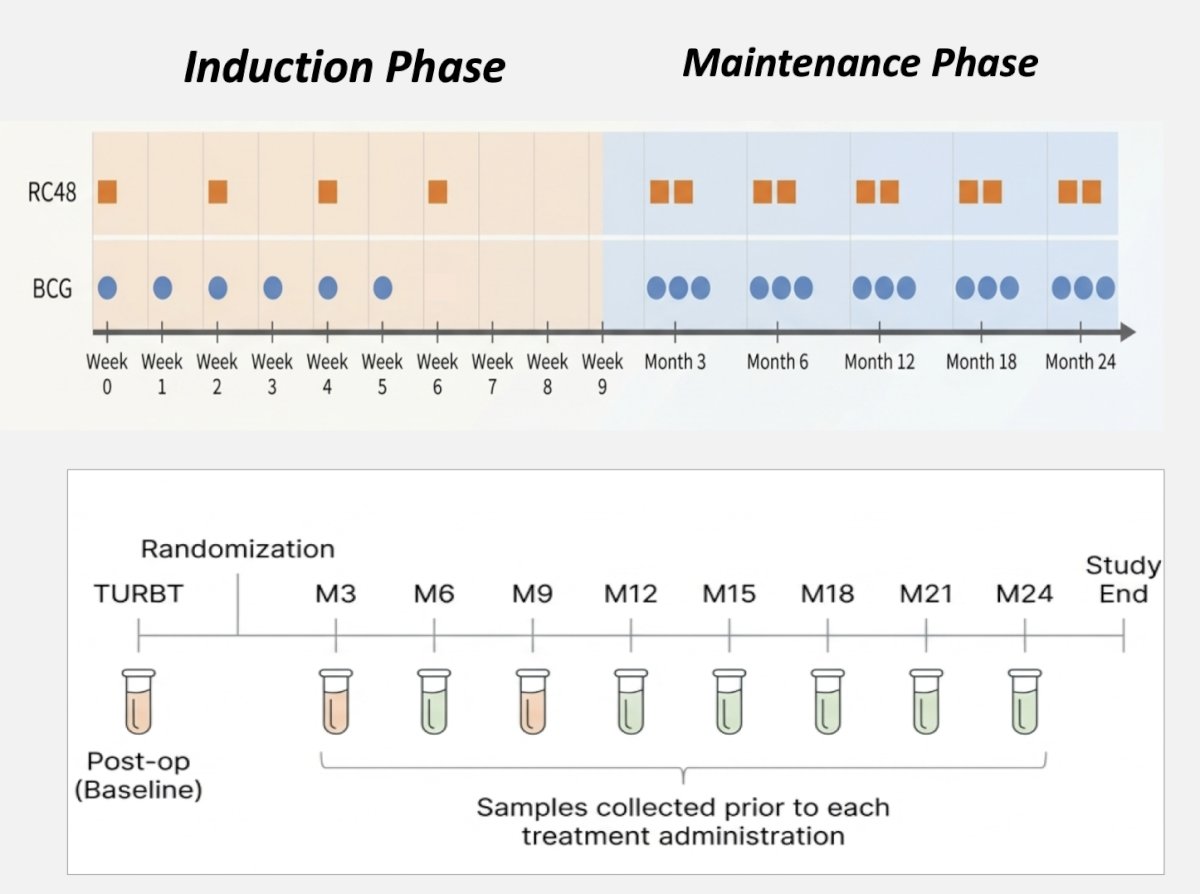
Eligible patients must be ≥18 years, have an ECOG performance status of 0–2, and have histologically confirmed high risk non muscle invasive bladder cancer (T1, high-grade Ta, and/or CIS) with no prior BCG therapy. HER2 expression (IHC 1+/2+/3+) must be confirmed by a central laboratory using the most recent archival or fresh tumor tissue. A total of 182 participants will be randomized 1:1 to receive either disitamab vedotin (2.0 mg/kg every two weeks for up to 14 cycles) + BCG (induction: 6 weekly doses; maintenance: 3 weekly doses at months 3, 6, 12, 18, and 24) or BCG alone (induction and maintenance). Randomization will be stratified by CIS status:
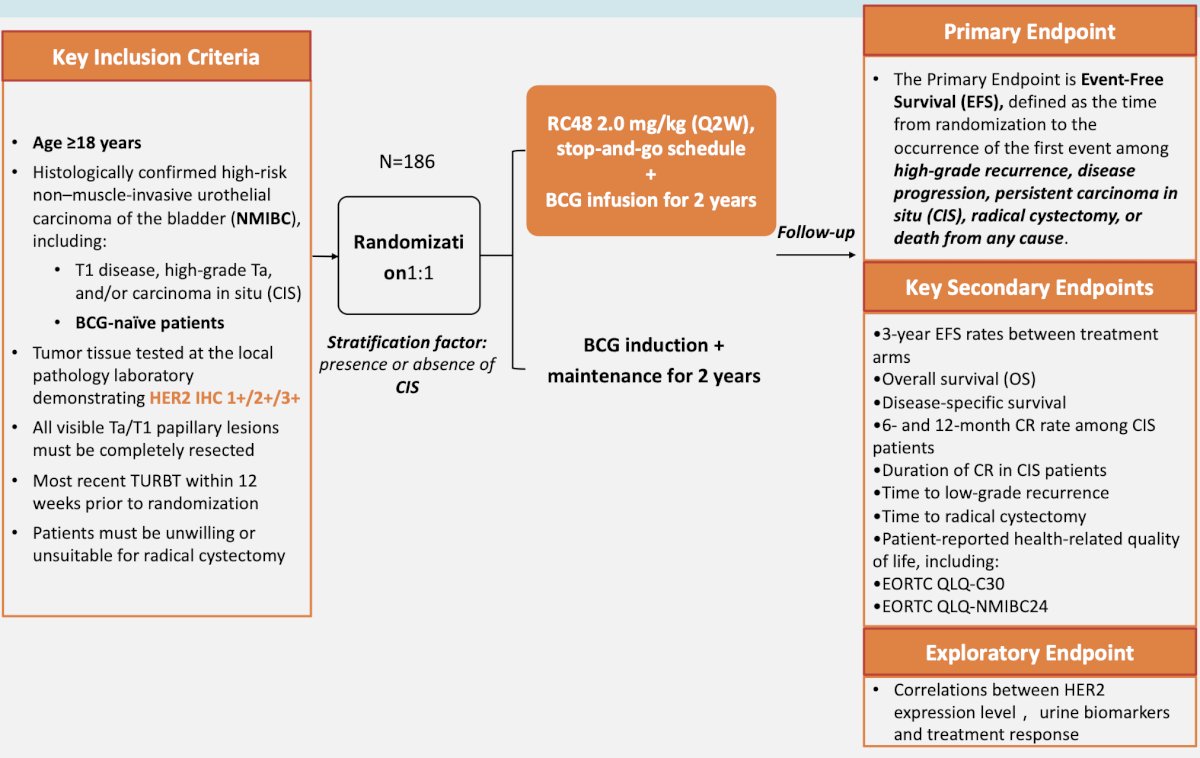
The treatment schedule and biomarker evaluation will be as follows:
The primary endpoint is investigator-assessed event free survival. Key secondary endpoints include recurrence free survival for low-grade disease, overall survival, disease specific survival, safety, and health-related quality of life. The study is powered at 80% to detect a 20% improvement in 3-year event free survival in the experimental arm. Patient screening and enrollment are currently underway across multiple clinical sites in China. By validating a biomarker driven approach, the HERO study has the potential to introduce the first precision medicine therapy for BCG-naïve high risk non muscle invasive bladder cancer. This trial is registered on ClinicalTrials.gov as NCT07207824.
Presented by: Yi-Jun Shen, MD, Fudan University Shanghai Cancer Center, Shanghai, China
Written by: Zachary Klaassen, MD, MSc – Urologic Oncologist, Associate Professor of Urology, Georgia Cancer Center, Wellstar MCG Health, @zklaassen_md on Twitter during the 2026 European Association of Urology (EAU) Annual Meeting, London, United Kingdom, Fri, Mar 13 – Mon, Mar 16, 2026.
References:
- Sheng X, Zeng G, Zhang C, et al. Disitamab Vedotin plus Toripalimab in HER2-Expressing Advanced Urothelial Cancer. N Engl J Med. 2025 Dec 11;393(23):2324-2337.