

(UroToday.com) The European Association of Urology (EAU) 2026 Annual Congress was host to a high-risk and locally advanced prostate cancer session on neoadjuvant strategies and radical prostatectomy outcomes. Dr. David Hennes presented follow-up outcomes and safety data from LuTectomy, a phase 1/2 trial of [¹⁷⁷Lu]Lu-PSMA-617 prior to prostatectomy in patients with high-risk, localized prostate cancer.
Dr. Hennes noted that patients with high-risk, localized prostate cancer remain at significant risk of biochemical recurrence despite treatment with curative-intent local therapy. PSMA-targeted radioligand therapy with [¹⁷⁷Lu]Lu-PSMA-617 has demonstrated meaningful clinical activity in the metastatic castration-resistant prostate cancer (mCRPC) setting.1,2,3 However, its role earlier in the disease course, particularly as neoadjuvant therapy before radical prostatectomy, remains uncertain.
The LuTectomy trial was designed to explore whether PSMA-targeted radioligand therapy administered prior to surgery could be safely delivered and potentially improve oncologic outcomes in men with high-risk localized disease.4 The present analysis reports longer-term safety and biochemical recurrence outcomes based on the prespecified objectives of the trial.
LuTectomy is a single-arm, phase I/II clinical trial enrolling men with high-risk prostate cancer defined by at least one of the following criteria:
- PSA >20 ng/mL
- ISUP grade group ≥3
- Clinical stage ≥cT2c
All patients were required to demonstrate high tumour uptake on [⁶⁸Ga]Ga-PSMA-11 PET/CT imaging prior to treatment.
Participants were treated in two cohorts prior to robotic radical prostatectomy:
- Cohort A (n = 10): one cycle of [¹⁷⁷Lu]Lu-PSMA-617 (5 GBq)
- Cohort B (n = 10): two cycles of [¹⁷⁷Lu]Lu-PSMA-617 (5 GBq per cycle)
- Radioligand therapy was administered approximately six weeks prior to surgery in both cohorts
The study had two primary endpoints:
- Safety: Treatment-related adverse events (TRAEs) were assessed and graded according to CTCAE version 5.0.
- Efficacy: Time to biochemical recurrence following prostatectomy, defined as the first PSA value ≥0.2 ng/mL after surgery, was analyzed using Kaplan–Meier methodology.
Between May 2020 and April 2022, a total of 20 patients were enrolled. Baseline disease characteristics reflected a high-risk population:
- Median PSA: 18 ng/mL (interquartile range 11–35)
- ISUP grade group ≥3 in 18 patients (90%)
With longer follow-up, the median duration of follow-up reached 45.6 months (95% CI 36.0–not reached).
Overall, 10/20 patients (50%) experienced biochemical recurrence following radical prostatectomy. The median biochemical recurrence-free survival: 32.1 months (95% CI 19.4–not reached)
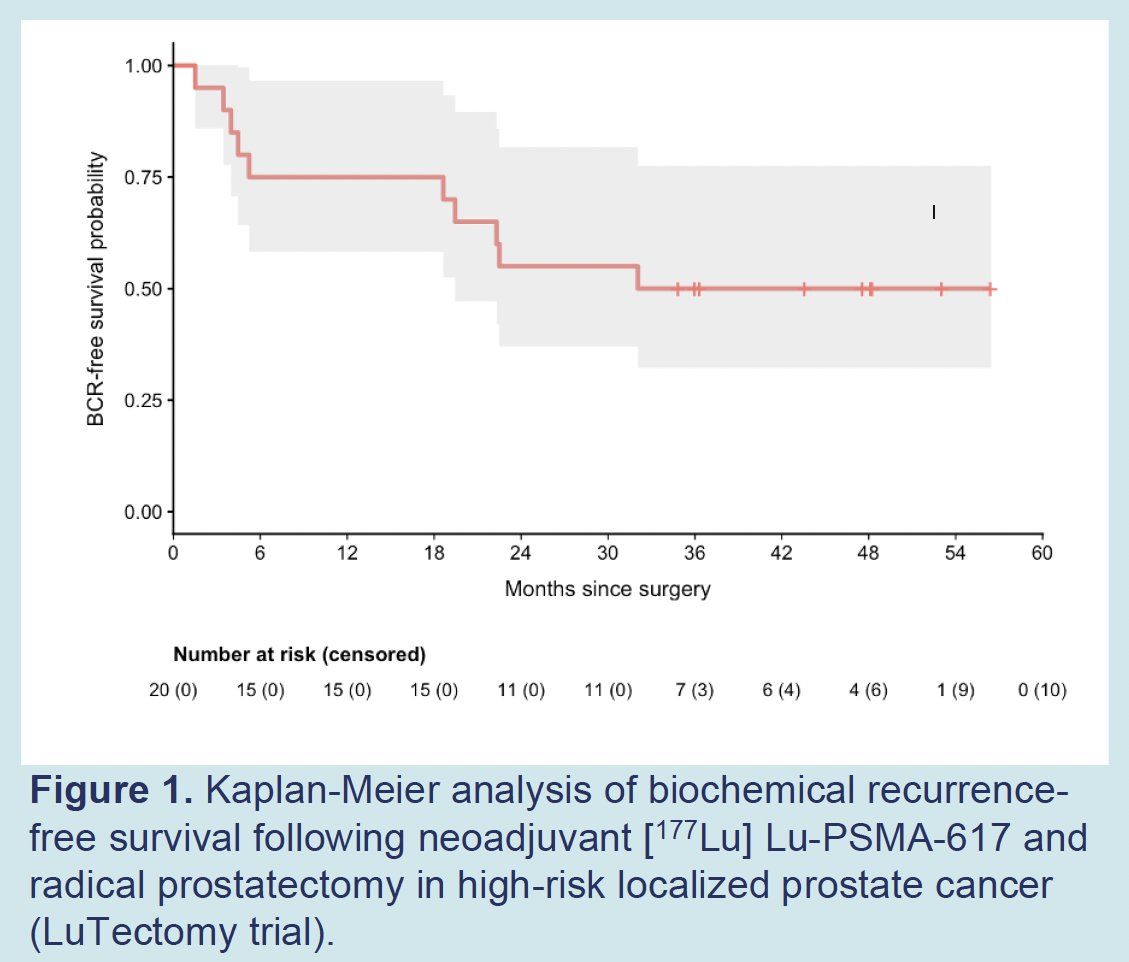
Among the 10 patients who developed biochemical recurrence:
- Seven patients (70%) underwent salvage radiotherapy
- Two of these patients subsequently progressed to mCRPC and initiated enzalutamide therapy
- Three patients (30%) declined salvage radiotherapy:
- One patient was managed with intermittent androgen deprivation therapy
- Two patients continued with conservative management strategies
From a safety standpoint, treatment was well-tolerated.
- One possibly treatment-related grade 2 adverse event (chronic kidney disease) was reported in a patient with pre-existing hypertension and diabetes.
- No grade 3–4 treatment-related adverse events occurred.
- No treatment-related deaths were observed.
Importantly, the absence of severe toxicity supports the feasibility of administering PSMA-targeted radioligand therapy prior to radical prostatectomy in this high-risk patient population.
Dr. Hennes concluded his presentation of the LuTectomy trial as follows:
- Longer term follow-up supports the safety of [177Lu]Lu-PSMA-617 prior to robotic radical prostatectomy
- Further research in randomised trials is needed to determine if this improves cure rates or time to BCR in this high-risk population.
Presented by: David Hennes, MD, BSc, DipSurgAnat, Peter MacCallum Cancer Centre, Division of Cancer Surgery, Melbourne, Australia
Written by: Rashid K. Sayyid, MD, MSc, Assistant Professor, Urologic Oncologist, Department of Urology at The University of Arizona and Banner University Medical Center, Tucson, AZ – @rksayyid on X during the 2026 European Association of Urology (EAU) Annual Meeting, London, United Kingdom, Fri, Mar 13 – Mon, Mar 16, 2026.