

(UroToday.com) The European Association of Urology (EAU) 2026 Annual Congress was host to a session on hormone-sensitive prostate cancer. Dr. Amit Bahl presented results from the RECOmmEnD study evaluating the potential for drug–drug interactions between novel androgen receptor pathway inhibitors (ARPIs) and concomitant medications in patients with metastatic hormone-sensitive prostate cancer (mHSPC) treated in routine clinical practice.
Dr. Bahl noted that prostate cancer remains the most common male cancer, and approximately one-third of patients present with de novo mHSPC. Over the past decade, treatment intensification with androgen receptor pathway inhibitors (ARPIs) added to androgen deprivation therapy (ADT) has significantly improved overall survival in this disease state.1-3
In contemporary clinical practice, several ARPIs are available for use in mHSPC, including apalutamide, enzalutamide, and darolutamide. While treatment selection is influenced by multiple clinical factors, a critical consideration is the potential for drug–drug interactions with concomitant medications that patients may already be receiving.
The RECOmmEnD study is a UK prospective real-world evaluation designed to assess clinical outcomes among patients with mHSPC treated with darolutamide in combination with docetaxel chemotherapy and ADT (i.e., triplet therapy). Given that patients with advanced prostate cancer frequently receive multiple medications for comorbid conditions, the investigators sought to evaluate the potential for drug-drug interactions among the three ARPIs when assessed against the concomitant medications recorded at baseline in the RECOmmEnD study.
A total of 315 patients were enrolled from 21 UK centers over a 20-month period beginning in November 2022. For each patient, concomitant medications at study entry were documented, and disease characteristics were collected. The potential drug–drug interactions between these concomitant medications and each ARPI (apalutamide, enzalutamide, and darolutamide) were evaluated using Stockley’s Drug Interactions Checker. The analysis focused on identifying potential interactions, assessing whether concomitant medication use should be avoided, determining whether dose modifications might be required, and evaluating the potential for increased risk of adverse events.
Among the 315 enrolled patients, 75 patients (23.8%) were not taking any concomitant medications at baseline. Overall, 842 concomitant medications were recorded across the cohort, corresponding to a median of three concomitant medications per patient.
The analysis of potential drug–drug interactions revealed meaningful differences between the ARPIs, with the lowest frequency observed with darolutamide:
- Apalutamide was associated with potential interactions in 38.6% of concomitant medications (325 interactions)
- Enzalutamide demonstrated a similar interaction rate at 37.8% (318 interactions)
- Darolutamide demonstrated a substantially lower interaction rate of 18.4% (155 interactions)
The risk of increased adverse events due to concomitant medication interactions was also low overall but remained numerically higher with apalutamide and enzalutamide:
- Apalutamide: 0.6%
- Enzalutamide: 0.7%
- Darolutamide: 0.1%
Advisories recommending avoidance of concurrent medication use were relatively uncommon but were similarly observed more frequently with apalutamide and enzalutamide:
- Apalutamide: 2.5%
- Enzalutamide: 1.9%
- Darolutamide: 0.1%
Recommendations to alter the dosing of concomitant medications were similarly most frequent with apalutamide (32.6%; 275 cases) and enzalutamide (22.1%; 186 cases), whereas these advisories were substantially less common with darolutamide (11.2%; 94 cases).
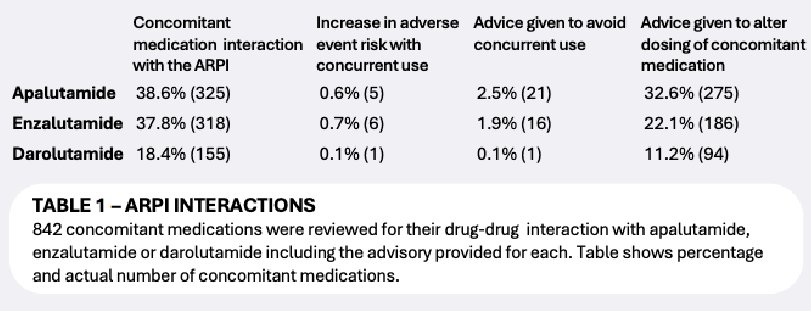
Taken together, these findings demonstrate that darolutamide exhibited the lowest overall rate of potential drug–drug interactions among the ARPIs evaluated in this real-world cohort.
Dr. Bahl concluded as follows:
- Darolutamide had the lowest potential for drug-drug interactions of the three ARPIs investigated.
- The median number of concomitant medications reported were lower than have been reported for other studies. This could reflect fitter patients with fewer co-morbidities being selected for triplet therapy or reporting limitations of RWE studies.
- However, there were still a significant number of drug-drug interactions that would require management and have implications for optimal ARPI selection, patient monitoring, and resource utilization.
Presented by: Amit Bahl, MBBS, FRCR, Consultant Clinical Oncologist, Department of Clinical Oncology, University Hospitals Bristol and Weston NHS Foundation Trust, Bristol, United Kingdom=
Written by: Rashid K. Sayyid, MD, MSc, Assistant Professor, Urologic Oncologist, Department of Urology at The University of Arizona and Banner University Medical Center, Tucson, AZ – @rksayyid on X during the 2026 European Association of Urology (EAU) Annual Meeting, London, United Kingdom, Fri, Mar 13 – Mon, Mar 16, 2026.
References:
- Smith MR, Saad F, Chowdhury S, et al. Apalutamide treatment and metastasis-free survival in prostate cancer. N Engl J Med. 2018;378(15):1408-1418.
- Armstrong AJ, Szmulewitz RZ, Petrylak DP, et al. ARCHES: A randomized phase III study of enzalutamide plus androgen deprivation therapy for metastatic hormone-sensitive prostate cancer. J Clin Oncol. 2019;37(32):2974-2986.
- Fizazi K, Shore N, Tammela TL, et al. Darolutamide in combination with androgen deprivation therapy and docetaxel for metastatic hormone-sensitive prostate cancer: ARASENS trial. N Engl J Med. 2022;386(12):1132-1142.