

(UroToday.com) The 2026 European Association of Urology (EAU) annual meeting featured a urology trials in bladder and prostate cancer session and a presentation by Dr. Søren Klingenberg discussing COBRA, a study assessing chemoablation or bladder resection with adjuvant chemotherapy in recurrent non-muscle invasive bladder cancer.
TURBT is standard for non-muscle invasive bladder cancer, but residual disease occurs in up to 55% of cases. Consequently, adjuvant intravesical therapy with mitomycin C or BCG is recommended. Chemoablation may provide a less invasive alternative with the potential to diminish recurrence and repeated TURBTs. The objective of this trial is to compare dose-dense mitomycin C chemoablation (with adjuvant BCG for non-responders) to standard TURBT or office-based procedures followed by adjuvant instillation therapy in patients with recurrent Ta low-grade non-muscle invasive bladder cancer. The investigators hypothesize that mitomycin C chemoablation will result in durable responses in complete responders, enable early selection of BCG candidates among non-responders, and reduce the overall number of procedures compared to standard care. If effective, chemoablation combined with selective BCG could represent a paradigm shift in managing recurrent Ta low-grade non-muscle invasive bladder cancer by improving long-term outcomes while reducing surgical interventions.
This is an international, multicenter randomized controlled trial across nine Nordic sites in Denmark, Norway, Sweden, and Iceland. Patient inclusion was initiated in June 2025 with a target enrollment of 272 patients with recurrent Ta low-grade non-muscle invasive bladder cancer and no prior intravesical therapy. Eligible participants are randomized 1:1:
- Control arm: TURBT or office procedure (biopsy and fulguration or laser ablation) followed by adjuvant instillation therapy with Mitomycin C or BCG according to histology.
- Intervention arm: Dose-dense mitomycin C chemoablation (3 instillations per week for 2 weeks), followed by either continued adjuvant mitomycin C or tumor removal and BCG according to response
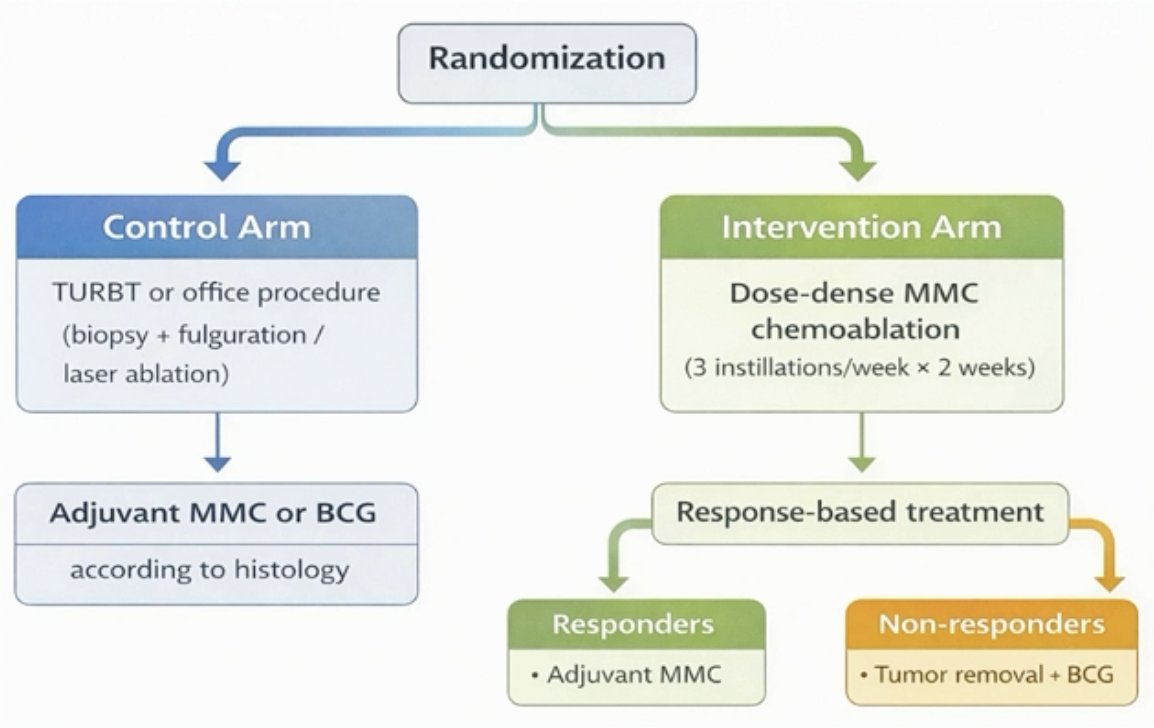
As of March 2026, 38 patients have been enrolled at Aarhus University Hospital, with 4 enrolled at other sites. The primary endpoint is 2-year recurrence-free survival, and secondary endpoints include 5-year recurrence-free survival, progression-free survival, overall survival, and the number of TURBTs and office procedures during follow-up. Recurrence rates during follow-up, as well as subgroup differences based on initial chemoablation response, will be assessed using chi-squared tests. Between-group variations in procedure rates will likewise be evaluated with the chi-squared test. Recurrence-free survival will be analyzed with Kaplan-Meier survival curves and compared by the log-rank test. Cox proportional hazards regression will be applied to estimate hazard ratios with 95% confidence intervals. Patients will be censored at death, disease progression, or the end of follow-up. The trial is registered at ClinicalTrials.gov (NCT06781879) and the EU Clinical Trials Register (EudraCT 2022-502221-18-00).
Presented by: Søren Klingenberg, Aarhus University Hospital, Aarhus, Denmark
Written by: Zachary Klaassen, MD, MSc – Urologic Oncologist, Associate Professor of Urology, Georgia Cancer Center, Wellstar MCG Health, @zklaassen_md on Twitter during the 2026 European Association of Urology (EAU) Annual Meeting, London, United Kingdom, Fri, Mar 13 – Mon, Mar 16, 2026.
Related Content:
EAU 2026: Case-Based Panel Discussion High-Risk NMIBC Post-BCG Failure: Spare the Bladder? Bladder Sparing: Trial Overview, Other Intravesical Options