

(UroToday.com) The European Association of Urology (EAU) 2026 Annual Congress was host to a session on risk stratification for non-muscle invasive bladder cancer (NMIBC). Dr. Jayant Siva presented results from a large validation study evaluating the International Bladder Cancer Group (IBCG) clinical risk model for patients with intermediate-risk (IR) NMIBC.
IR NMIBC represents a highly heterogeneous disease group with significant variability in recurrence and progression outcomes. This heterogeneity has contributed to a wide variation in guideline recommendations regarding the use of adjuvant intravesical therapy following transurethral resection of the bladder tumor (TURBT). To address this variability, the IBCG previously proposed a simplified clinical model incorporating five readily identifiable risk factors:
- Multifocality
- Tumor size greater than 3 cm
- Early recurrence
- Frequent recurrence
- Prior failure of intravesical therapy
This model was designed to improve the clinical risk stratification within the IR NMIBC population. In this study, the investigators sought to independently validate this scoring and stratification framework.
The authors performed a large single-institution retrospective analysis that included patients diagnosed with IR NMIBC between 1988 and 2025 who underwent TURBT followed by adjuvant intravesical chemotherapy. Based on the number of IBCG-defined clinical risk factors present, patients were stratified into three categories:
- IR-low: 0 risk factors
- IR-intermediate: 1–2 risk factors
- IR-high: ≥3 risk factors
The primary outcomes of interest were 3-year recurrence-free survival and progression-free survival. Cox proportional hazards models were applied to evaluate differences in oncologic outcomes across the defined risk strata.
A total of 2,980 patients with IR NMIBC were included in the analysis. The median age was 76 years, and 74% of patients were male. Based on the IBCG stratification criteria, 1,197 patients (40%) were classified as IR-low, 1,635 patients (55%) as IR-intermediate, and 148 patients (5%) as IR-high.
At 3 years, recurrence rates demonstrated a clear stepwise increase across the risk groups:
- IR-low: 16%
- IR-intermediate: 48%
- IR-high: 95%
A similar pattern was observed for disease progression, with 3-year progression rates as follows:
- IR-low: 3%
- IR-intermediate: 9%
- IR-high: 30%
Cox proportional hazards modeling confirmed a significant increase in risk across strata. Compared with IR-low patients, those in the IR-intermediate group had significantly higher risks of both recurrence (HR 4.07) and progression (HR 3.45). Patients classified as IR-high had markedly elevated risks, with hazard ratios of 17.21 for recurrence and 13.60 for progression (all p<0.001).
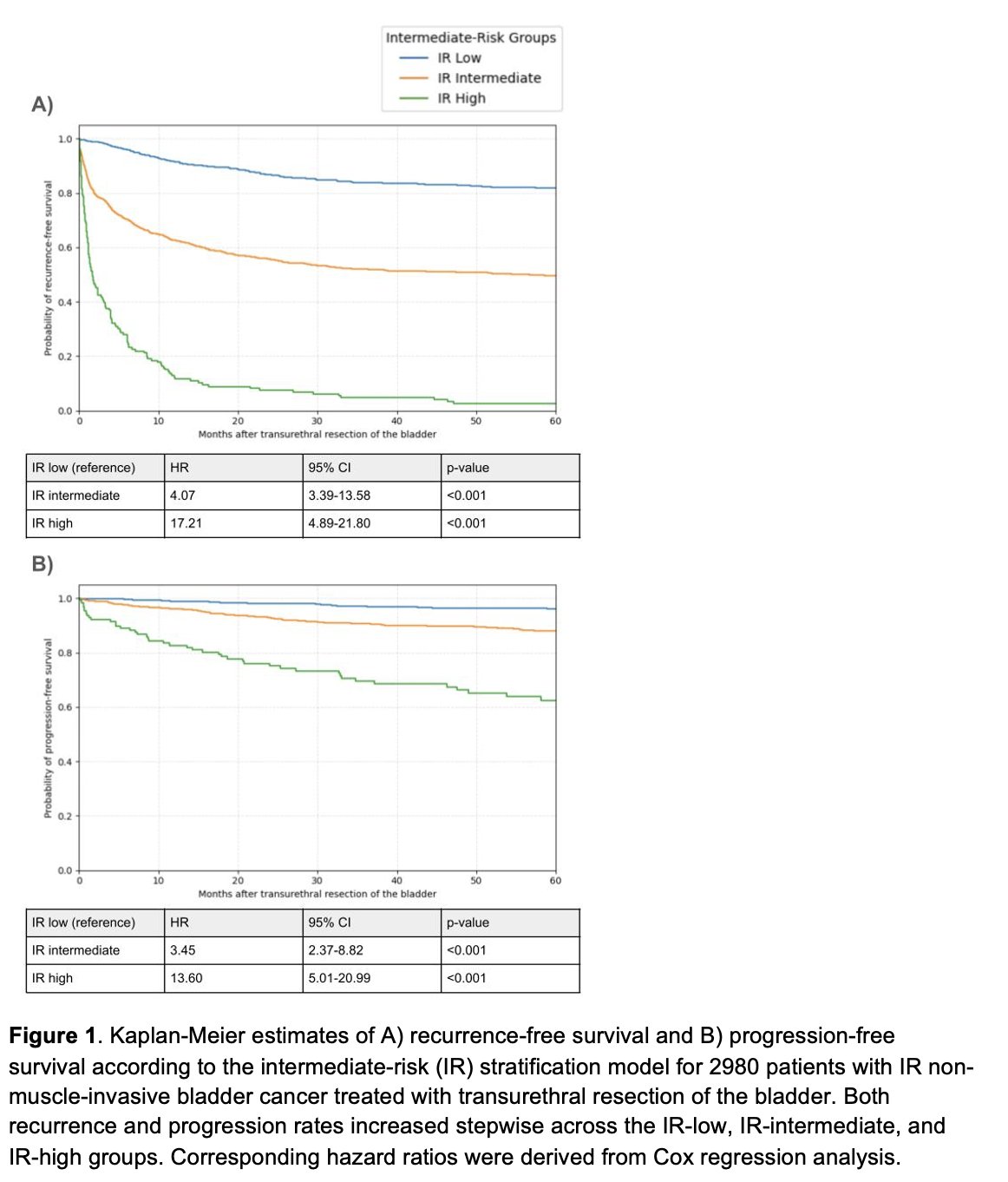
Taken together, these findings represent the largest clinical validation to date of the IBCG stratification model for IR NMIBC. The results demonstrate that patients within this traditionally heterogeneous group can be reliably categorized into three distinct prognostic subgroups with substantially different risks of recurrence and progression. These data provide strong support for integrating the IBCG risk model into routine clinical decision-making and future guideline development for intermediate-risk NMIBC.
Presented by: Jayant Siva, MD, Research Fellow, Department of Urology, Cleveland Clinic, Cleveland, OH, USA
Written by: Rashid K. Sayyid, MD, MSc, Assistant Professor, Urologic Oncologist, Department of Urology at The University of Arizona and Banner University Medical Center, Tucson, AZ – @rksayyid on X during the EAU 2026 Annual Congress, London, UK, March 13th–16th, 2026