

(UroToday.com) The 2026 European Association of Urology (EAU) annual meeting featured a high-risk non-muscle invasive bladder cancer session and a presentation by Dr. Girish Kulkarni discussing the interim analysis of light-activated TLD-1433 in a phase II clinical study of BCG-unresponsive non-muscle invasive bladder cancer CIS.
Bladder sparing therapies are required for BCG-unresponsive, non-muscle invasive bladder cancer. At EAU 2026, Dr. Kulkarni and colleagues reported on the interim results of a phase II clinical study of a light-activated small molecule, Ruvidar®, in patients with BCG-unresponsive non-muscle invasive bladder cancer CIS (+/- papillary disease).
Patients with BCG-unresponsive non-muscle invasive bladder cancer were accrued at 11 centers in Canada and the United States. Therapy consisted of an intravesical instillation of Ruvidar® (0.70 mg/cm2) followed by intravesical light activation with a 520 nm laser (90 J/cm2) under anesthesia. The primary endpoint was complete response at any point in time, and the secondary endpoint was duration of complete response, after the initial complete response. The tertiary endpoint was safety, and all adverse events were tracked for resolution. Patients with a negative cystoscopy and positive cytology, without a confirmatory negative biopsy, were defined as an indeterminate response. All complete response or indeterminate response analyses, for who the sponsor has received pathology samples have been validated by central pathology.
A total of 87/90 patients have been enrolled and treated in the study (Day 0). Of these patients, 82% were ≥ 65 years of age, 82% male, and 83% white. Tumor stage was distributed as follows: pure 81% CIS, 13% CIS + T1, and 6% CIS + Ta. There were 94% of patients classified as BCG-unresponsive and 6% as BCG-intolerant. The median number of BCG instillations was 15.5. The median duration of response was 14.2 months (95% CI 11.1, 17.3), and extended follow-up demonstrated a duration of complete response of 22.2% (10/45) at 2 years and 20.0% (9/45) at 3 years. The primary endpoint of complete response at any time was 64.3% (95% CI 47.1, 81.4):
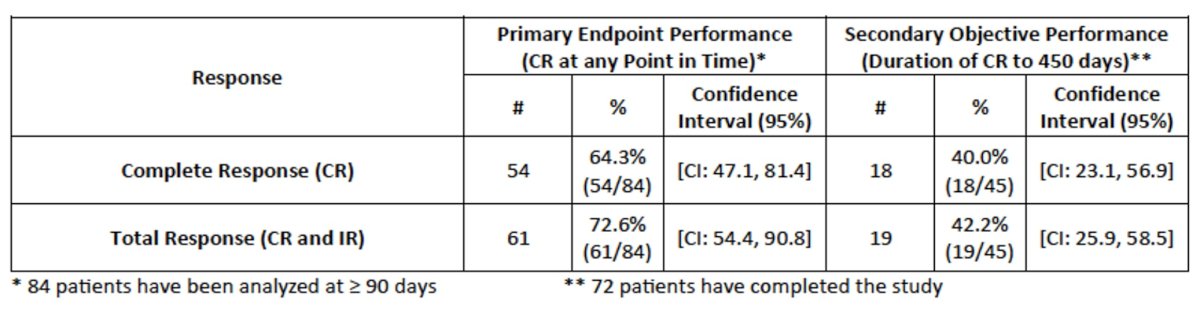
On Kaplan-Meier analysis, if a complete response is obtained, the long-term estimated probability of remaining cancer-free at 1, 2, and 3 years was 48.7%, 35.9%, and 25.2%, respectively. There were 21 serious adverse events identified: one grade 1, three grade 2, 12 grade 3, three grade 4 (all resolved between 1 and 82 days), and one grade 5. All were deemed unrelated/unlikely to be related to the study drug or study device light activation system.
Dr. Kulkarni concluded this presentation discussing the interim analysis of light-activated TLD-1433 in a phase II clinical study of BCG-unresponsive non-muscle invasive bladder cancer CIS by emphasizing that light-activated Ruvidar® is a viable treatment option for patients with BCG-unresponsive non-muscle invasive bladder cancer CIS (+/- papillary disease) with an acceptable safety profile.
Presented by: Girish Kulkarni, MD, PhD, FRCSC, Urologic Surgeon, Assistant Professor, Department of Surgery, Princess Margaret Cancer Centre, University Health Network, University of Toronto, Toronto, Canada
Written by: Zachary Klaassen, MD, MSc – Urologic Oncologist, Associate Professor of Urology, Georgia Cancer Center, Wellstar MCG Health, @zklaassen_md on Twitter during the 2026 European Association of Urology (EAU) Annual Meeting, London, United Kingdom, Fri, Mar 13 – Mon, Mar 16, 2026.