

(UroToday.com) The 2025 European Association of Urology (EAU) Annual Meeting held in Madrid, Spain was host to the clinically relevant questions in the management of advanced, hormone-sensitive prostate cancer: Thematic session. Dr. Gunhild von Amsberg discussed why local treatment is useless and toxic for high-volume de novo metastatic hormone-sensitive prostate cancer.
Dr. von Amsberg highlighted that metastatic hormone-sensitive prostate cancer (mHSPC) is a highly heterogeneous disease, with de novo high-volume cases carrying the poorest prognosis. Metastasis-to-metastasis spread is common, occurring either through monoclonal seeding of daughter metastases or the transfer of multiple tumor clones between metastatic sites. Patients with de novo high-volume disease have a higher frequency of TP53, BRCA2, and RB1 alterations, which are linked to more aggressive progression. This suggests that the primary tumor is not the main driver of disease progression in these patients.

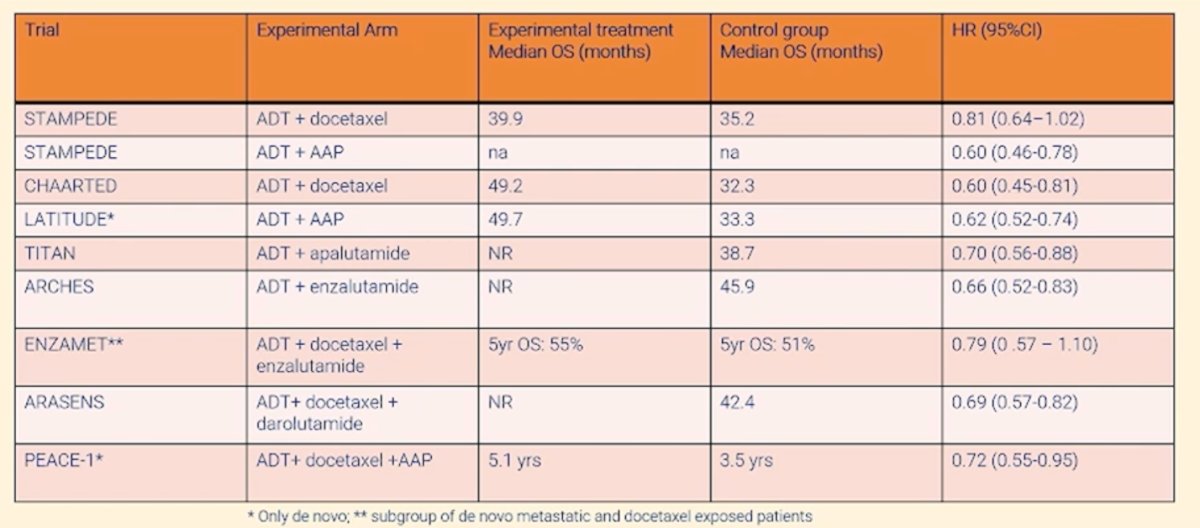
Systemic treatments such as docetaxel or the combination of an ARPI with docetaxel plus ADT have been shown to significantly improve survival in this population as shown below.
We still lack sufficient data to confirm the effectiveness of radiotherapy in high-volume metastatic hormone-sensitive prostate cancer. In the HORRAD (2) and STAMPEDE (3) trials, radiotherapy to the primary tumor did not improve overall survival in high-volume patients.
Moreover, systemic therapy with ADT alone or ADT plus docetaxel is no longer the current standard of care. In STAMPEDE, only 18% of patients received docetaxel, and neither HORRAD nor STAMPEDE included androgen receptor signaling inhibitors.2,3
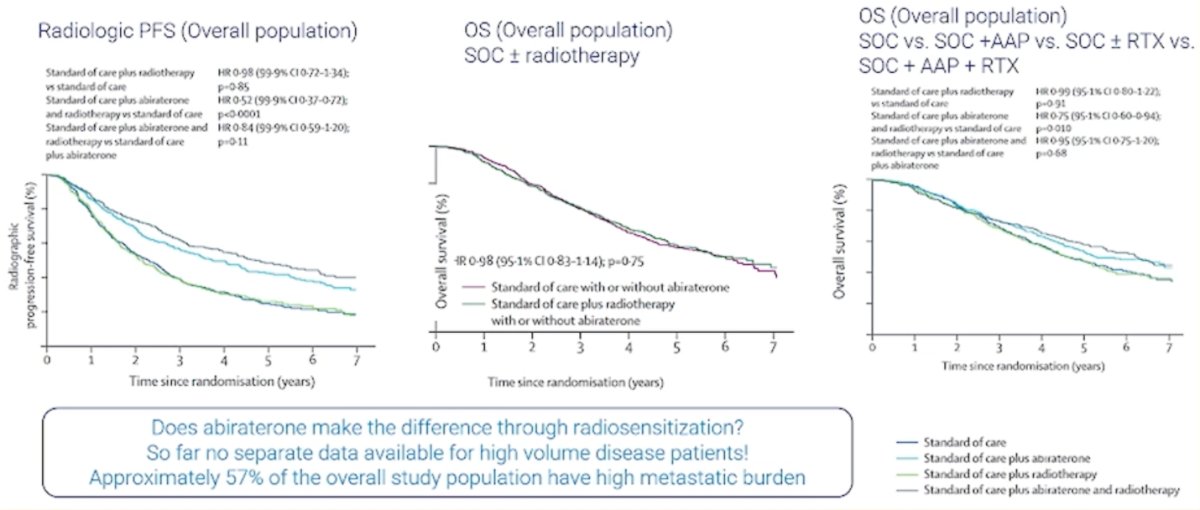
Looking at the PEACE-1 trial, there has been no overall survival benefit observed in either the low-volume or the overall population so far. The only improvement was in radiographic progression-free survival (rPFS), and only when abiraterone was given concurrently.1 This raises the question of whether abiraterone enhances the effects of radiotherapy through radiosensitization.
Currently, no separate data is available for high-volume patients in PEACE-1. While approximately 57% of the study population had a high metastatic burden, any conclusions about this subgroup remain speculative.
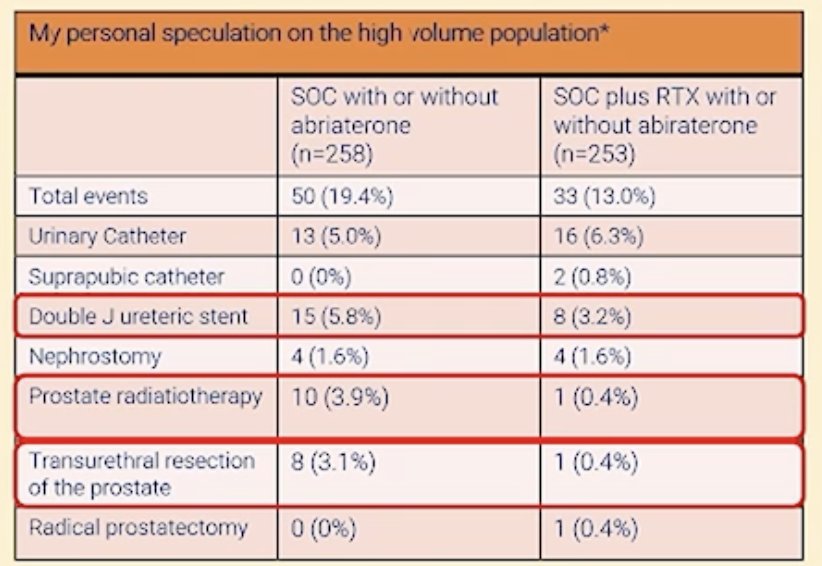
Dr. von Amsberg raised the question of whether adding radiotherapy does more harm than good. Since there is no specific data for the high-volume population Dr. von Amsberg presented her own personal speculation on the high-volume population. Assuming all evaluable non-low-volume patients are high-volume, 17.2% experienced a serious GU event—13% with radiotherapy and 19.4% without, resulting in a 6.4% difference.
Additionally, 2.6% more patients required double J stents, 3.5% more underwent prostate irradiation and 2.7% more needed TURPs. This raises the question of whether prostate radiotherapy is justified in high-volume mHSPC patients, considering its potential toxicities, quality-of-life impact, and healthcare costs. Dr. von Amsberg emphasized that these calculations are her personal estimates and should be interpreted with caution.
We need to consider the toxicity associated with prostate radiotherapy. A recently published individual patient data meta-analysis of six randomized trials found that acute toxicity following prostate radiotherapy was significantly associated with late toxicity and declines in patient-reported quality of life.4
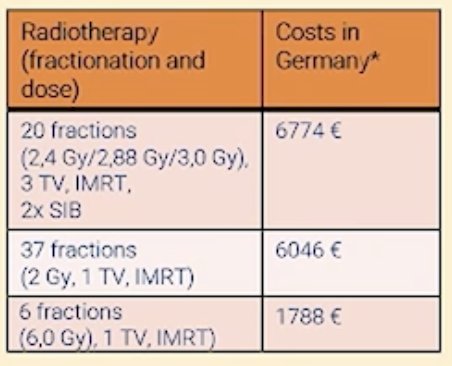
Additionally, radiotherapy comes with costs. In Germany, depending on the fractionation and dose, expenses range between 2,000 and 6,000 euros per patient. At a population level, these numbers become substantial.
Presented by: Gunhild von Amsberg, MD, Urologic Oncologist at UCC-Hamburg, Associated Faculty der Martini-Klinik, Hamburg, Germany
Written by: Julian Chavarriaga, MD – Urologic Oncologist at Cancer Treatment and Research Center (CTIC) via Society of Urologic Oncology (SUO) Fellow at The University of Toronto. @chavarriagaj on Twitter during the European Association of Urology (EAU) 2025 Annual Meeting, Madrid, Spain, Fri, Mar 21 – Mon, Mar 24, 2025.
References:- Fizazi K, Foulon S, Carles J, Roubaud G, McDermott R, Fléchon A, Tombal B, Supiot S, Berthold D, Ronchin P, Kacso G, Gravis G, Calabro F, Berdah JF, Hasbini A, Silva M, Thiery-Vuillemin A, Latorzeff I, Mourey L, Laguerre B, Abadie-Lacourtoisie S, Martin E, El Kouri C, Escande A, Rosello A, Magne N, Schlurmann F, Priou F, Chand-Fouche ME, Freixa SV, Jamaluddin M, Rieger I, Bossi A; PEACE-1 investigators. Abiraterone plus prednisone added to androgen deprivation therapy and docetaxel in de novo metastatic castration-sensitive prostate cancer (PEACE-1): a multicentre, open-label, randomised, phase 3 study with a 2 × 2 factorial design. Lancet. 2022 Apr 30;399(10336):1695-1707. doi: 10.1016/S0140-6736(22)00367-1. Epub 2022 Apr 8. PMID: 35405085.
- Boevé LMS, Hulshof MCCM, Verhagen PCMS, Twisk JWR, Witjes WPJ, de Vries P, Jeroen A van Moorselaar R, Vis AN, van Andel G. Prostate Cancer-related Events in Patients with Synchronous Metastatic Hormone-sensitive Prostate Cancer Treated with Androgen Deprivation Therapy with and Without Concurrent Radiation Therapy to the Prostate; Data from the HORRAD Trial. Eur Urol. 2025 Mar;87(3):357-363. doi: 10.1016/j.eururo.2024.08.035. Epub 2024 Sep 20. PMID: 39304427.
- Parker CC, James ND, Brawley CD, Clarke NW, Hoyle AP, Ali A, Ritchie AWS, Attard G, Chowdhury S, Cross W, Dearnaley DP, Gillessen S, Gilson C, Jones RJ, Langley RE, Malik ZI, Mason MD, Matheson D, Millman R, Russell JM, Thalmann GN, Amos CL, Alonzi R, Bahl A, Birtle A, Din O, Douis H, Eswar C, Gale J, Gannon MR, Jonnada S, Khaksar S, Lester JF, O'Sullivan JM, Parikh OA, Pedley ID, Pudney DM, Sheehan DJ, Srihari NN, Tran ATH, Parmar MKB, Sydes MR; Systemic Therapy for Advanced or Metastatic Prostate cancer: Evaluation of Drug Efficacy (STAMPEDE) investigators. Radiotherapy to the primary tumour for newly diagnosed, metastatic prostate cancer (STAMPEDE): a randomised controlled phase 3 trial. Lancet. 2018 Dec 1;392(10162):2353-2366. doi: 10.1016/S0140-6736(18)32486-3. Epub 2018 Oct 21. PMID: 30355464; PMCID: PMC6269599.
- Nikitas J, Jamshidian P, Tree AC, Hall E, Dearnaley D, Michalski JM, Lee WR, Nguyen PL, Sandler HM, Catton CN, Lukka HR, Incrocci L, Heemsbergen W, Pos FJ, Roy S, Malone S, Horwitz E, Wong JK, Arcangeli S, Sanguineti G, Romero T, Sun Y, Steinberg ML, Valle LF, Weidhaas JB, Spratt D, Telesca D, Kishan AU. The interplay between acute and late toxicity among patients receiving prostate radiotherapy: an individual patient data meta-analysis of six randomised trials. Lancet Oncol. 2025 Mar;26(3):378-386. doi: 10.1016/S1470-2045(24)00720-4. Epub 2025 Jan 30. PMID: 39894025.