

(UroToday.com) The 2025 European Association of Urology (EAU) Annual Congress held in Madrid, Spain was host to an abstract session on the latest advances in the diagnosis and follow-up of non-muscle invasive bladder cancer (NMIBC). Dr. Girish Kulkarni presented PROGRxN-BCa, an artificial intelligence (AI)-based model to predict progression risk in NMIBC and improve the sub-stratification of intermediate-risk disease NMIBC patients.
Accurate prediction of tumour progression is vital to inform patient counseling, intensify treatment when appropriate, and consider eligibility for clinical trials. However, there are numerous limitations with both clinical and AI tools available today. The aim of this study was to overcome these limitations by developing a robust internationally developed AI model to predict NMIBC progression.
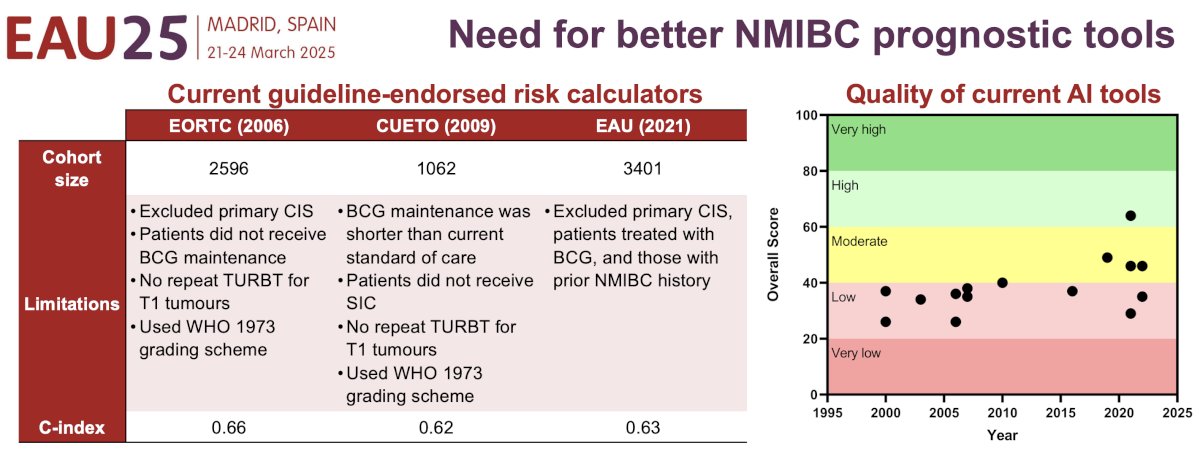
This is the largest NMIBC cohort to date (n=12,659). This model was developed using a training set of 3,324 patients treated at 4 academic or community hospitals between 2005 and 2022. It underwent external validation using a cohort of 9,335 patients treated at 30 North American and European institutions between 2005 and 2023.
PROGRxN-BCa was based on a random survival forest, and it was compared against the current guideline-endorsed EAU risk calculator for the outcome of time to progression to muscle-invasive or metastatic disease.
The study investigators found that:
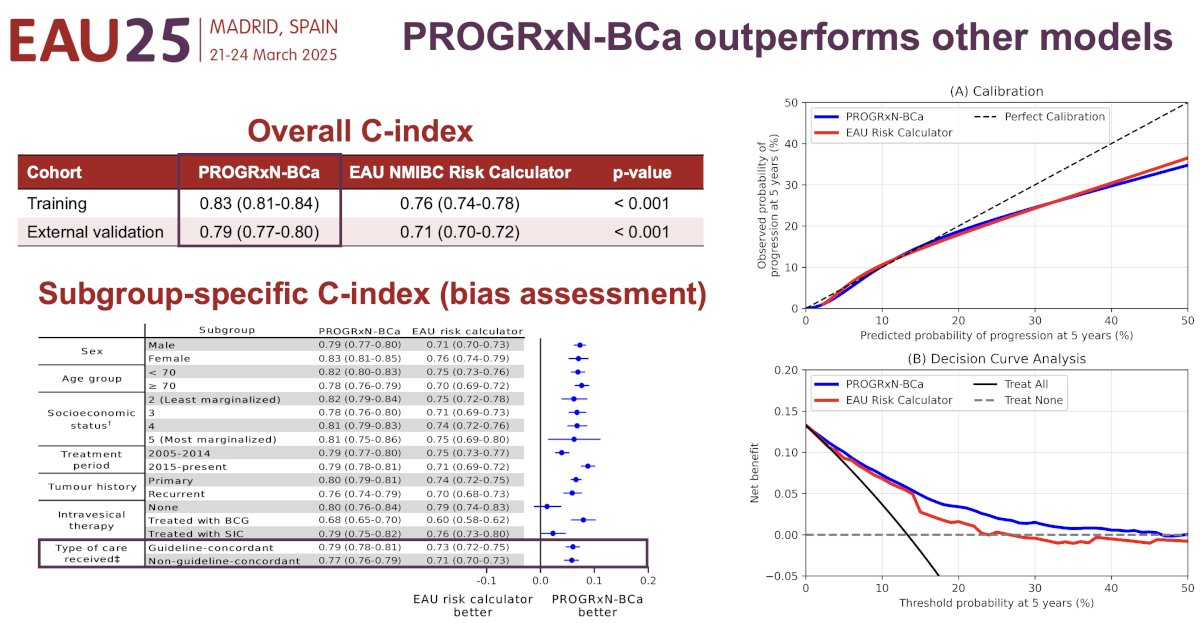
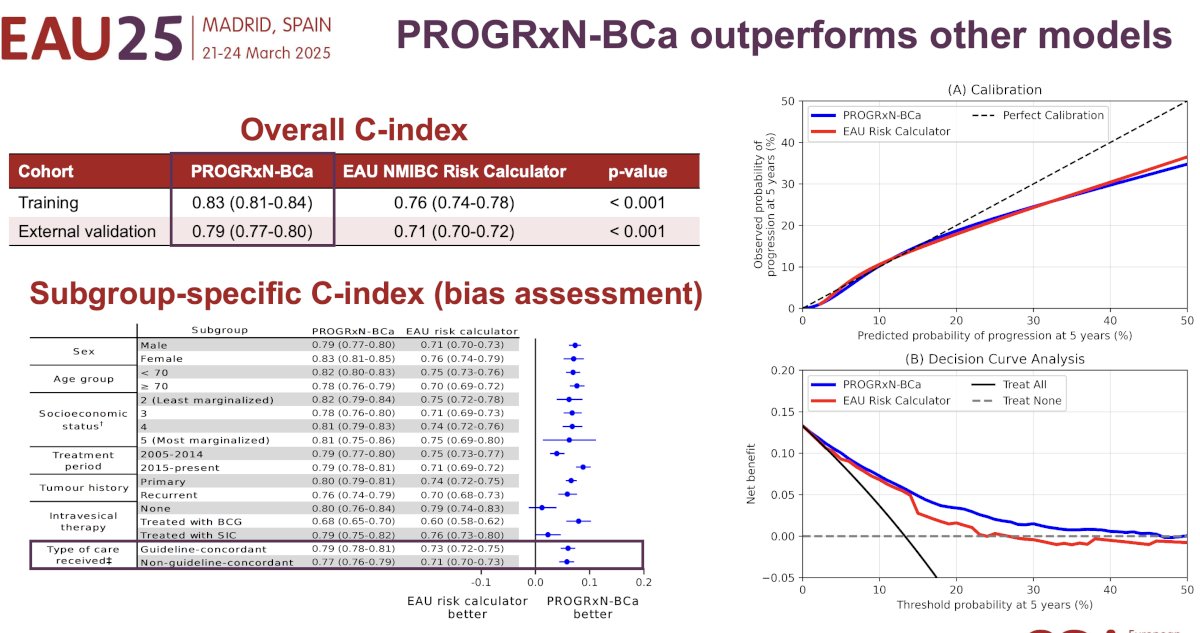
- PROGRxN-BCa AI model outperformed the other models based on overall c-index and across clinically relevant subgroups – generally around 10% better
- What’s notable is that this model was also consistently better irrespective of whether guideline-concordant care was followed (e.g. repeat TURBT, BCG for T1)
- This model (shown by the blue line) is also well-calibrated and has a higher net benefit on decision curve analysis.
The study investigators also looked at the sub-stratification of intermediate risk patients. Current guidelines recommend counting the number of intermediate risk factors, and as shown below on the left, it is challenging to distinguish patients with 0 risk factors from those with 1-2. However, with this AI model, patients can be separated into distinct risk tertiles as shown below on the right.
In conclusion, Dr. Kulkarni and colleagues demonstrated in the largest NMIBC cohort, to date, that this AI model outperforms currently available risk stratification tools and greatly improves the sub-stratification of the intermediate-risk group
Presented by: Girish Kulkarni, MD, PhD, Professor, Department of Surgery, Division of Urology, University of Toronto, Toronto, ON, Canada
Written by: Rashid K. Sayyid, MD, MSc – Robotic Urologic Oncology Fellow at The University of Southern California, @rksayyid on Twitter during the 2025 European Association of Urology (EAU) Annual Meeting held in Madrid, Spain between March 21st and 24th 2025