

(UroToday.com) The 2025 European Association of Urology (EAU) Annual Congress held in Madrid, Spain between March 21st and 24th 2025, was host to an abstract session on the latest advances in the diagnosis and follow-up of non-muscle invasive bladder cancer (NMIBC). Dr. Param Mariappan presented a study of Bladder Epicheck-triggered photodynamic diagnosis biopsies for the detection of high-grade recurrences missed by white light cystoscopy (WLC).
While WLC remains the ‘cornerstone’ of surveillance strategies in high-risk NMIBC (HR-NMIBC), it has moderate sensitivity (70%) and misses approximately 50% of carcinoma in situ (CIS) recurrences. In an attempt to overcome these limitations, PhotoDynamic Diagnosis (PDD)-guided biopsies have become increasingly utilized and have shown promise for detecting tumors that WLC may miss. In addition, Bladder EpiCheck, a urine-based marker, has demonstrated high sensitivity (91%) and specificity (84%) for high-grade (HG) tumors, and it provides a strong anticipatory positive signal. This study aimed to evaluate the performance of Bladder EpiCheck against WLC, using PDD-guided biopsy as the reference standard in the surveillance of HR-NMIBC.
As part of an NHS Quality Improvement initiative within the Effectiveness and Efficiency program, HR-NMIBC patients undergoing surveillance at a tertiary center were enrolled between July 2023 and August 2024. All patients underwent both WLC and Bladder EpiCheck testing. Urine samples for Bladder EpiCheck testing were collected prior to WLC and sent to a certified laboratory for analysis. The cystoscopists were blinded to the Bladder EpiCheck results. A positive WLC result triggered resection or biopsy under general anesthesia, while a negative WLC result with a positive Bladder EpiCheck test result prompted a PDD-guided biopsy under general anesthesia.
Of the 348 HR-NMIBC patients undergoing surveillance between July 2023 and August 2024, 328 were included in the final analysis. The results were as follows:
- 30 (9.1%) patients had pathologically proven recurrences:
- 24 (7.3%) had high-grade (HG) tumors, including 10 with CIS alone.
- 6 (1.8%) had low-grade (LG) tumors.
- 277 (84.5%) patients remained recurrence-free
- 21 (6.4%) patients are still indeterminate at presentation
Bladder EpiCheck detected 23 (96%) HG, 9 (90%) CIS, and 6 (100%) LG tumors. In comparison, WLC identified 16 (67%) HG, 4 (40%) CIS, and 4 (67%) LG tumors. WLC was equivocal in one (4%) case of HG recurrence. Among the 277 patients without evidence of disease recurrence, Bladder EpiCheck and WLC were negative in 263 (95%) and 270 (97.5%) cases, respectively.
The positive predictive value (PPV) for Bladder EpiCheck was 67.4%, with a negative predictive value (NPV) for both overall and HG disease of 99.6%. WLC demonstrated a PPV of 74%, an NPV of 96.3%, and an HG NPV of 98.5%.
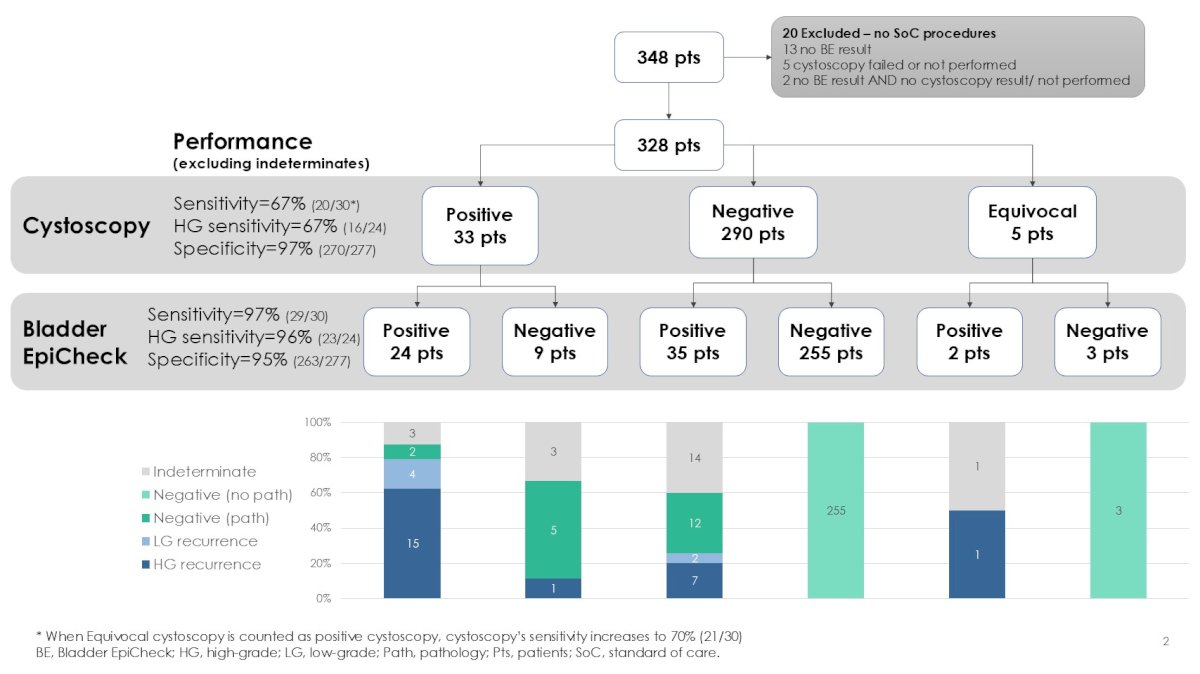
Dr. Mariapan concluded that Bladder EpiCheck demonstrated superior sensitivity over WLC with 44% more HG recurrences detected, without compromising specificity. PDD-guided biopsies of Bladder EpiCheck positive patients who are WLC negative, unveil the true performance of Bladder EpiCheck and WLC, particularly in CIS. Performing Bladder EpiCheck alone at surveillance visits, followed by PDD-guided biopsy in Bladder EpiCheck positives, could reduce 95% of unnecessary cystoscopies while detecting 96% of HG disease. This evidence suggests significant utility for surveillance programs by effectively and efficiently detecting HG recurrence earlier, particularly CIS, which could also translate into opportunities for bladder preservation.
Presented by: Param Mariappan, FRCS (Urol), PhD, Edinburgh Bladder Cancer Surgery (EBCS), The University of Edinburgh, Western General Hospital, Edinburgh, UK
Written by: Rashid K. Sayyid, MD, MSc – Robotic Urologic Oncology Fellow at The University of Southern California, @rksayyid on Twitter during the 2025 European Association of Urology (EAU) Annual Congress held in Madrid, Spain between March 21st and 24th, 2025