

(UroToday.com) The Bladder Cancer Advocacy Network (BCAN) Bladder Cancer Think Tank 2025 held in Washington, D.C., United States, between July 30th and August 1st. was host to the Session BCAN-Funded Investigator Speakers - Rapid Research Update 2025. Dr. Brendan Guercio elucidates the effects of nutrition on the microbiome and immunotherapy efficacy.
Dr. Guercio highlighted emerging evidence from multiple studies, including small, randomized trials, demonstrating that altering the gut microbiome through interventions like fecal microbiota transplant or probiotics can influence the efficacy of immune checkpoint blockade.1 Since the gut microbiome is directly shaped by what we eat, dietary patterns can have a profound effect on both its composition and function. He noted that the fermentation of dietary fiber by beneficial gut bacteria produces butyrate, a short-chain fatty acid with known immunomodulatory properties, suggesting a potential link between diet, microbiota, and immune responsiveness.2
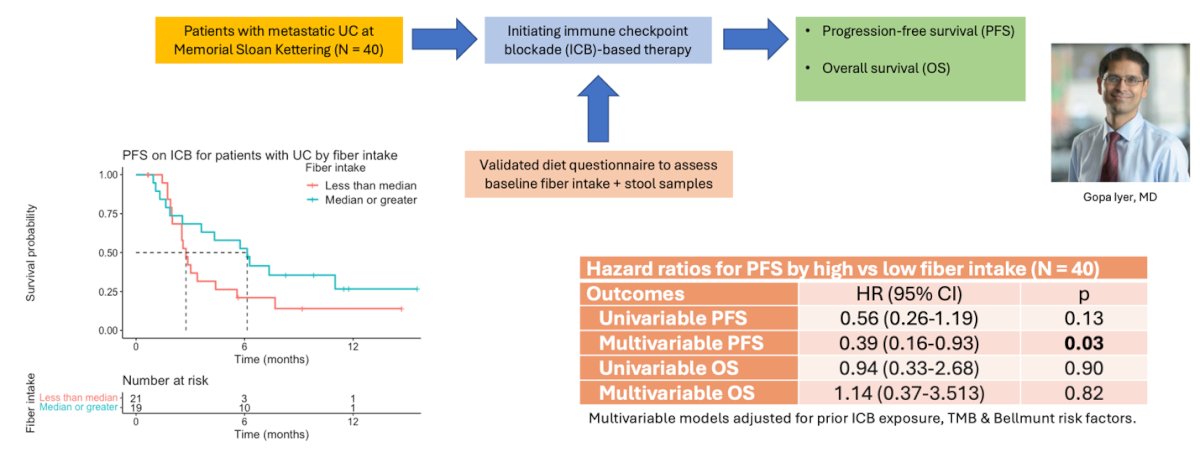
A cohort study funded by a 2021 BCAN Young Investigator Award, evaluating the impact of dietary fiber intake on outcomes in patients with metastatic urothelial carcinoma treated with immune checkpoint blockade. Conducted at Memorial Sloan Kettering and led by Dr Guercio. The study included 40 patients who completed a validated dietary questionnaire and provided stool samples prior to initiating ICB-based therapy. Patients were stratified by fiber intake into two groups: those with intake below the median and those with intake at or above the median.3
Progression-free survival was longer among patients with higher fiber intake, as shown in the Kaplan-Meier curve. Multivariable analysis, adjusted for prior ICB exposure, tumor mutational burden, and Bellmunt risk factors, showed that higher fiber intake was associated with improved progression-free survival (HR 0.39, 95% CI 0.16–0.93, p = 0.03). No significant difference was observed in overall survival. These findings suggest a potential relationship between diet and immunotherapy response in advanced urothelial cancer.
The next phase of this research, supported by a BCAN Career Development Award (CDA), aims to explore the role of diet and the microbiome in patients receiving enfortumab vedotin and pembrolizumab for metastatic urothelial cancer. This prospective study will enroll 146 patients initiating combination therapy. Participants will complete a dietary questionnaire to evaluate intake of fiber and other nutrients and provide stool samples for microbiome and metabolomic profiling. Patients will be followed for progression-free survival, overall survival, objective response, and immune-related adverse events, with the goal of identifying nutritional and microbial correlates of treatment outcomes. The study design is illustrated below.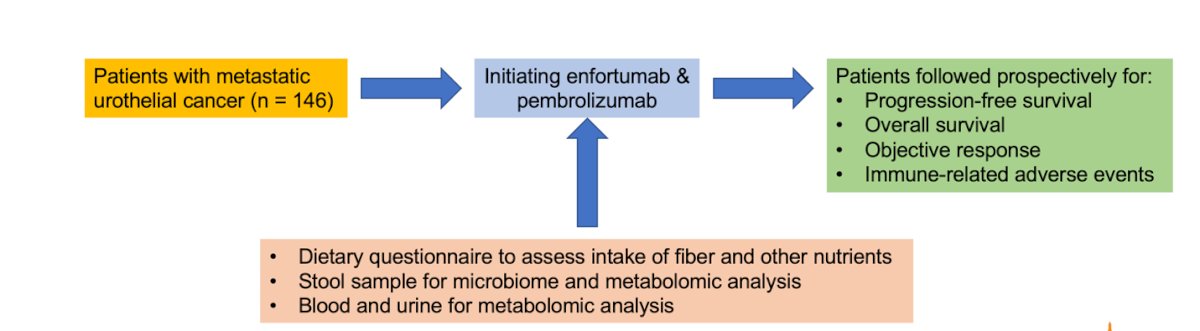
Ultimately, Dr. Guercio and colleagues aim to test their hypotheses in an interventional clinical trial evaluating whether dietary fiber and microbiome modulation through strategies such as increased fiber intake or probiotics can enhance the anti-tumor immune response in patients receiving enfortumab vedotin and pembrolizumab. The concept is grounded in the idea that dietary fiber influences the gut microbiota, which in turn produces immunomodulatory metabolites like short-chain fatty acids that may improve immunotherapy efficacy.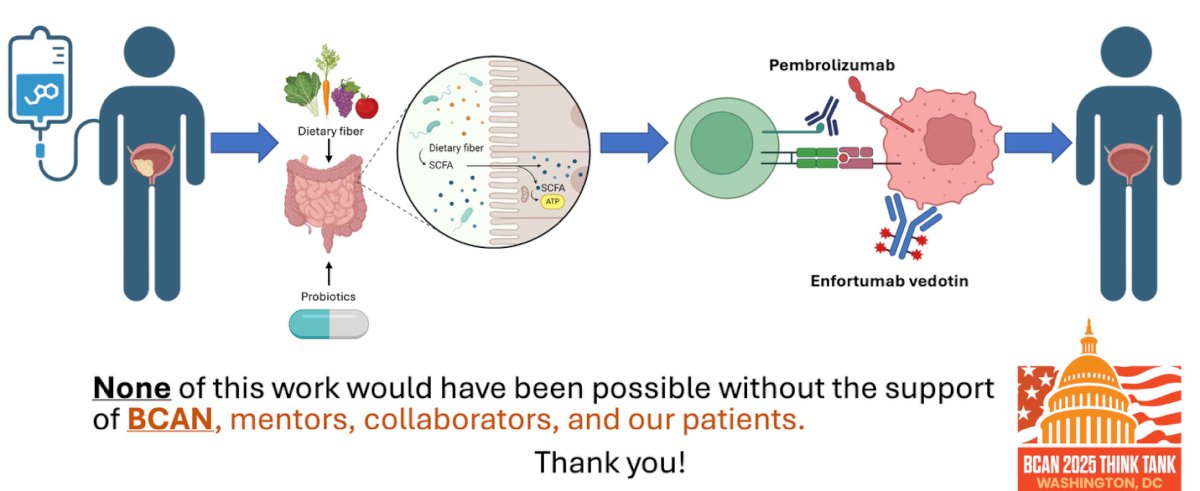
Presented by: Brendan Guercio, MD, Assistant Professor, Department of Medicine, Hematology/Oncology at the University of Rochester Medical Center, Rochester, NY, United States of America.
Written by: Julian Chavarriaga, MD – Urologic Oncologist at Cancer Treatment and Research Center (CTIC) via Society of Urologic Oncology (SUO) Fellow at The University of Toronto. @chavarriagaj on Twitter during the Bladder Cancer Advocacy Network (BCAN) Bladder Cancer Think Tank 2025 held in Washington, D.C., United States, between July 30th and August 1st
References:
- Dizman N, Meza L, Bergerot P, Alcantara M, Dorff T, Lyou Y, Frankel P, Cui Y, Mira V, Llamas M, Hsu J, Zengin Z, Salgia N, Salgia S, Malhotra J, Chawla N, Chehrazi-Raffle A, Muddasani R, Gillece J, Reining L, Trent J, Takahashi M, Oka K, Higashi S, Kortylewski M, Highlander SK, Pal SK. Nivolumab plus ipilimumab with or without live bacterial supplementation in metastatic renal cell carcinoma: a randomized phase 1 trial. Nat Med. 2022 Apr;28(4):704-712. doi: 10.1038/s41591-022-01694-6. Epub 2022 Feb 28. PMID: 35228755; PMCID: PMC9018425.
- Spencer CN, McQuade JL, Gopalakrishnan V, McCulloch JA, Vetizou M, Cogdill AP, Khan MAW, Zhang X, White MG, Peterson CB, Wong MC, Morad G, Rodgers T, Badger JH, Helmink BA, Andrews MC, Rodrigues RR, Morgun A, Kim YS, Roszik J, Hoffman KL, Zheng J, Zhou Y, Medik YB, Kahn LM, Johnson S, Hudgens CW, Wani K, Gaudreau PO, Harris AL, Jamal MA, Baruch EN, Perez-Guijarro E, Day CP, Merlino G, Pazdrak B, Lochmann BS, Szczepaniak-Sloane RA, Arora R, Anderson J, Zobniw CM, Posada E, Sirmans E, Simon J, Haydu LE, Burton EM, Wang L, Dang M, Clise-Dwyer K, Schneider S, Chapman T, Anang NAS, Duncan S, Toker J, Malke JC, Glitza IC, Amaria RN, Tawbi HA, Diab A, Wong MK, Patel SP, Woodman SE, Davies MA, Ross MI, Gershenwald JE, Lee JE, Hwu P, Jensen V, Samuels Y, Straussman R, Ajami NJ, Nelson KC, Nezi L, Petrosino JF, Futreal PA, Lazar AJ, Hu J, Jenq RR, Tetzlaff MT, Yan Y, Garrett WS, Huttenhower C, Sharma P, Watowich SS, Allison JP, Cohen L, Trinchieri G, Daniel CR, Wargo JA. Dietary fiber and probiotics influence the gut microbiome and melanoma immunotherapy response. Science. 2021 Dec 24;374(6575):1632-1640. doi: 10.1126/science.aaz7015. Epub 2021 Dec 23. PMID: 34941392; PMCID: PMC8970537.
- Brendan John Guercio et al. Associations of diet with survival of patients (pts) with metastatic cancer of the urothelium (mUC) and renal cell carcinoma (mRCC) on immune checkpoint blockade (ICB).. JCO 41, 4598,(2023).