

(UroToday.com) The 2026 American Urologic Association (AUA) Annual Meeting was host to an upper tract urothelial carcinoma (UTUC) poster session. Dr. Sri Saran Manivasagam presented a machine learning-based model for the prediction of progression to radical nephroureterectomy after endoscopic management of UTUC.
Endoscopic ablation is an established kidney-sparing treatment option for appropriately selected patients with localized UTUC. However, a subset of patients ultimately requires radical nephroureterectomy because of recurrent or progressive disease. Accurately identifying patients at increased risk for treatment failure at the time of initial management could improve patient counseling, surveillance planning, and treatment selection.
The objective of this study was to develop and validate machine learning models capable of estimating the two-year risk of progression to RNU after first-time endoscopic treatment.
The investigators performed a multicenter retrospective analysis of 437 patients from 11 institutions who underwent first-time endoscopic treatment for UTUC between December 2003 and January 2023. Patients who underwent RNU within three months of endoscopic treatment, presumed to reflect incomplete initial ablation rather than true disease progression, were excluded.
Overall, 51 patients (11.6%) progressed to RNU within two years. Eight machine learning models were developed and validated using a 70:30 training-to-testing split. Model performance was assessed using the area under the receiver operating characteristic curve (AUC), sensitivity, and specificity.
Clinical factors associated with progression to RNU included:
- High-grade tumors (41.2% versus 23.6%, p=0.011)
- Charlson Comorbidity Index (CCI) ≥5 (78.4% versus 66.7%, p=0.004)
- Presence of local symptoms (68.6% versus 61.1%, p=0.011)
- Tumor size >2 cm (47% versus 11.6%, p=0.003).
Among the eight evaluated algorithms, the gradient boosting model demonstrated the strongest predictive performance, with an AUC of 0.882, sensitivity of 76.4%, and specificity of 100%. The random forest model also performed well, achieving an AUC of 0.841, sensitivity of 70.5%, and specificity of 97.6%. Overall, all models achieved very high specificity, ranging from 97.6% to 100%, with more variable sensitivity (28.5% to 78.4%).
The poster also included a variable importance analysis, which identified the Charlson Comorbidity Index as the most influential predictor, followed by age at index ablation and biopsy grade. Other important contributors included the presence of local symptoms, lesion size >2 cm, prior bladder cancer history, smoking status, sex, body mass index, and race. These findings highlight that both tumor-related and patient-related factors contribute meaningfully to the risk of eventual progression to nephroureterectomy.
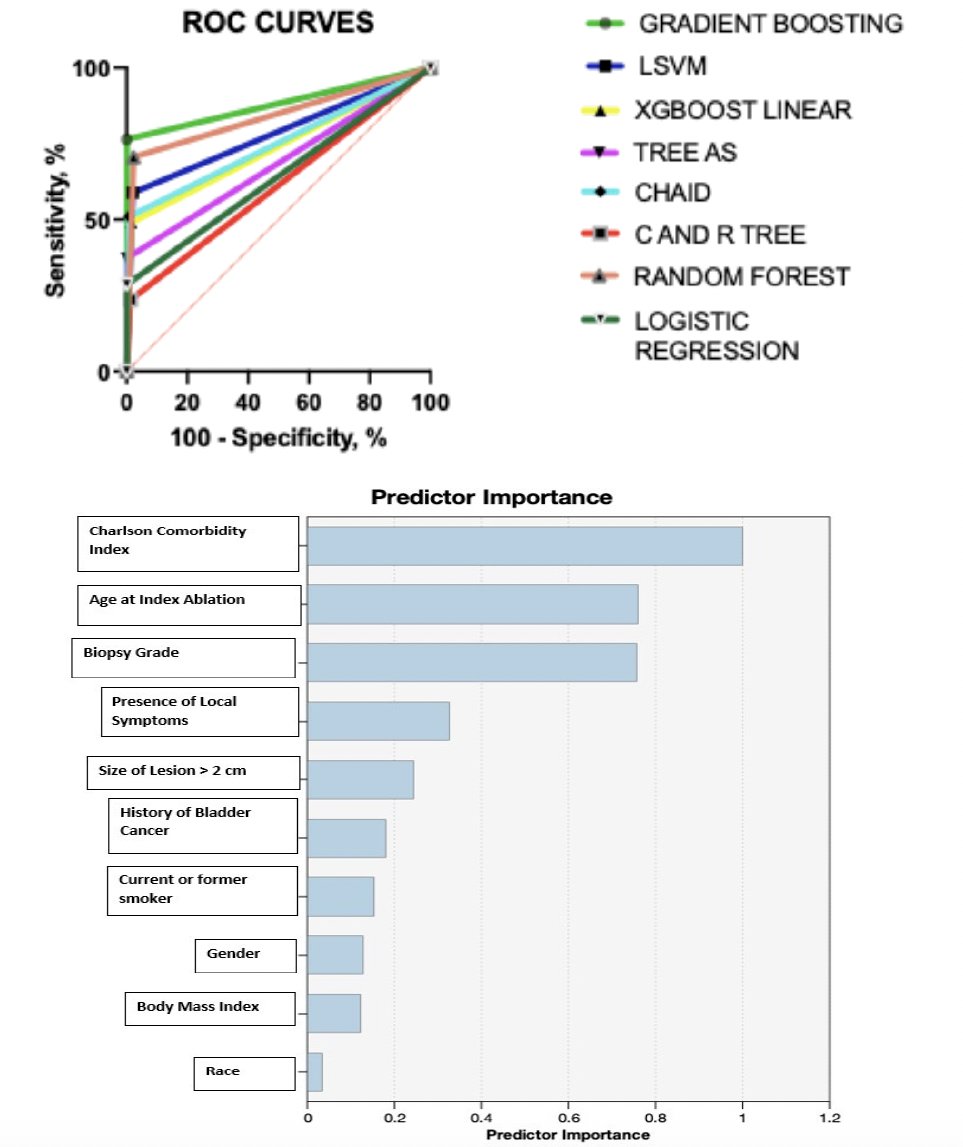
The investigators concluded that machine learning models built from routinely collected clinical variables can effectively estimate the two-year risk of progression to radical nephroureterectomy following initial endoscopic treatment of UTUC. Such tools may provide valuable support for pre-treatment counseling and help identify patients who may be better served by upfront definitive surgery rather than kidney-sparing endoscopic management.
Presented by: Sri Saran Manivasagam, Urology Research Fellow, Department of Urology, Penn State University College of Medicine, Milton S. Hershey Medical Center, Hershey, USA
Written by: Rashid K. Sayyid, MD, MSc, Assistant Professor, Urologic Oncologist, Department of Urology at The University of Arizona and Banner University Medical Center, Tucson, AZ – @rksayyid on X during the AUA 2026 Annual Meeting, Washington, DC, May 15th–18th, 2026