

(UroToday.com) The 2026 American Urologic Association (AUA) Annual Meeting featured an important presentation by Dr. Neeraj Agarwal evaluating whether radiographic progression-free survival (rPFS) is a clinically meaningful surrogate endpoint for overall survival (OS) in men with metastatic castration-resistant prostate cancer (mCRPC), using individual patient-level data from the phase III TALAPRO-2 trial.
As therapies for advanced prostate cancer continue to improve, there is increasing interest in identifying intermediate endpoints that reliably predict long-term survival outcomes. The Prostate Cancer Working Group 3 (PCWG3)-defined rPFS endpoint is increasingly recognized as a meaningful imaging-based endpoint in advanced prostate cancer. Demonstrating a strong relationship between rPFS and OS may support earlier assessment of treatment efficacy and facilitate more timely regulatory approval of effective therapies.
This analysis sought to evaluate the correlation strength between rPFS and OS across multiple clinically relevant patient populations using final TALAPRO-2 OS data with a cutoff date of September 3, 2024.
TALAPRO-2 was a phase III, randomized, double-blind, placebo-controlled trial evaluating talazoparib plus enzalutamide versus placebo plus enzalutamide as first-line treatment for mCRPC.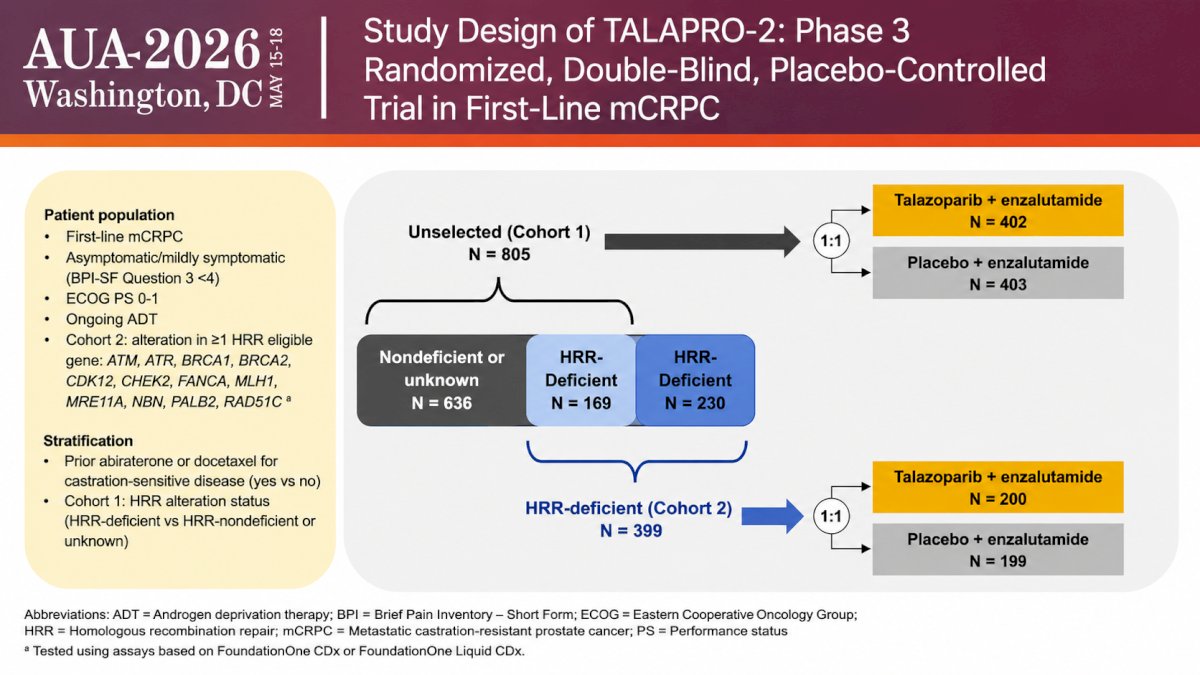
Eligible patients had:
- First-line mCRPC
- Asymptomatic or mildly symptomatic disease (Brief Pain Inventory–Short Form question 3 score ≤4)
- ECOG performance status 0–1
- Ongoing androgen deprivation therapy
The study consisted of two cohorts:
- Cohort 1 (unselected population): 805 patients
- Cohort 2 (HRR-deficient population): 399 patients harboring alterations in at least one homologous recombination repair gene, including ATM, ATR, BRCA1, BRCA2, CDK12, CHEK2, FANCA, MLH1, MRE11A, NBN, PALB2, and RAD51C
In Cohort 1, 402 patients were randomized to talazoparib plus enzalutamide and 403 to placebo plus enzalutamide. In Cohort 2, 200 patients received talazoparib plus enzalutamide and 199 received placebo plus enzalutamide.
The primary endpoint of TALAPRO-2 was blinded independent central review (BICR)-assessed rPFS according to PCWG3 criteria, defined as the time from randomization to objective radiographic progression in soft tissue per RECIST 1.1, progression in bone, or death, whichever occurred first. The key alpha-protected secondary endpoint was OS.
For this analysis, the investigators evaluated correlations between both BICR-assessed and investigator-assessed rPFS and OS using three complementary statistical approaches:
- Spearman’s rho via Clayton copula
- Kendall’s tau via Clayton copula
- Kendall’s tau from frailty variance modeling
Correlation coefficients were interpreted as:
- <0.4: weak
- 0.4 to ≤0.7: moderate
- 0.7: strong
Analyses were performed using pooled treatment arms and separately within each treatment arm.
The populations of interest included:
- Unselected population
- HRR-deficient population
- HRR-nondeficient/unknown population
- BRCA-mutated (BRCA1, BRCA2, or BRCA co-occurring mutations)
- BRCA-nondeficient/unknown population
- Patients with and without prior taxane or androgen receptor pathway inhibitor exposure
The first major analysis evaluated investigator-assessed rPFS and OS across the unselected, HRR-deficient, and BRCA-mutated populations. Across all three statistical models and regardless of treatment arm, investigator-assessed rPFS demonstrated a positive moderate-to-strong correlation with OS.
In the unselected cohort (n=805):
- Spearman’s rho was 0.823 overall, 0.849 with talazoparib plus enzalutamide, and 0.794 with placebo plus enzalutamide
- Frailty-model Kendall’s tau was 0.769 overall
In the HRR-deficient cohort (n=399):
- Spearman’s rho was 0.772 overall
- Frailty-model Kendall’s tau was 0.727 overall
In the BRCA-mutated cohort (n=155):
- Spearman’s rho was 0.733 overall
- Frailty-model Kendall’s tau was 0.705 overall
These findings indicate strong correlations between investigator-assessed rPFS and OS in all three clinically important populations.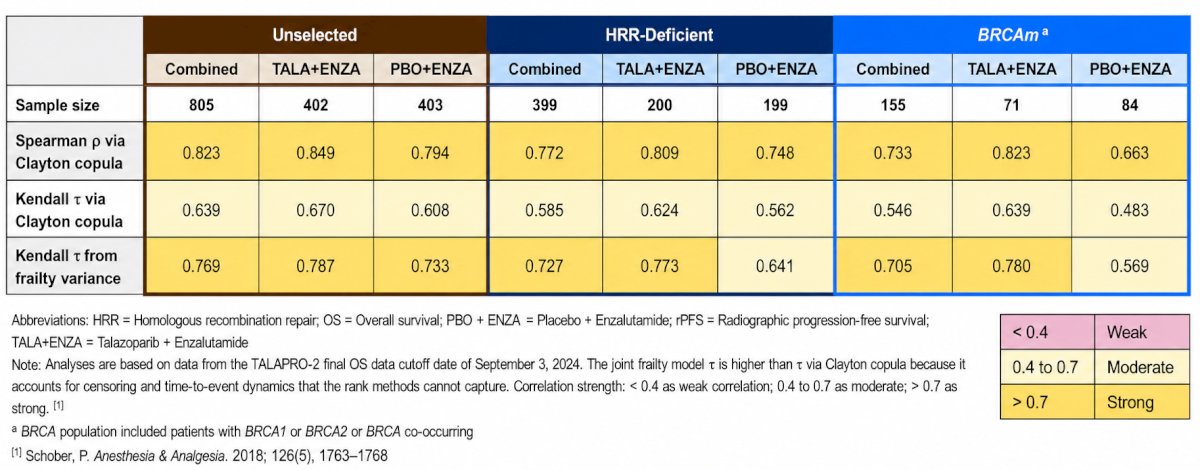
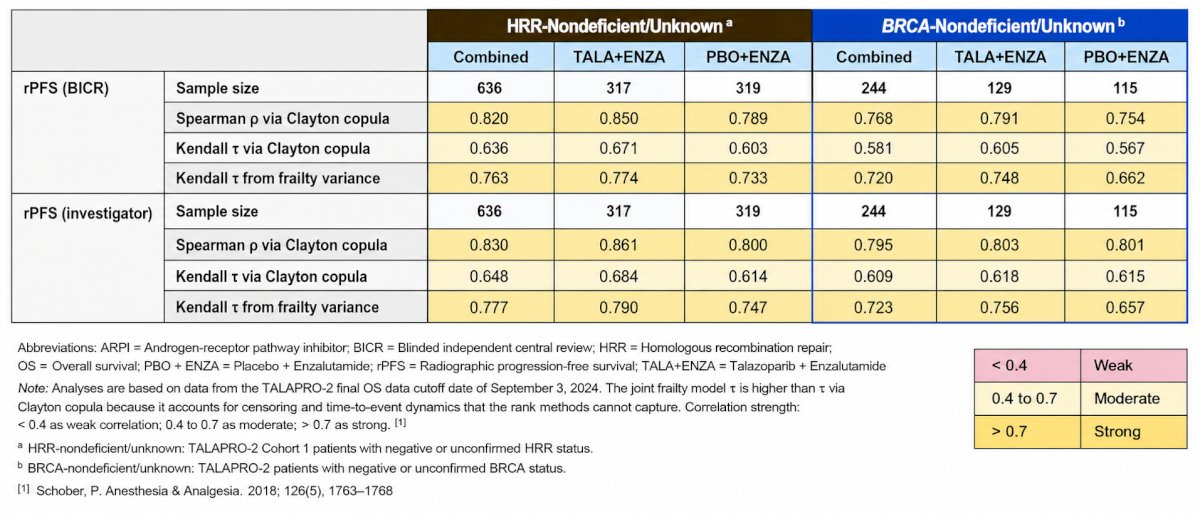
The second analysis evaluated both BICR-assessed and investigator-assessed rPFS in the HRR-nondeficient/unknown and BRCA-nondeficient/unknown subgroups.
In the HRR-nondeficient/unknown cohort (n=636):
- BICR-assessed Spearman’s rho was 0.820 overall
- Investigator-assessed Spearman’s rho was 0.830 overall
- Frailty-model Kendall’s tau values were 0.763 and 0.777, respectively
In the BRCA-nondeficient/unknown cohort (n=244):
- BICR-assessed Spearman’s rho was 0.768 overall
- Investigator-assessed Spearman’s rho was 0.795 overall
- Frailty-model Kendall’s tau values were 0.720 and 0.723, respectively
Across additional subgroups defined by prior taxane or androgen receptor pathway inhibitor exposure, moderate-to-strong correlations were consistently observed, with coefficients ranging from 0.434 to 0.844. Only one weak correlation was identified, in the placebo plus enzalutamide arm of the BRCA-mutated subgroup, where the coefficient was 0.365.
Dr. Agarwal concluded as follows:
- In TALAPRO-2, rPFS showed a consistent positive moderate-strong correlation with OS across unselected, HRR-deficient, and BRCAm populations, and across three different statistical methods.
- These results were consistently observed across several other subgroups of interest, including HRR- and BRCA-nondeficient or unknown groups and patients with or without prior taxane or ARPi exposure.
- This represents the first individual patient-level analysis to evaluate rPFS-OS correlations for a PARP inhibitor in the first-line mCRPC setting, including biomarker-defined subgroups.
- These findings provide new evidence validating the relationship between rPFS and OS across clinically relevant populations in a contemporary treatment landscape.
Presented by: Neeraj Agarwal, MD, FASCO, Professor, Presidential Endowed Chair of Cancer Research, Director GU Program, and the Center of Investigational Therapeutics (CIT), Huntsman Cancer Institute, University of Utah, Salt Lake City, UT
Written by: Rashid K. Sayyid, MD, MSc, Assistant Professor, Urologic Oncologist, Department of Urology at The University of Arizona and Banner University Medical Center, Tucson, AZ – @rksayyid on X during the American Urological Association (AUA) 2026 Annual Meeting, Washington, DC, Fri, May 15 – Mon, May 18, 2026.
Related content: Radiographic Progression-Free Survival and Overall Survival Correlation in TALAPRO-2 - Neeraj Agarwal
Reference: