

(UroToday.com) The 2026 American Urological Association annual meeting featured a planning to plenary, behind the scenes of leading Urology clinical trials session, and a presentation by Dr. Neal Shore discussing his reflections and advice on finding your pathway to the plenary stage. Dr. Shore started his presentation by giving a snapshot of his career at a glance. Dr. Shore received a BA in Public Policy and US history from Duke University in 1980, followed by his MD from the Duke University School of Medicine (1984).
He subsequently trained in Surgery/Urology residency at New York Hospital Medical Center and Memorial Sloan Kettering Cancer Center. In 1998, he founded the Carolina Urologic Research Center, and he is now the director of the GU Oncology Division of START Cancer (2025). During his career, Dr. Shore has conducted 500+ clinical trials and has been a part of 30+ FDA-approved therapies (androgen receptor pathway inhibitors, PARP inhibitors, radiopharmaceutical therapy, immunotherapy, and antibody drug conjugates). During this time, he built the Carolina Urologic Research Center, starting with 1 research coordinator.
Over the years, Dr. Shore notes that GU oncology has drastically changed. Previously, there were 1,500 people in a ballroom, dressed in black and navy suits, mainly discussing surgical interventions. This included discussion of surgical extirpative techniques, debating “what type of continent diversion should be used?” or “What type of brachytherapy seed should be used?” At that time, trials were the purview of academic centers, with an internecine warfare between community and academic centers, and no emphasis on multidisciplinary teams. Now, there are phase III trial updates as plenary sessions at the AUA, and community sites are conducting global trials. Importantly, 80-85% of cancer care is in the community, and multidisciplinary teams are the standard.
For the remainder of his talk, Dr. Shore noted 6 observations from his journey.
Observation #1: Mentors MatterDr. Shore notes that the people who invest in you shape the trajectory of your entire career. For Dr. Shore, this included (i) his parents, Dr. Sey (family physician) and Phyllis (school teacher) Shore, who taught him values and work ethic, (ii) Dr. David Sabiston (Chairman of Surgery, Duke), who taught him the standard of surgical excellence, (iii) Drs. Alan Yagoda and Willet Whitmore (mentors at MSKCC), who were pioneers in urologic oncology, (iv) Dr. Wendell Rosse (medical student advisor), who provided early guidance to shape his direction, (v) Dr. E. Darracott Vaughn (Chief of Urology, Cornell), an intellectual surgeon and gentleman, and (vi) Drs. H.B. Carter and P. Genvert (co-chief residents), noting the importance of peer mentorship.
Observation #2: Failure and the Fork in the RoadDr. Shore emphasized the Robert Frost quote “Two roads diverged in a wood, and I – I took the one less traveled, and that has made all the difference.” There are several important points noted by Dr. Shore:
- What excites you? What turns you on?
- Device studies? Biomarker studies? Systemic therapy? Surgical iterative studies? What drives your curiosity/passion?
- Changing employment, location, or direction is a growth opportunity
- Appreciate the ‘crux’ moment and go forward
- In 1980-2004, it was surgical oncology only
- By 2010, the shift to systemic therapy was clear, and it continues – career opportunities abound.
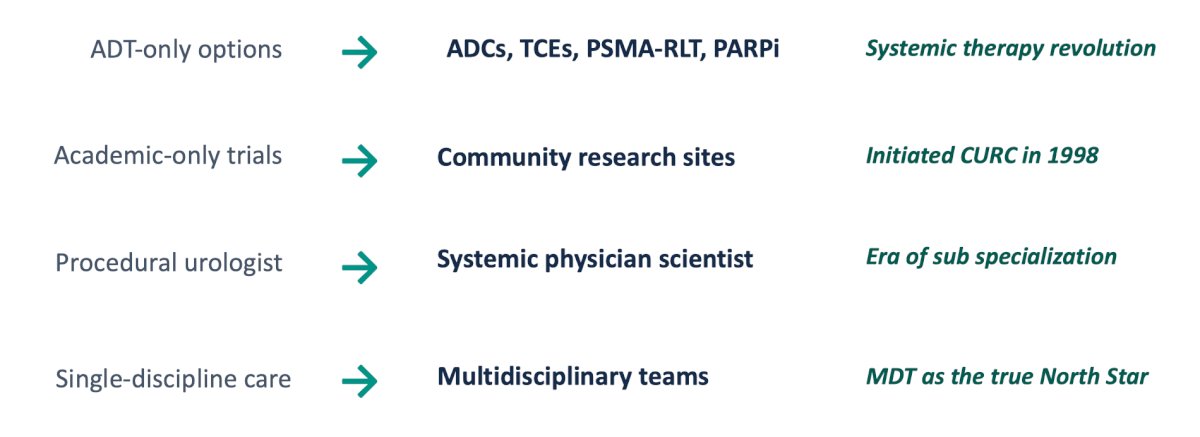
The following are several examples in Dr. Shore’s career of looking around the corner:
- Systemic therapy revolution: ADT only options antibody drug conjugates, T-cell engagers, PSMA radioligand therapy, and PARP inhibitors
- Initiated CURC in 1998: academic-only trials, community research sites
- Era of sub-specialization: procedural urologist, systemic physician scientist
- Multidisciplinary teams as the true north star: single-discipline care, multidisciplinary teams
Who knows what communications will look like in 5, 10, or 20 years?
Observation #4: Collaborators are EverythingDr. Shore notes that there are doers versus talkers, and we need to identify doers early, given that careers are fortified by curating with colleagues. We can’t do it on our own – multidisciplinary teams are burgeoning, and the standard of care is a team that spans disciplines, settings, and economics. Generosity is paramount – sharing credit, financials, and opportunities, such as authorship, presentations, and advisory boards, to bolster our colleagues’ careers. Optimization occurs when community and academia collaborate – across AUA, SUO, SITC, ASCO, ESMO, LUGPA, EAU, APCCC, etc.
Observation #5: Engage and Step Forward
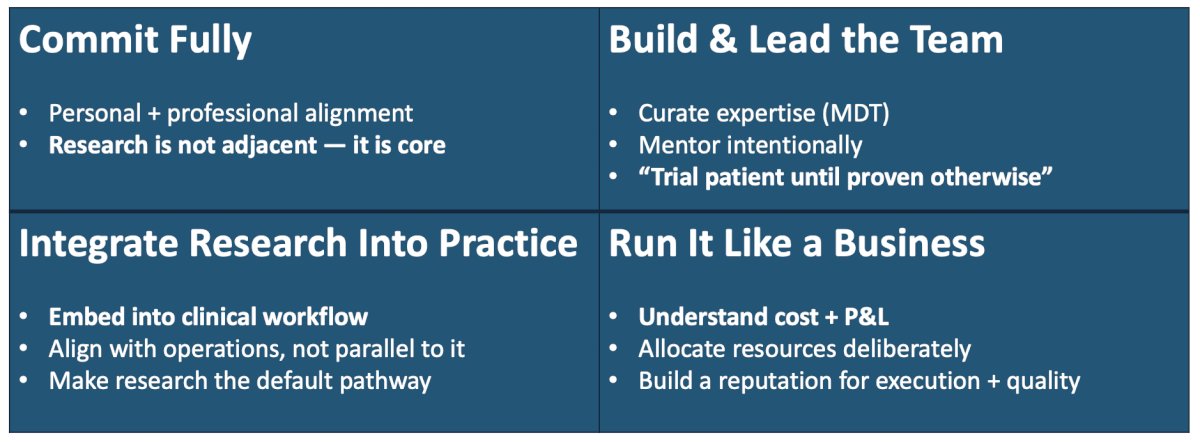
Dr. Shore notes that a big part of it is just showing up. Some people finish their workload and go home, but the first step is to be present and attend, since it’s a privilege to be in the room when it happens. Second, industry is not a dirty word. Work with biopharma and device companies, attend advisory boards, and evaluate trial designs. Government funding is decreasing, and we must embrace changes. Third, become a “healthcare globalist”, engaging with the AUA, SUO, LUGPA, EAU, ASCO, ESMO, and APCCC. We need to build relationships that cross borders and disciplines, regardless of the home base – build a network! Dr. Shore notes the following 4 lessons learned:
- Commit fully
- Build and lead the team
- Integrate research into practice
- Run it like a business
It is important that when we meet a fork in the road: anticipate innovative education, motivate: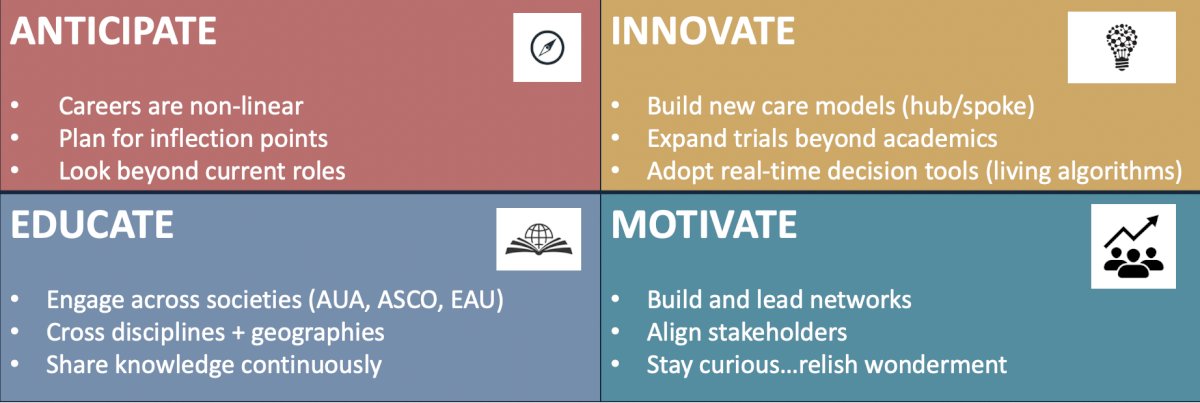
Our path isn’t linear, and our impact shouldn’t be either.
Observation #6: Science is the Value (Truth)
Clinical trials are the standard of care for:
- The patient:
- Access to state-of-the-art therapies near home
- Personalized, individual care
- Expanded access for underserved communities
- Evidence applied at the point of care, not years later
- The clinician scientist:
- Intellectual stimulation and wonderment
- Early experience with new technologies
- Variation from routine – burnout avoidance
- Engagement with global colleagues
- The practice:
- Professional differentiation
- Early adoption of new technologies
- Stronger position with payors
- Standardized care using dynamic, continuously updated pathways
Dr. Shore concluded his presentation discussing his reflections and advice on finding your pathway to the plenary stage with the following take-home points:
- Wonderment: find mentors, embrace forks, align with doers
- Anticipate, innovate, educate, and motivate
- Step forward: always enjoy, and a plenary(s) awaits you
Presented by: Neal D. Shore, MD, FACS, Director, CPI (Certified Principal Investigator by the Association of Clinical Research Professionals), START Carolinas/Carolina Urologic Research Center, Head of GU Oncology and Radiopharm, START Center for Cancer Research Institute, AUC Urology Specialists, Myrtle Beach, SC
Written by: Zachary Klaassen, MD, MSc – Urologic Oncologist, Associate Professor of Urology, Georgia Cancer Center, Wellstar MCG Health, @zklaassen_md on Twitter during the American Urological Association (AUA) 2026 Annual Meeting, Washington, DC, Fri, May 15 – Mon, May 18, 2026.