

(UroToday.com) The 2026 American Urologic Association (AUA) Annual Meeting was host to a prostate cancer clinical trials-in-progress session. Dr. Himanshu Nagar presented IRRADIANT, an ongoing study of irreversible electroporation versus radiation boost for intermediate-risk prostate cancer.
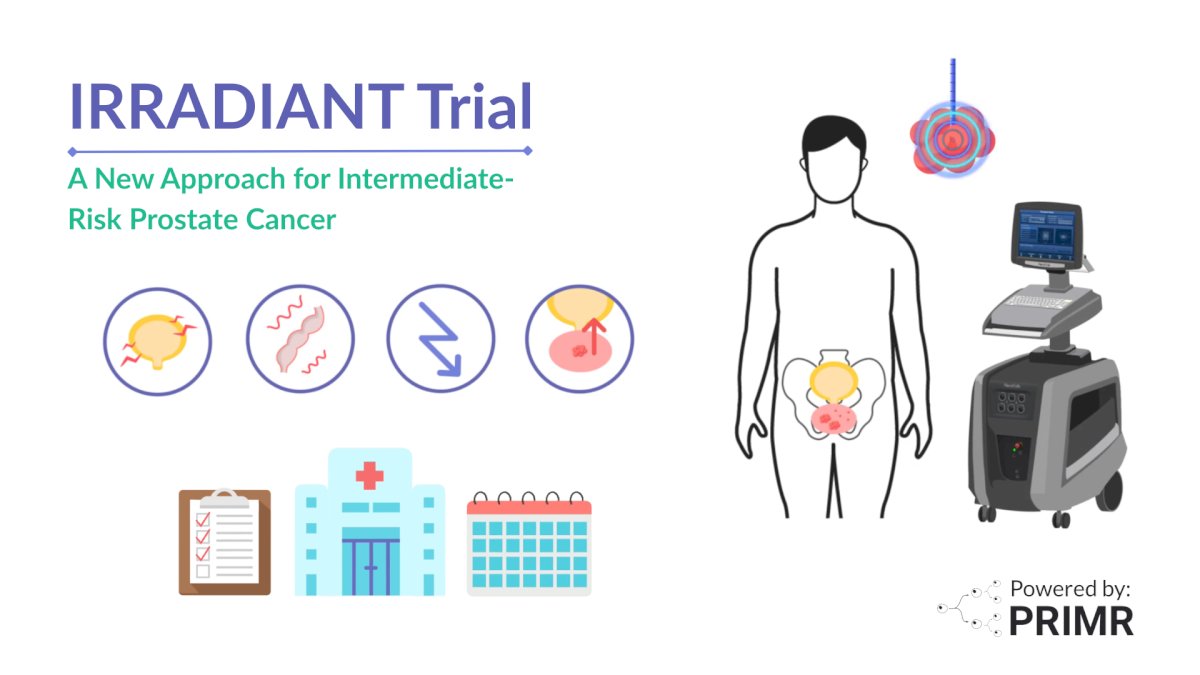
Intermediate-risk prostate cancer accounts for approximately half of all newly diagnosed prostate cancer cases in the United States and represents a biologically heterogeneous disease state. Despite this heterogeneity, treatment paradigms remain largely uniform, with most patients receiving radical prostatectomy or dose-escalated radiation therapy. Modern radiation approaches incorporating a focal boost to the MRI-visible dominant intraprostatic lesion (DIL) have improved biochemical control, but long-term treatment-related morbidity remains substantial, with patient-reported urinary dysfunction in approximately 25%, bowel dysfunction in 10%, and sexual dysfunction in as many as 70% of patients.
Focal ablative therapies have emerged as tissue-sparing alternatives that selectively target the dominant lesion while preserving adjacent normal structures. However, focal therapy alone has been associated with recurrence rates of 40–60%, reflecting the challenge of undetected multifocal and microscopic disease elsewhere within the prostate. This therapeutic gap has motivated the development of RTIRE, an innovative combined modality strategy that integrates reduced-dose whole-gland radiation therapy with focal irreversible electroporation.
Irreversible electroporation is a non-thermal ablative technique that delivers high-voltage electrical pulses to create nanopores in tumor cell membranes, leading to apoptosis while preserving connective tissue architecture. Unlike thermal energy-based modalities, IRE minimizes collateral damage to critical structures such as the urethra and neurovascular bundles and functions independently of DNA damage pathways, potentially offering activity against radioresistant tumor subclones.
The biologic rationale for RTIRE is highly complementary. Radiation therapy addresses occult multifocal and microscopic disease throughout the gland, whereas IRE precisely ablates the MRI-visible dominant lesion. Together, this approach is designed to maintain oncologic efficacy while enabling radiation dose de-escalation and reducing urinary, bowel, and sexual toxicity.
The investigators previously completed a phase 1/2 study (NCT05345444), which demonstrated that RTIRE was feasible, well tolerated, and associated with encouraging early oncologic outcomes.1 Building upon these results, the IRRADIANT trial (IRreversible electroporation versus RADIAtioN boost) will provide a definitive comparison against current standard-of-care focal dose escalation.
IRRADIANT is a multicenter randomized non-inferiority trial enrolling men with intermediate-risk prostate cancer who have elected definitive radiation therapy. Participants will be randomized to one of two treatment strategies:
- Experimental arm: Reduced-dose whole-gland radiation therapy plus focal IRE boost to the dominant intraprostatic lesion
- Control arm: Standard whole-gland radiation therapy with integrated radiation boost to the dominant intraprostatic lesion
The primary objective is to demonstrate non-inferiority of IRE boost compared with radiation boost with respect to the 2-year negative biopsy rate.
Secondary objectives include comparisons of:
- Biochemical progression-free survival (bPFS)
- Metastasis-free survival (MFS)
- Overall survival (OS)
- Gastrointestinal quality of life using the EPIC Bowel Assessment (EPIC-BA)
- Urinary symptoms using the International Prostate Symptom Score (IPSS)
- Sexual and ejaculatory function using the International Index of Erectile Function-6 (IIEF-6) and Male Sexual Health Questionnaire-Ejaculatory Dysfunction (MSHQ-EjD)
Patient-reported outcomes will be collected at baseline and at 3-, 6-, 12-, and 24-months following completion of radiation therapy.
A particularly innovative aspect of the study is the planned integration of advanced machine learning approaches combining clinical, genomic, molecular, and imaging data to develop predictive models for treatment response and toxicity. This translational component may help identify which patients derive the greatest benefit from RTIRE and refine future precision treatment strategies.
The IRRADIANT trial is funded by AngioDynamics, the manufacturer of the NanoKnife IRE platform, and clinical trial registration is pending.
The investigators concluded that IRRADIANT will rigorously test whether IRE boost can preserve oncologic efficacy while improving functional outcomes compared with standard radiation dose escalation. If successful, this study could establish RTIRE as a novel, organ-preserving, function-sparing treatment paradigm for men with intermediate-risk prostate cancer.
Presented by: Himanshu Nagar, MD, MS, Radiation Oncologist, Memorial Sloan Kettering Cancer Center, New York, NY
Written by: Rashid K. Sayyid, MD, MSc, Assistant Professor, Urologic Oncologist, Department of Urology at The University of Arizona and Banner University Medical Center, Tucson, AZ – @rksayyid on X during the American Urological Association (AUA) 2026 Annual Meeting, Washington, DC, Fri, May 15 – Mon, May 18, 2026.
Related content: Combining Focal Irreversible Electroporation with Hypofractionated Radiation: The Phase 3 IRRADIANT Study - Timothy McClure
References:
- Diven M, Ballman K, Marciscano A, et al. Radiation Therapy and IRreversible Electroporation for Intermediate Risk Prostate Cancer (RTIRE). BMC Urol. 2024;24(1):155.