

(UroToday.com) The 2026 American Urological Association annual meeting featured a plenary session, a behind-the-scenes session on leading Urology clinical trials, and a presentation by Dr. Jason Hafron discussing perspectives of running clinical trials as a urologist in community practice. Dr. Hafron started his presentation by emphasizing that a key problem is that patients are not enrolling in clinical trials. Among 3.2 million patients, trial enrollment is shockingly low:1
- Kidney cancer: 0.20% enrollment rate
- Prostate cancer: 0.06% enrollment rate
- Bladder cancer: 0.04% enrollment rate
- All cancers (NCDB): ~0.1% enrollment rate
- Diverse patients: large, diverse populations improve racial and ethnic diversity
- Faster enrollment: accelerated recruitment
- Non-institutional IRB: streamlined approval
- Real-world data: practical applicability
- Patient relationships: longitudinal trust
The community setting makes sense for clinical trials because 85-90% of urology care is community-based, thus community urologists manage the vast majority of GU cancer patients – yet nearly all clinical trials run through academic centers. Thus, clinical trials should be in the community, too. Additionally, there is improved generalizability among community practices (i) with a diverse, real-world patient mix, (ii) patients that reflect routine clinical practice, (iii) results that are applicable to most patients, and (iv) a broader geographic access. This is contrary to academic centers, which have (i) a narrow, homogeneous population, (ii) strict eligibility, (iii) results that may not translate to typical patients, and (iv) limited geographic reach. Location also matters for patients, since many have to travel vast distances to get to academic centers, and patients are less likely to get treatment at NCI centers if they live further away.
Dr. Hafron noted that there are also systemic barriers for community practices, including:
- No built-in infrastructure: unlike academic centers, there is limited staffing, with inadequate research-focused personnel
- Scarcity of available trials, particularly for early-phase and industry-sponsored trials in smaller practices
- Fragmented systems: EMR, research, and billing
- Financial uncertainty: unpredictable funding

Additionally, there are also physician barriers:
- Competing priorities: clinic volume, OR time, and administrative burden leave little room for research
- Lack of training and confidence: limited educational opportunities in residency and career for clinical research
- Financial uncertainty: unpredictable funding for the human resources needed to run trials

As such, community practices are not equivalent to academic centers, and a different playbook is required. The 5 core challenges for community practices are:
- Infrastructure: variable staffing, no standardized workflows
- Patient identification: manual screening, missed eligible patients
- Workflow integration: trials layered on top of care, not embedded in care
- Financial model: unclear return on investment, high start-up costs
- Physician engagement: limited time, low visibility into trial opportunities
What works? The following is a practical playbook for community practice:
- Data infrastructure solves infrastructure: trusted, real-time data across sites and longitudinal patient tracking
- A navigation model solves patient identification: dedicated research navigators, centralized tracking, and real-time follow-up
- Embed trials into clinical workflow solves workflow integration: screening at the point of care, not the post-visits, and EMR-integrated protocols replace spreadsheets
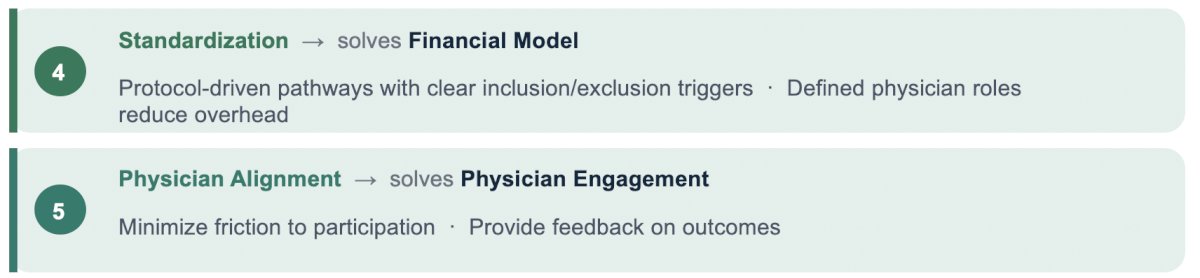
- Standardization solves the financial model: protocol-driven pathways with clear inclusion/exclusion triggers, and defined physician roles reduce overhead
- Physician alignment solves physician engagement: minimizes friction to participation and provides feedback on outcomes

Of note, 73% of patients who enrolled in a clinical trial were motivated by their physician’s recommendation.
At the Michigan Institute of Urology, Dr. Hafron notes that they are a multi-site community urology practice in southeast Michigan, focusing on prostate and bladder cancer trials. This includes having 6 research coordinators, 10-15 open trials per year, and 1,500 research visits/year. Key outcomes include (i) improved patient identification through IOD request, centralized pathology review, and EMR-integrated screening, (ii) greater enrollment consistency via a dedicated navigator, (iii) streamlined workflow through protocol-driven pathways, and (iv) leadership practice buy-in beyond financial incentives.
Dr. Hafron believes that the future of community trials is:
- Decentralized and hybrid models: trials move closer to where patients live and receive care
- AI-driven patient ID: machine learning finds eligible patients faster and more accurately
- Clinical pathway integration: trials become part of the care journey, not an add-on
- Industry shifts to community: sponsors increasingly rely on community sites for enrollment

The next generation of trials will not be built around institutions; they will be built around patients.
Dr. Hafron concluded his presentation discussing perspectives of running clinical trials as a urologist in community practice with the following take-home points:
- Community urology is essential to clinical trial access and scale
- Success requires infrastructure, not enthusiasm alone
- The future belongs to practices that integrate research into care delivery
Presented by: Jason Hafron, MD, CMO, Oncologist, Chief Medical Officer and Medical Director of Clinical Research, Michigan Institute of Urology, Solaris Health, MI
Written by: Zachary Klaassen, MD, MSc – Urologic Oncologist, Associate Professor of Urology, Georgia Cancer Center, Wellstar MCG Health, @zklaassen_md on Twitter during the American Urological Association (AUA) 2026 Annual Meeting, Washington, DC, Fri, May 15 – Mon, May 18, 2026.
Reference:
- Noel ODV, Akgul B, Bhandari M, et al. Clinical trial participation in kidney, bladder, and prostate malignancies in the United States: Sociodemographic distribution and impact on survival. Urol Oncol. 2026 Jun;44(6):176-188.