

(UroToday.com) The 2026 American Urological Association (AUA) Annual Meeting featured an educational session focused on how emerging clinical trial data are translated into clinical knowledge and disseminated throughout the urologic oncology community. In a practical and highly relevant presentation titled “Education and Dispersion of Information,” Zachary Klaassen discussed the pathways through which new evidence moves from initial presentation to widespread incorporation into clinical practice.
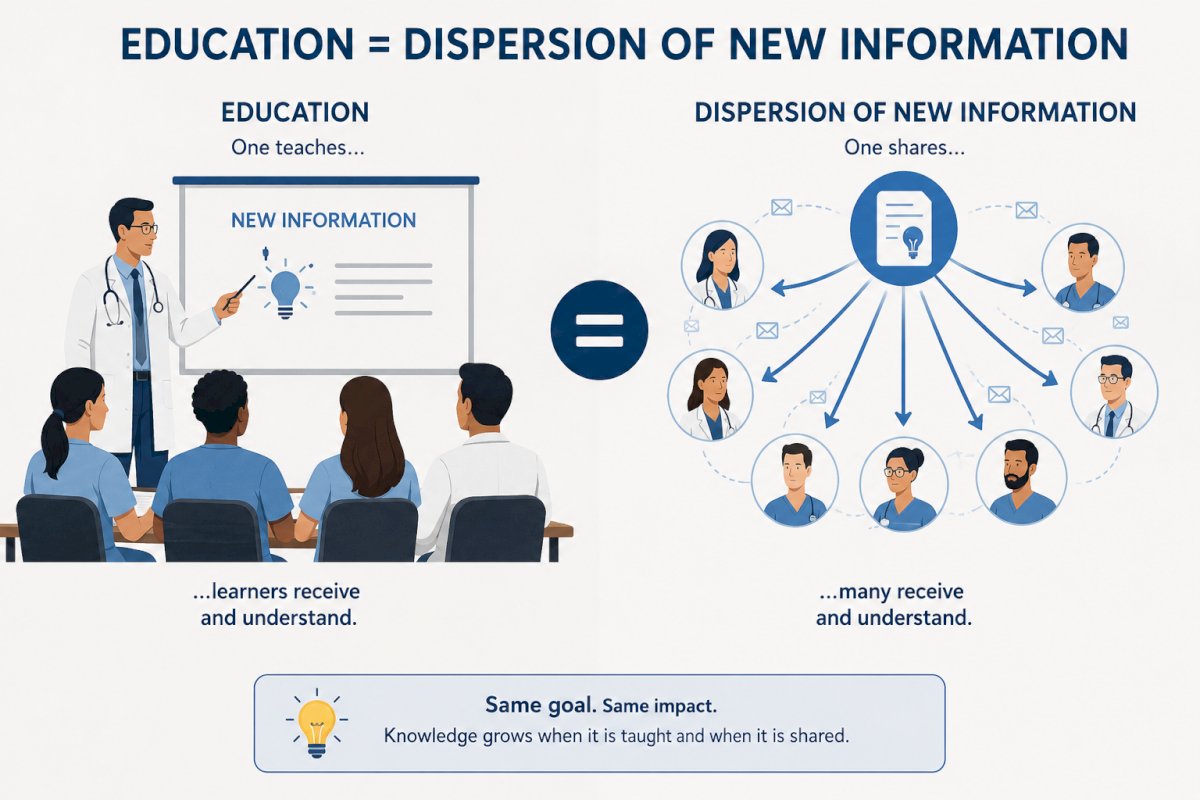
Dr. Klaassen began by posing two fundamental questions that underpin evidence translation in modern oncology: “How do we learn new trial data?” and “How do we get the information out there?” His central message was that these processes are inherently linked. In essence, educating clinicians and dispersing information are two sides of the same coin, and effective implementation of new evidence requires repeated exposure through multiple complementary channels rather than reliance on any single platform.
Dr. Klaassen first highlighted scientific meetings as the traditional and often most immediate mechanism for introducing new data. Conferences such as the AUA Annual Meeting, American Society of Clinical Oncology Genitourinary Cancers (ASCO GU) Symposium, and the European Association of Urology (EAU) Congress provide rapid visibility for important trial results. Beyond simply presenting data, these meetings foster debate and discussion, allow real-time interpretation by experts, and create opportunities for networking and peer-to-peer validation. This early exposure often shapes clinicians’ first impressions regarding the potential practice-changing implications of new studies.
Peer-reviewed publications remain the definitive source for detailed evaluation of new evidence. While conference presentations generate awareness and excitement, full manuscripts provide the methodological rigor, statistical detail, and comprehensive discussion necessary for critical appraisal. Publication in high-impact journals also facilitates broader acceptance of findings and serves as the evidentiary foundation for subsequent guideline updates and practice adoption.
Social media has become an increasingly powerful tool for the rapid and global dissemination of clinical data. Dr. Klaassen highlighted platforms such as X and LinkedIn, which enable investigators and clinicians to share trial highlights, visual abstracts, presentation screenshots, and expert commentary in real time. These platforms democratize access to information by extending conference content to clinicians unable to attend in person and facilitating immediate discussion among practitioners worldwide.
Moving from knowledge acquisition to clinical implementation, Dr. Klaassen emphasized the critical role of multidisciplinary tumor boards. These forums allow new evidence to be interpreted within the context of individual patient characteristics, competing treatment options, and institutional resources. By applying emerging data to real-world cases, tumor boards serve as an essential bridge between clinical trial findings and practical decision-making.
Clinical practice guidelines represent one of the most influential mechanisms for converting evidence into standardized care. Organizations, including the AUA, National Comprehensive Cancer Network, EAU, and ASCO, systematically review emerging evidence and translate it into graded recommendations. These documents distill complex data into practical guidance and play a central role in harmonizing treatment approaches across institutions and practice settings.
A particularly important point raised by Dr. Klaassen was that breakthrough data often remain concentrated in academic centers, creating a dissemination gap between tertiary referral institutions and community practices. Because most patients receive cancer care outside of major academic centers, deliberate outreach is necessary to ensure broad uptake of important advances. He identified several strategies to address this challenge, including speaker bureaus, community continuing medical education programs, and community-focused case discussions that tailor evidence to the realities of everyday practice.
Dr. Klaassen also discussed the expanding role of expert-led digital education. Platforms such as UroToday, GU Cast, and BackTable Urology offer diverse educational formats, including written conference coverage, podcasts, interviews, journal clubs, and case-based discussions. These resources provide curated expert interpretation and allow clinicians to engage with new evidence on demand and at their own pace.
Using UroToday as an example, Dr. Klaassen highlighted several educational approaches that reinforce learning after major meetings, including conference coverage, virtual journal clubs, and peer-to-peer discussions. Such platforms synthesize complex trial results into concise, clinically focused summaries and help sustain educational momentum long after data are first presented.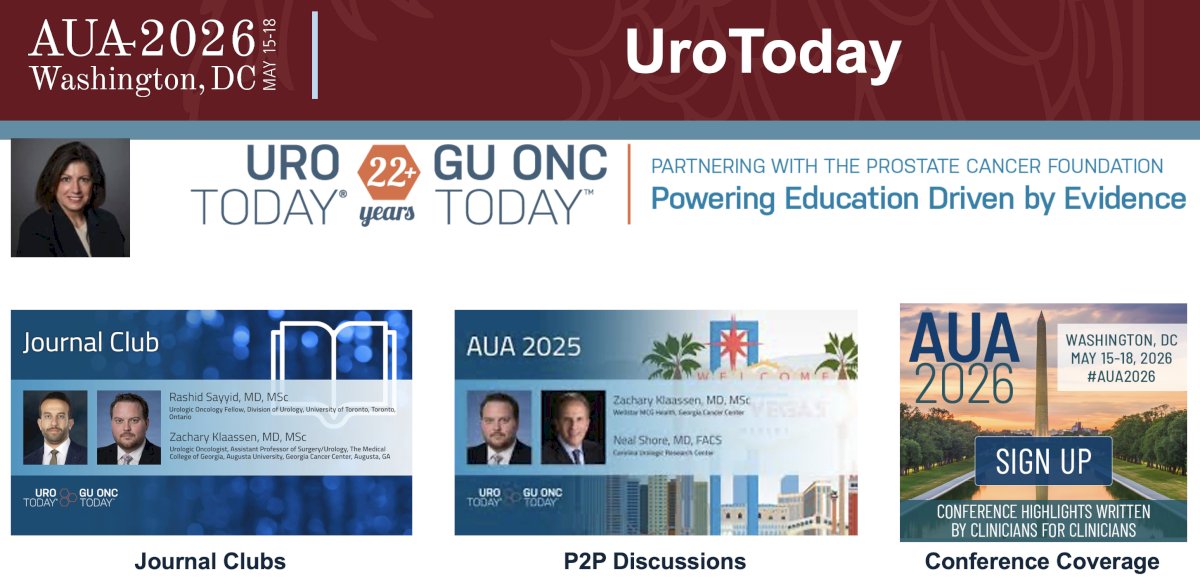
Dr. Klaassen concluded with a succinct but highly impactful take-home message: the most effective strategy for educating clinicians and dispersing new information is repetition across multiple channels. Scientific meetings introduce the data, publications provide validation, social media amplifies awareness, tumor boards contextualize findings, guidelines formalize recommendations, community outreach broadens access, and digital education reinforces understanding. Through repeated exposure in different formats, emerging evidence is progressively translated into routine clinical practice.
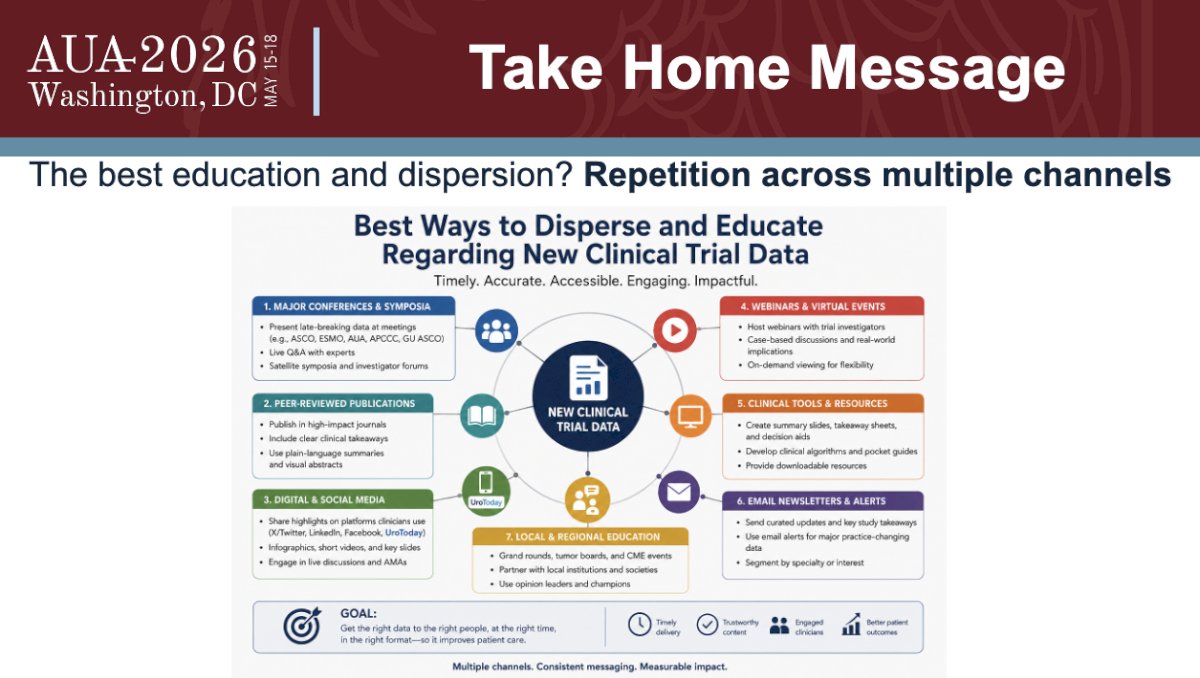
In summary, this presentation provided an insightful overview of the modern evidence dissemination ecosystem in urologic oncology. Dr. Klaassen emphasized that generating robust clinical trial data is only the first step toward improving patient outcomes. Equally important is the deliberate and coordinated effort to educate clinicians through diverse and complementary platforms so that meaningful advances are rapidly and effectively integrated into care across both academic and community settings.
Presented by: Zachary Klaassen, MD, MSc, Urologic Oncologist, Assistant Professor of Surgery/Urology at the Medical College of Georgia at Augusta University, Well Star MCG, Georgia Cancer Center, Augusta, GA
Written by: Rashid K. Sayyid, MD, MSc, Assistant Professor, Urologic Oncologist, Department of Urology at The University of Arizona and Banner University Medical Center, Tucson, AZ – @rksayyid on X during the American Urological Association (AUA) 2026 Annual Meeting, Washington, DC, Fri, May 15 – Mon, May 18, 2026.