

(UroToday.com) The 2026 AUA annual meeting featured an invasive bladder cancer session and a presentation by Dr. Daniel Roberson discussing perioperative and oncologic outcomes of consolidative surgery for advanced urothelial carcinoma following induction enfortumab vedotin and pembrolizumab. Combination enfortumab vedotin + pembrolizumab has led to unprecedented responses in advanced urothelial carcinoma. However, the role of consolidative surgery for patients with favorable treatment response remains undefined. This study presented at AUA 2026 evaluated perioperative and oncologic outcomes of consolidative surgery after enfortumab vedotin + pembrolizumab for advanced urothelial carcinoma.
This was a multi-institutional, retrospective study conducted across 10 academic medical centers from 2023-2025. Eligible patients underwent consolidative radical cystectomy or nephroureterectomy following ≥ 2 cycles of induction enfortumab vedotin + pembrolizumab for cT4N0M0, cTanyN+M0, or cTanyNanyM+ urothelial carcinoma. The decision and timing for surgery were based on radiographic treatment response and were at the treating physicians’ discretion. Pathologic, perioperative, and oncologic endpoints are reported.
Dr. Roberson and colleagues identified a total of 53 patients who underwent post-enfortumab vedotin + pembrolizumab surgery, of whom 21 patients (39.6%) had a complete radiographic response to enfortumab vedotin + pembrolizumab. Baseline characteristics, perioperative, and oncologic outcomes are detailed in the following table:
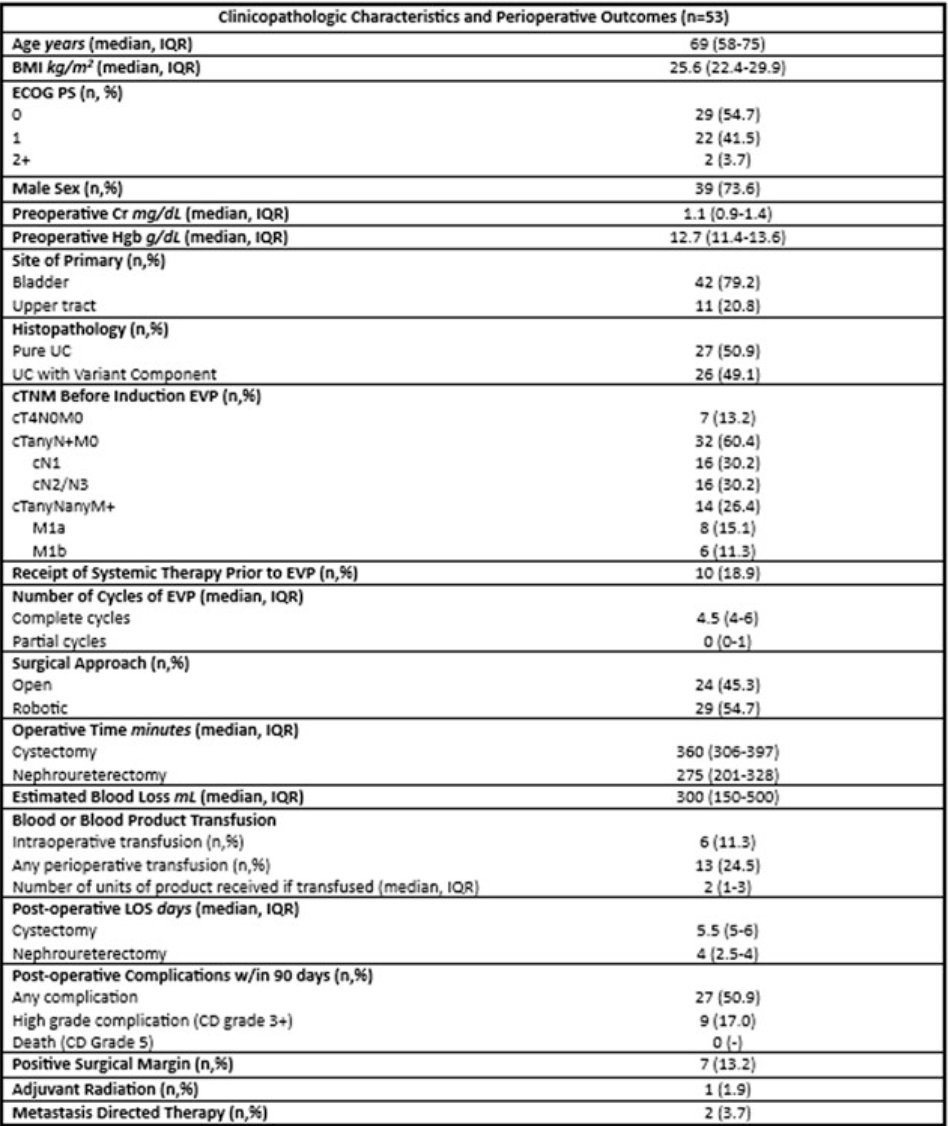
Pathologic downstaging was found in 39 (73.6%) patients, including 20 (37.7%) patients with pathologic complete response and 12 (22.6%) patients with only non-invasive residual disease in the primary.
Within 90 days of surgery, 9 (17%) patients experienced a high-grade complication (Clavien ≥ 3). Twelve (22.6%) patients continued adjuvant systemic therapy post operatively. With a median follow up after surgery of 6 (IQR 3-11) months, 6 patients experienced disease recurrence, of whom two died from urothelial carcinoma. Twelve-month recurrence-free survival was 82.8%.
Dr. Roberson concluded his presentation discussing perioperative and oncologic outcomes of consolidative surgery for advanced urothelial carcinoma following induction enfortumab vedotin and pembrolizumab with the following take home points:
- Among patients with advanced urothelial carcinoma, consolidative surgery after enfortumab vedotin + pembrolizumab is associated with high rates of pathologic downstaging and favorable early oncologic outcomes
- Surgery appears safe and feasible among carefully selected patients, with perioperative morbidity as expected for contemporary radical cystectomy or radical nephroureterectomy
- Consolidative surgery in the setting of advanced urothelial carcinoma shows promising early results, and this paradigm warrants further investigation
Presented by: Daniel Roberson, MD, Mayo Clinic, Mayo Clinic, Rochester, MN
Written by: Zachary Klaassen, MD, MSc – Urologic Oncologist, Associate Professor of Urology, Georgia Cancer Center, Wellstar MCG Health, @zklaassen_md on Twitter during the American Urological Association (AUA) 2026 Annual Meeting, Washington, DC, Fri, May 15 – Mon, May 18, 2026.