

(UroToday.com) Dr. Leonardo Quarta from the San Raffaele Scientific Institute, Milan, presented a study evaluating the oncologic outcomes and conditional survival of patients with prostate cancer (PCa) recurrence after radical prostatectomy (RP) who were managed with metastases-directed therapy (MDT) based on positive PSMA PET imaging.
As PSMA PET imaging has become more widely adopted for biochemical recurrence (BCR) detection, MDT — including stereotactic ablative radiotherapy (SABR) to nodal, bone, or visceral metastases — has emerged as a therapeutic option. However, real-world long-term outcomes following MDT in this setting remain poorly defined.
The study retrospectively analyzed 805 patients who underwent PSMA PET for BCR following RP (with or without salvage radiotherapy) between 2016 and 2024 at a single tertiary referral center. Patients who had received adjuvant radiotherapy were excluded.
Among 330 patients with a positive PSMA PET, 54% underwent MDT. Patients who underwent MDT were compared to those who did not. Primary outcomes included BCR-free survival and metastasis-free survival (MFS), evaluated via Kaplan-Meier analysis. Multivariable Cox regression models adjusted for adverse pathology, surgical margins, salvage treatments, and androgen deprivation therapy (ADT) use. Conditional survival analysis further assessed outcomes based on time elapsed without recurrence.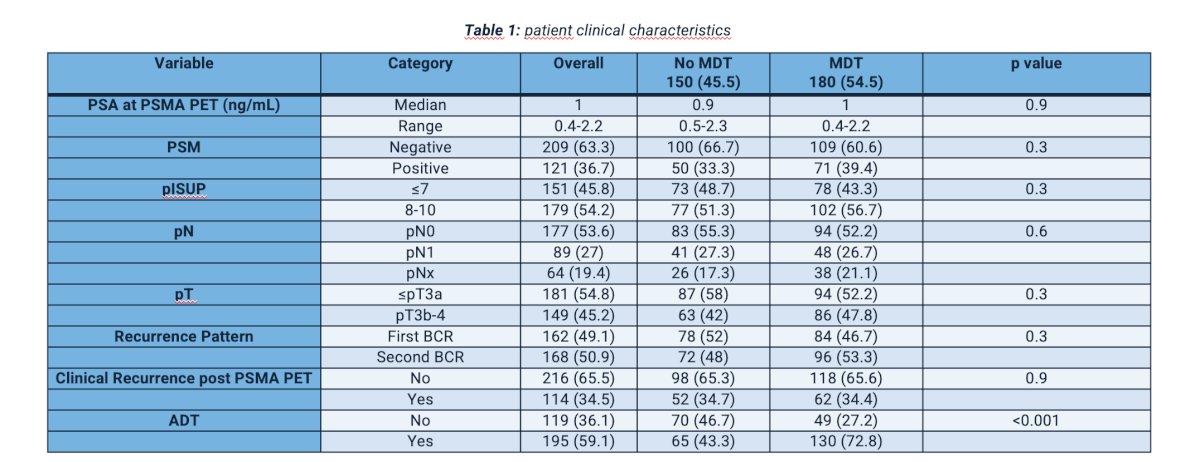
At a median follow-up of 36 months, 62 patients in the MDT group and 52 patients in the non-MDT group experienced metastatic progression. Patients who received MDT demonstrated significantly higher five-year BCR-free survival rates compared to those who did not (40% vs. 18%; p = 0.02), as well as improved five-year metastasis-free survival (MFS) (70% vs. 45%; p < 0.05). On multivariable analysis, MDT remained independently associated with a reduced risk of metastatic progression (HR 0.71; p = 0.03). Furthermore, the addition of androgen deprivation therapy (ADT) to MDT further improved five-year MFS (HR 0.61; p = 0.03) and delayed time to first recurrence (HR 0.98; p = 0.04).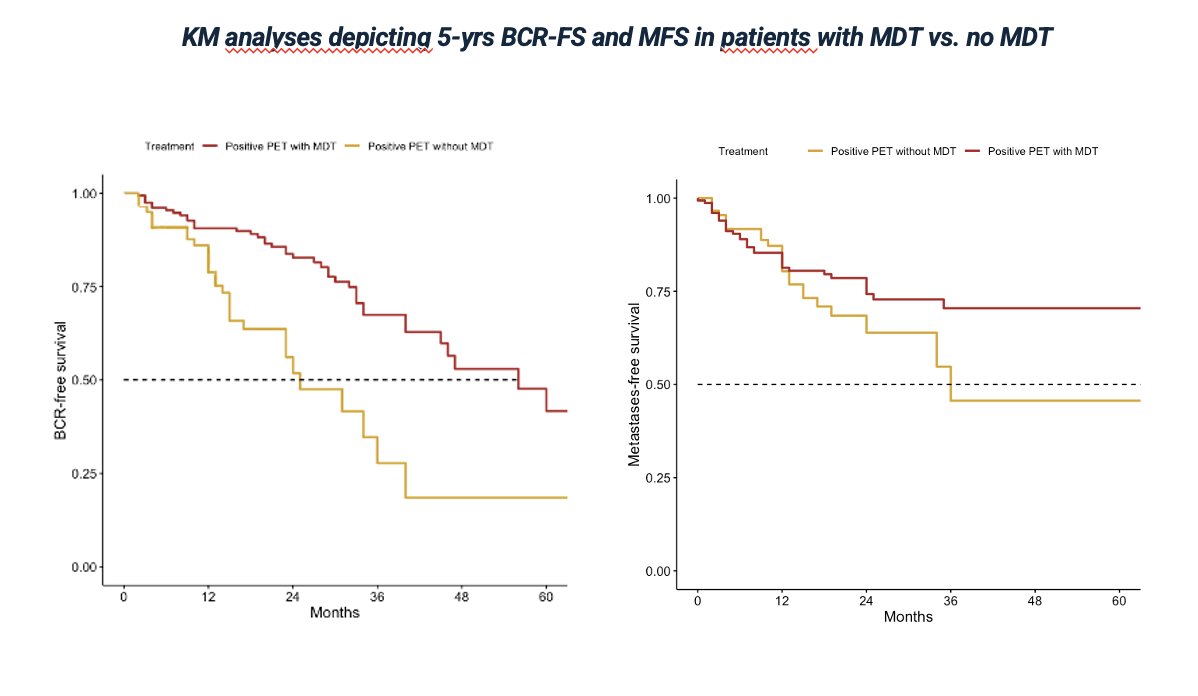
Figure 1.
Conditional survival analyses showed that patients who remained free of progression at 6 months, 1 year, and 2 years following MDT achieved progressively higher five-year BCR-free and MFS rates, with MFS rising from 59% at six months to 85% at two years. In contrast, patients who did not undergo MDT exhibited lower survival probabilities over time, with no significant improvement in outcomes despite remaining initially progression-free.
In patients with prostate cancer recurrence and a positive PSMA PET following radical prostatectomy, MDT significantly improved key oncologic outcomes, including BCR-free and metastasis-free survival.
- Survival benefits were further enhanced when ADT was administered in conjunction with MDT.
- Importantly, achieving a recurrence-free interval of 6 months or longer after MDT was strongly associated with improved long-term outcomes.
These findings highlight the potential of MDT, particularly when combined with systemic therapy, to meaningfully alter the disease course in selected patients with PSMA PET-detected recurrences.
Dr. Quarta’s presentation prompted some clarifying questions with one audience member inquiring on the main modality of MDT used in the study, which the presenter emphasized was Stereotactic Ablative Radiation Therapy or SABR.
Presented by: Leonardo Quarta, MD, San Raffaele Scientific Institute, Milan
Written by: Mark Sarwat Hana, Assistant Research Specialist, Department of Urology, University of California Irvine, during the American Urological Association's 2025 Annual Meeting, between April 26 – 29, 2025 in Las Vegas, NV.