

(UroToday.com) The American Urological Association (AUA) 2025 Annual Meeting, held in Las Vegas, NV, was host to an advanced prostate cancer podium session. Dr. Alejandro Sanchez presented the results of SOAR, a phase II trial of image-guided oligometastasectomy and radiation therapy in recurrent prostate cancer patients.
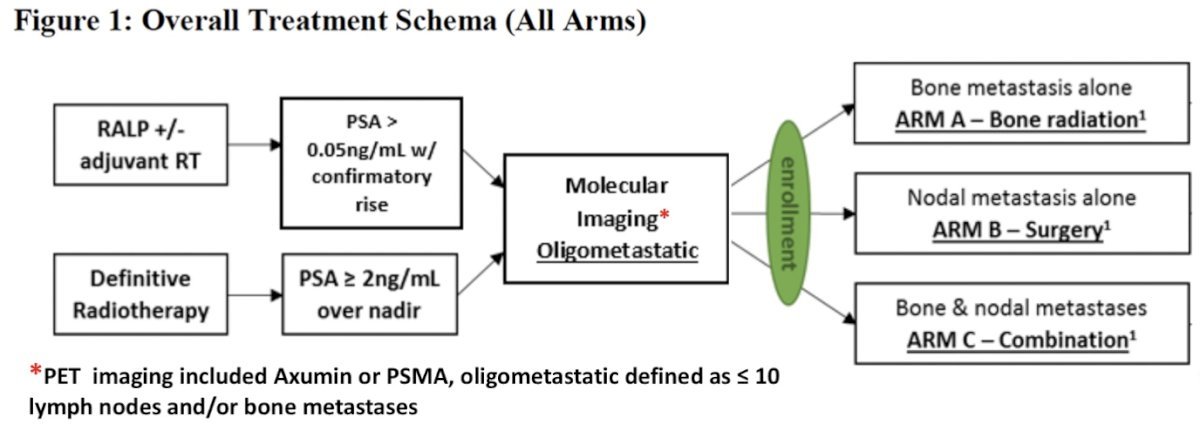
SOAR is a phase II trial of patients with oligorecurrent prostate cancer following primary prostatectomy or radiation therapy. Patients were staged using either an Axumin (n = 11) or PSMA PET (n=9). Oligometastatic disease was defined as ≤ 10 metastases, either of bone only (Group A), nodal only (Group B), or bone and nodal (Group C). The overall treatment schema is summarized below, with treatment as follows:
- Arm A (bone metastases): Bone radiation
- Arm B (nodal metastases alone): Surgery
- Arm C (bone + nodal metastases): Surgery + radiation
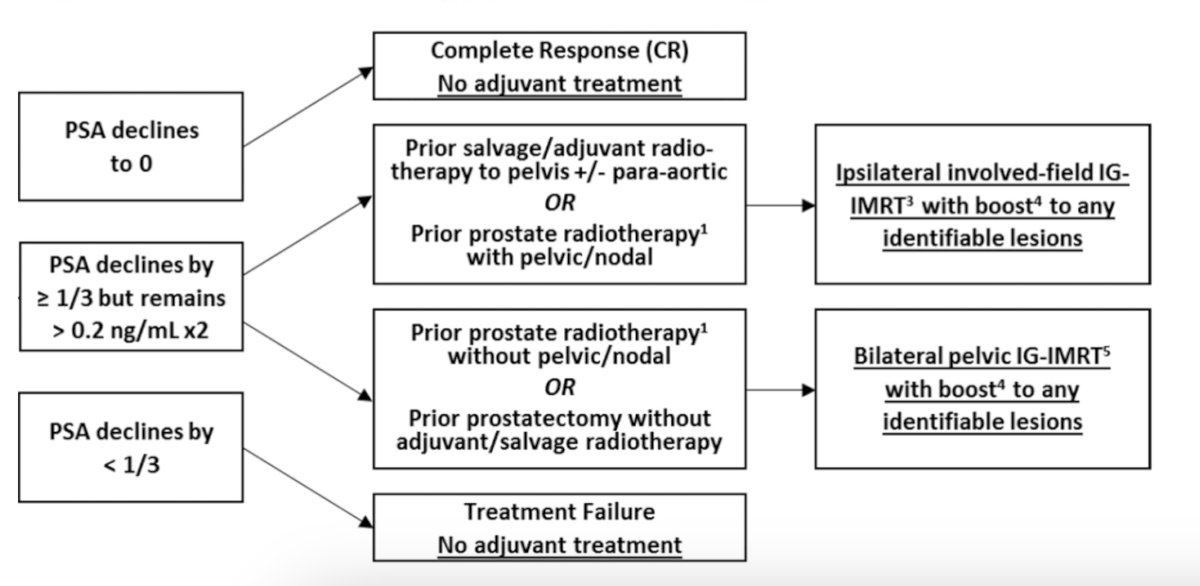
In patients with a PSA decline to undetectable levels (i.e., complete responders) or those with a PSA decline of <1/3, no adjuvant treatment was given. Groups A and C received adjuvant intensity-modulated radiotherapy (IMRT) without ADT if PSA response was ≥ 1/3 decrease but remained ≥ 0.2 ng/dL:
Surgical intervention for patients with prostate cancer disease included extended pelvic and/or retroperitoneal lymph node dissection, depending on the location of the lymph nodes. The primary endpoint was a reduction in PSA by ≥ 50% at 6 months. Secondary objectives included PSA progression free-survival, ADT-free survival, and perioperative safety.
This trial accrued a total of 20 patients between September 2019 and May 2023. Two of 20 patients were enrolled in Arm A, 18 of 20 patients in Arm B, and no patients were enrolled in Arm C. Within Arm B, two patients completed adjuvant radiotherapy.
The median age was 65 years (IQR 61-71), 95% had an ECOG of 0, and 10% were Hispanic. The median time from primary local therapy to trial treatment was 2.2 (IQR: 0.7–4.5) years, and the median PSA at enrolment was 1.3 ng/mL (IQR: 0.6–3.4).
All patients had a prior prostatectomy, with a median PSA of 8.1 ng/mL at diagnosis (IQR: 5.8–11.6), with 25% having GG1-2, 50% GG3, 25% GG4, and 25% having pTanyN1 disease. Overall, 85% of patients had a prior lymph node dissection, 35% had positive margins, and 45% had received adjuvant/salvage radiotherapy + ADT. The mean number of PET identified lymph nodes (Group B) was 1.8 (range: 1–6), and the mean number of lymph nodes identified on pathology was 5.1 (range: 1–31).
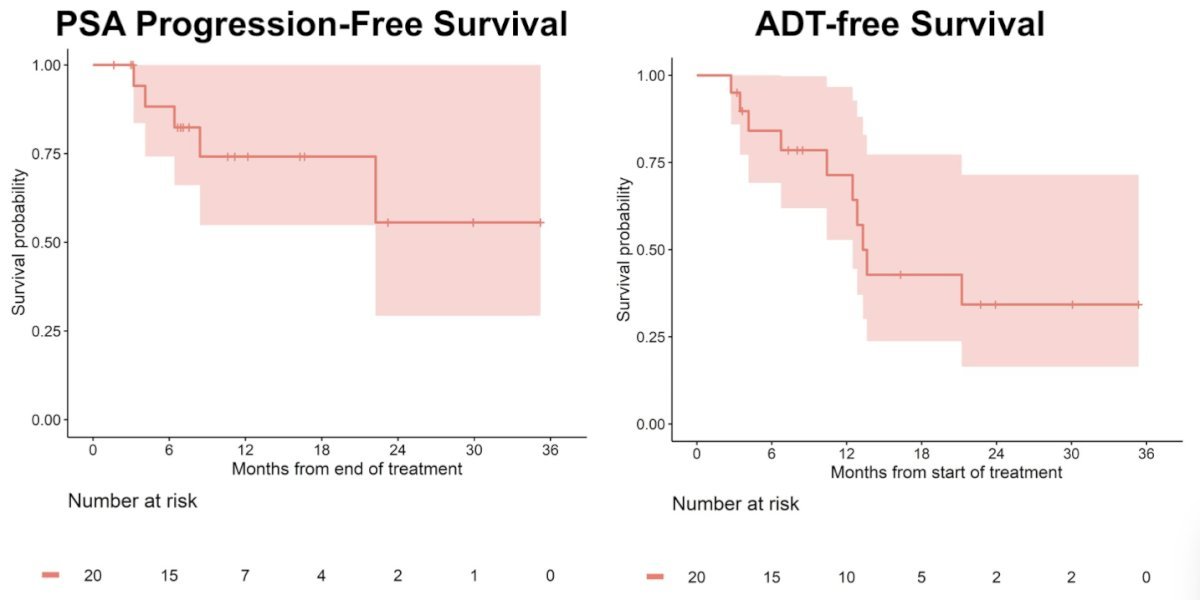
The primary endpoint of reduction in PSA by ≥ 50% at 6 months was 40% (95% CI: 19–64%). The secondary endpoint of PSA progression free-survival at 12 months was 74.1% (95% CI: 54.8–100%), and ADT-free survival at 12 months was 71.4% (95% CI: 52.7–96.6%):
There were no Clavien-Dindo Grade III-IV complications.
Dr. Sanchez concluded his presentation discussing SOAR, a phase II trial of image-guided oligometastatectomy and radiation therapy in recurrent prostate cancer, with the following take-home points:
- Treatment of oligometastatic disease after prostatectomy, identified on PET imaging, is safe, and at 12 months, ~70% of patients are free of PSA recurrence and off ADT
- Ongoing analyses include comparing imaging and pathology correlations, and comparing complete/partial responders and treatment failure
- Further research is needed to identify ideal candidates for salvage treatment
Presented by: Alejandro Sanchez, MD, Huntsman Cancer Institute at the University of Utah, Salt Lake City, UT
Written by: Rashid K. Sayyid, MD, MSc – Robotic Urologic Oncology Fellow at The University of Southern California, @rksayyid on Twitter during the 2025 American Urological Association (AUA) annual meeting held in Las Vegas, NV, Saturday, April 26 - Tuesday, April 29, 2025