

(UroToday.com) Dr. Dan Stoianovici of the Brady Urological Institute and Robotics Laboratory at Johns Hopkins University presented an updated analysis investigating the impact of prostate size and the number of systematic biopsy (SB) cores on the detection of clinically significant prostate cancer (csPCa). This work builds upon previous findings and incorporates new patient data from an ongoing robot-assisted biopsy clinical trial.
While MRI-targeted biopsy (TB) has improved prostate cancer detection, systematic biopsy (SB) remains a critical complementary approach, often identifying csPCa missed by TB. However, the optimal number of SB cores required, particularly as it relates to prostate volume, remains unclear. This updated analysis aimed to evaluate the joint influence of prostate volume and SB core number on both cancer detection probability (csCDP) and successful sampling of MRI-depicted regions of interest (ROIs), even when SB is performed without MRI guidance.
The analysis expanded from 42 to 56 patients enrolled in the robot-assisted biopsy trial. For each patient, SB plans with 1 to 24 cores were simulated, resulting in 1,128 simulated biopsy procedures and 16,800 total cores. Each simulation plan was optimized to maximize the probability of detecting csPCa ("capsules" relative to gland volumes). Outcomes assessed included overall csCDP and the percentage of MRI-detected ROIs successfully sampled using SB alone.

Simulation results demonstrated a significant impact of prostate volume on csPCa detection. As depicted in Figure 1 of the poster, prostate size was directly correlated with the effectiveness of SB: smaller prostates achieved higher cancer detection rates with fewer cores compared to larger prostates. While pointing to Figure 1, the presenter colloquially explained “even at 24 cores you will get nothing” when expounding on the difficulty of effective SB with larger prostate size.
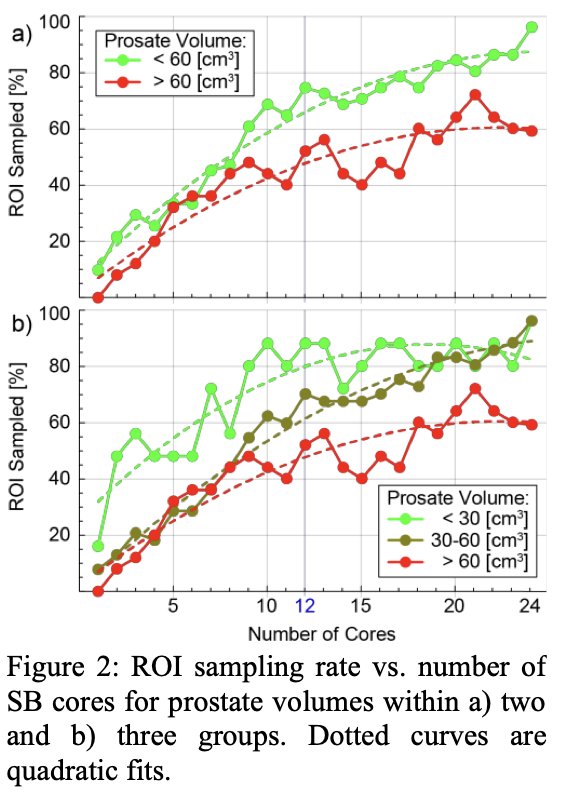
Further analysis examined the number of cores required to sample MRI-depicted ROIs even without MRI guidance. Patients were stratified by prostate size into groups (< 30 cm³, 30–60 cm³, and > 60 cm³). In prostates smaller than 30 cm³, an optimized SB plan using only 12 cores could successfully sample nearly 90% of MRI-defined ROIs. In contrast, larger prostates required significantly more cores to achieve comparable sampling success, and even then, under-sampling remained a concern.
Figure 2 illustrates that in small glands (< 30 cm³), detection rates plateaued with a moderate number of cores, whereas in larger glands, detection rates rose more slowly and plateaued at lower overall success percentages.
Dr. Stoianovici simply summed up his results by saying, “what these graphs are showing is what urologists have already known, that when you have a larger prostate, getting a biopsy is harder,” but clarified, “it is the first time that this is quantified.”
This updated study reinforces that prostate volume plays a critical role in systematic biopsy performance.
- In smaller prostates (<30 cm³), optimized systematic biopsy alone — even without MRI fusion — can achieve high detection rates of clinically significant prostate cancer with a relatively modest number of cores.
- In larger prostates, systematic biopsy alone is associated with higher risks of under-sampling and under-detection of csPCa.
These findings emphasize the importance of tailoring biopsy strategies to prostate size and support more selective integration of MRI-targeted techniques, particularly for patients with larger glands.
Presented by: Dan Stoianovici, PhD, Brady Urological Institute and Robotics Laboratory, Johns Hopkins University
Written by: Mark Sarwat Hana, Assistant Research Specialist, Department of Urology, University of California Irvine, 2025 Engineering and Endourology Society (EUS) at the American Urological Association's 2025 Annual Meeting, between April 26 – 29, 2025 in Las Vegas, NV.