

(UroToday.com) Dr. Alejandro Bautista-Pérez-Gavilán discussed his new work on going previously developed gold and silver nanoparticle coatings that have anti-microbial activity. At last year’s AUA, Dr. Bautista-Pérez-Gavilán and team showed that these nanoparticles had 100% reduction of microbial activity across multiple species.
In the work presented today, optimization of the gold and silver nanoparticle coatings is achieved by suiting a dynamic environment of the urinary tract and improving synthesis to achieve the highest concentration of nanoparticles. The team designed several different coatings with the overarching theory that a polydopamine matrix can enhance the activity of these nanoparticles and can fix them to the surface of polyurethane coupons.
For results of the optimization process, the team saw that across steric speeds, a dynamic molecular process, the concentration of nanoparticles is the same. However, with temperature variation, it was observed that the concentration of nanoparticles dramatically decreases as temperature increased, suggesting that a thermodynamic process contributes to nanoparticle concentration. When assessing antimicrobial properties of the coated nanoparticles, a combined matrix of polydopamine and nanoparticles showed 100% production across several days. In the dynamic environment, with slightly higher concentrations of bacteria, the matrix showed a promising reduction in antibacterial activity. A summary of results is represented graphically below.
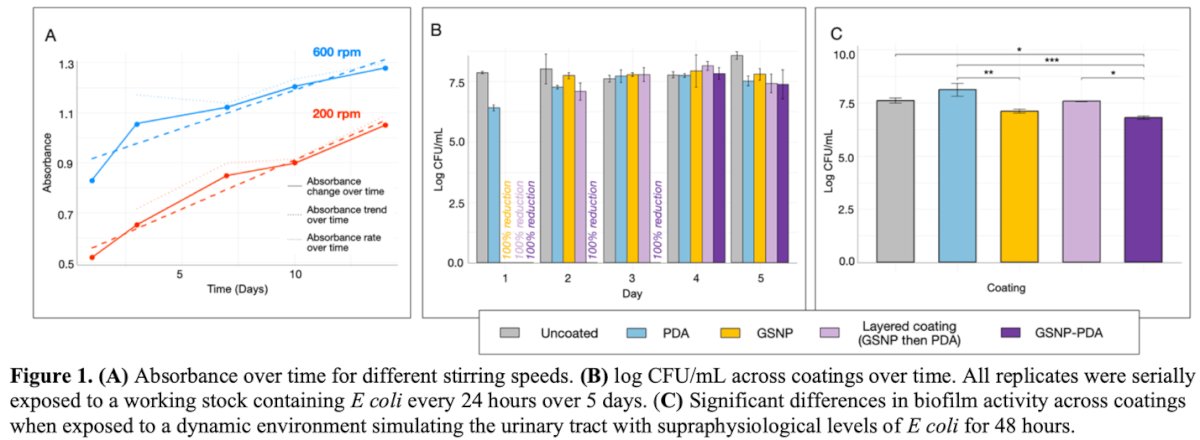
During the discussion, an audience member suggested simulating the mechanical stability of the nanoparticles under physiologic urinary flow rates to identify if the polydopamine coating will weaken. Dr. Alejandro Bautista-Pérez-Gavilán expressed agreement with this suggestion and alluded to ongoing efforts to investigate this relationship. The authors believe that polydopamine is a suitable coating for the nanoparticles, however, this requires further studies to confirm and expand their findings.
Presented by: Alejandro Bautista-Pérez-Gavilán, MD, Research Fellow, Department of Urology, Cleveland Clinic, Ohio, USA
Written by: Tyler Lunow-Luke, Medical Student Year 3, University of California, Irvine, during the 2025 American Urological Association (AUA) Annual Meeting, April 26 – April 29, 2025, Las Vegas, Nevada
References:- Bautista-Perez-Gavilan, A., Gutierrez-Aceves, J., De, S., Miller, A. W., & Krishna, V. (2025, April 28). Optimization of gold-silver nanoparticle coatings with antimicrobial and antibiofilm properties [Poster presentation]. 38th EUS Annual Meeting, Las Vegas, NV, USA.