

(UroToday.com) The 2025 AUA annual meeting featured a bladder cancer clinical trials in progress session and a presentation by Dr. Boris Chertin discussing a prospective open label study to evaluate the safety and efficacy of intravesical sustained release gemcitabine docetaxel combination (NDV-01) in high risk non muscle invasive bladder cancer. In bladder cancer, there is a high unmet medical need for organ sparing therapies. There are over 800,000 bladder cancer patients in the United States alone, with ~75% of these patients having non muscle invasive disease. Approximately 70-80% of patients with non muscle invasive bladder cancer develop recurrence after treatment, and 23% of recurrent patients have 5 or more recurrences. Moreover, non muscle invasive bladder cancer patients are receiving fewer courses of BCG secondary to global BCG shortages. Thus, bladder cancer is one of the highest lifetime treatment costs of all cancers, with a >$6 billion annual cost of treatment in the United States.
Gemcitabine + docetaxel has shown a 50-60% 12 month recurrence free survival in BCG unresponsive high risk non muscle invasive bladder cancer, and 85-92% rate in BCG-naïve non muscle invasive disease. Gemcitabine is a non-vesicant chemotherapeutic agent that acts as a deoxycytidine nucleoside analog, thereby inhibiting DNA synthesis, resulting in cell apoptosis. Docetaxel is an anti-mitotic chemotherapeutic agent that inhibits tubulin disassembly, thereby stopping cell division. Treatment with gemcitabine + docetaxel requires catheter placement and two hours of follow-up in the clinic, and patients must avoid urination for two hours after installation. For the most part, this has been reserved for treatment at academic medical centers, and data is based on retrospective studies.
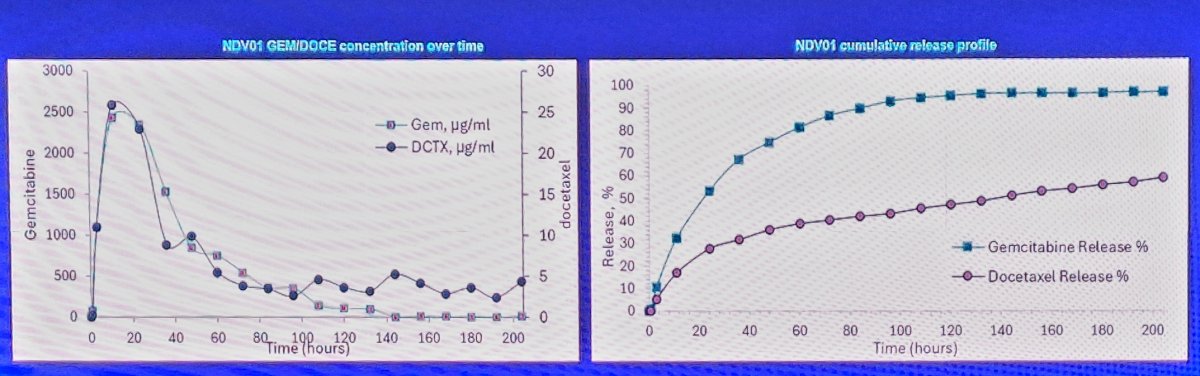
NDV-01 has targeted activity, with a bladder-targeted semi-solid matrix acting as an in situ drug reservoir inside the bladder. There is a synergistic mechanism of action with the combination of gemcitabine (1000 mg) and docetaxel (40 mg), with programmed release of the drugs into the bladder continuously for over 10 days. NDV-01 spontaneously and gradually disintegrates and is safely excreted in the urine. There has been no bladder obstruction observed in multiple repeated doses, and it comes in a prefilled syringe that allows easy instillation in less than 10 minutes.
In vitro profiles demonstrate stable and predictable drug levels, minimizing peaks and troughs associated with systemic side effects. Controlled drug exposure can maximize anti-tumor activity while reducing the frequency of administration, enabling biweekly dosing:
This study was an open-label, single-arm, single center study to evaluate the safety and efficacy of NDV-01 in high risk non muscle invasive bladder cancer. Inclusion criteria included patients with high grade disease with CIS, Ta, or T1 tumors, and could be either BCG naïve, BCG unresponsive, intolerant, or experienced patients. There will be 70 patients receiving intravesical NDV-01 with 6 bi-weekly instillations, and maintenance of monthly instillations. Follow-up will include urine cytology, cystoscopy, upper tract imaging, and TURBT if necessary. The oncological outcomes include:
- High grade recurrence free survival
- Progression free survival
- Cystectomy free survival
- Metastasis free survival
- Cancer specific survival
- Overall survival
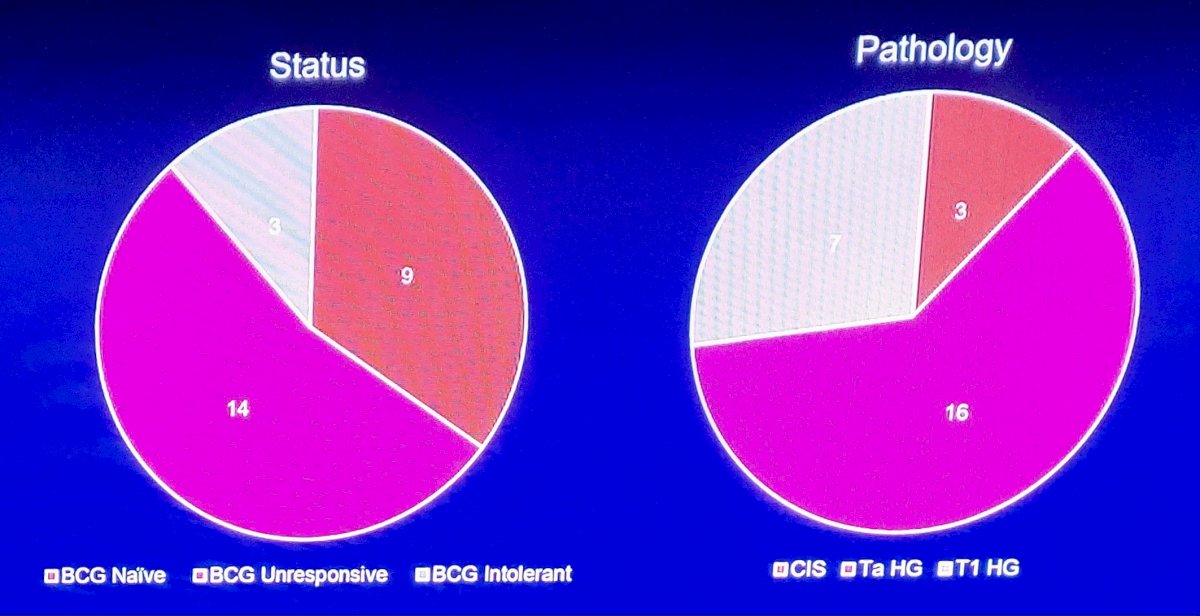
To date, there have been 26 patients enrolled, with a median age of 72.4 years (IQR 66.9-78.3), 84.6% of patients are male, all patients are Caucasian, and 73.1% have an ECOG performance status of 0. The BCG status and pathology characteristics are as follows:
To date, cystoscopic examination has been performed on 20 patients at 3 month follow-up. There were 19 patients with a negative cytology, and among the one patient with a positive cytology, subsequent cystoscopy and random biopsies were negative. There were 3 patients with high grade Ta recurrence (15%), of which 2 were in BCG naïve patients, and 1 was in a BCG unresponsive patient, for an overall high grade recurrence free survival rate of 85%. At 6 months, cystoscopy has been performed in 6 patients, cytology was negative in all patients, and one patient had CIS confirmed with biopsy. There has been a complete response in one patient with HG Ta recurrence at 3 months, who subsequently had another induction course of therapy. With regards to tolerability, 8 patients (30.7%) had grade 1 dysuria that resolved in two days, and 5 patients (19.2%) had grade 1 nonspecific flank pain likely secondary to musculoskeletal in origin that resolved in 24 hours.
Dr. Chertin concluded his presentation discussing a prospective open label study to evaluate the safety and efficacy of intravesical sustained release gemcitabine docetaxel combination (NDV-01) in high risk non muscle invasive bladder cancer with the following take home points:
- This preliminary data shows high efficacy and safety with NDV-01 in BCG-naïve and BCG-unresponsive patients with non muscle invasive bladder cancer
- Longer follow-up and continued enrolment are required
Written by: Zachary Klaassen, MD, MSc – Urologic Oncologist, Associate Professor of Urology, Georgia Cancer Center, Wellstar MCG Health, @zklaassen_md on Twitter during the 2025 American Urological Association (AUA) annual meeting held in Las Vegas, NV, Saturday, April 26 - Tuesday, April 29, 2025