

(UroToday.com) Dr. Simone Scuderi and colleagues evaluated the impact of pre-operative PSMA PET/CT on early oncologic outcomes in prostate cancer patients treated with radical prostatectomy (RP), using a multi-center Italian experience.
As the authors noted, PSMA PET/CT is increasingly being utilized in the pre-operative setting for staging, supplanting traditional staging studies (CT scan and NM Bone scan). It should be noted that its use is variable, primarily depending on availability – in Europe, it is likely more utilized than in the US. Even in the US, though, it is increasingly being used.
PSMA-PET in prostate cancer (PCa) staging is associated with higher accuracy for nodal and metastatic detection than conventional imaging. As the authors note, however, current clinical guidelines still do not recommend PSMA-PET before radical prostatectomy (RP).
The authors hypothesized that the implementation of PSMA PET in the preoperative staging pathway is associated with better patient risk stratification and early cancer control. To that effect, they identified 3,978 cN0M0 PCa patients treated with RP +/- extended pelvic nodal dissection between 2010 - 2022. Of these, 3,518 men staged with conventional imaging were identified in a single institution dataset (Group 1). An additional 278 patients with available details both on PSMA PET and CT scans were identified from a multi-institutional cohort of men staged with PSMA-PET (Group 2). Early recurrence was defined as PSA persistence (first postoperative PSA >= 0.1 ng/ml) or PSA rise >= 0.2 ng/ml within 1 year after RP. Multivariable logistic regressions (MLR) tested the impact of the preoperative imaging on early recurrence. MLR models tested for predictor status of PET-PSMA and CT-scan after adjusting for PSA, biopsy grade group (GG), and non-organ-confined (NOC) disease at mpMRI. Accuracy of MLR models containing PET-PSMA (model 1) and CT-scan (model 2) were assessed with the ROC-derived AUC. Decision-curve analyses (DCA) assessed the net benefit associated with the use of the two models.
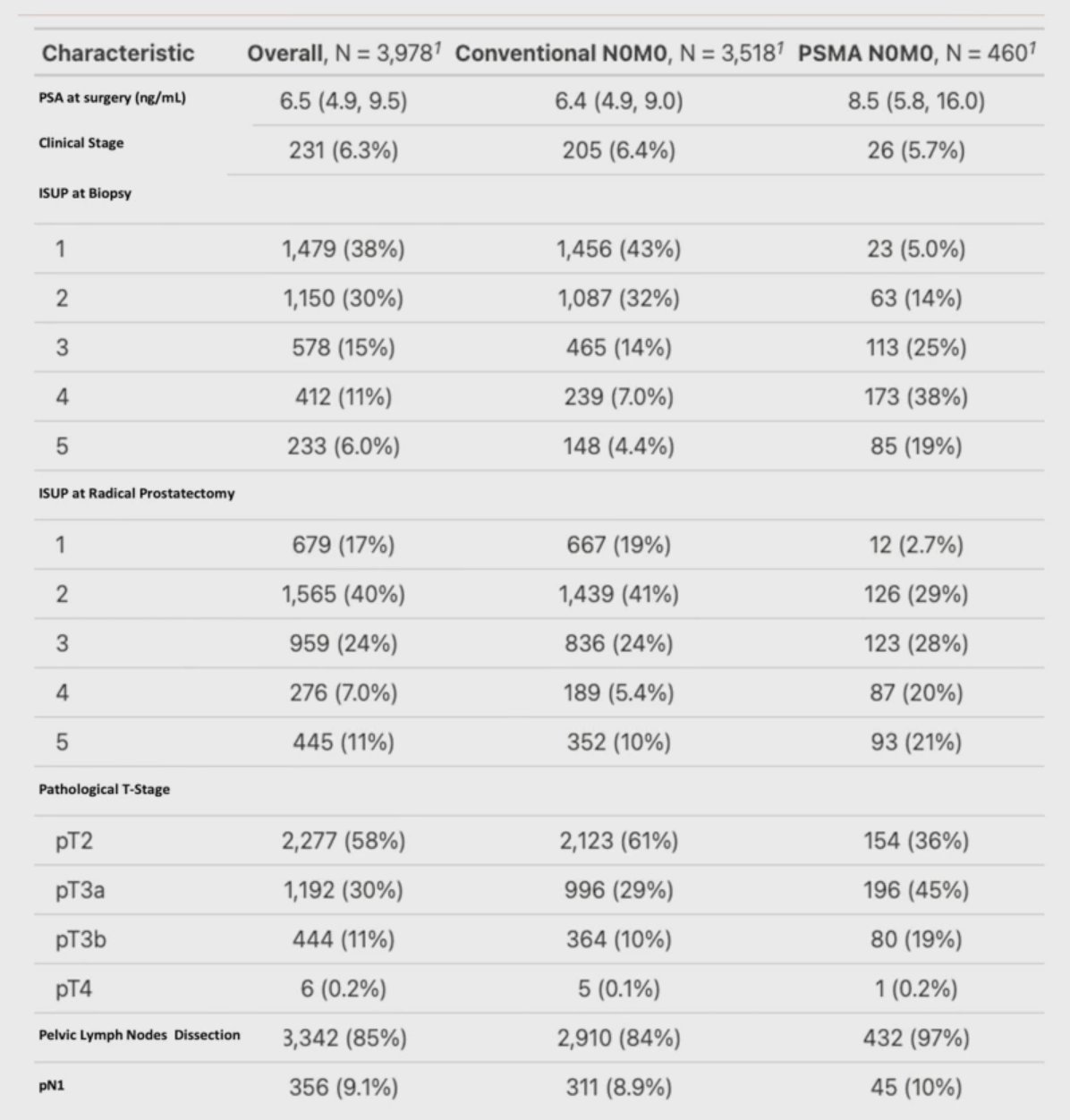
In this study, 282 patients experienced early recurrence. Patients in Group 2 had higher preoperative PSA values (8.5 vs. 6.4 ng/mL) and higher rates of biopsy grade group (GG) >3 (57% vs. 11%, all p <0.01) compared to Group 1.
*They were likely selected for this, as they got a PSMA PET/CT.
Full demographics are shown below:
Early Recurrence Free-survival is shown below:
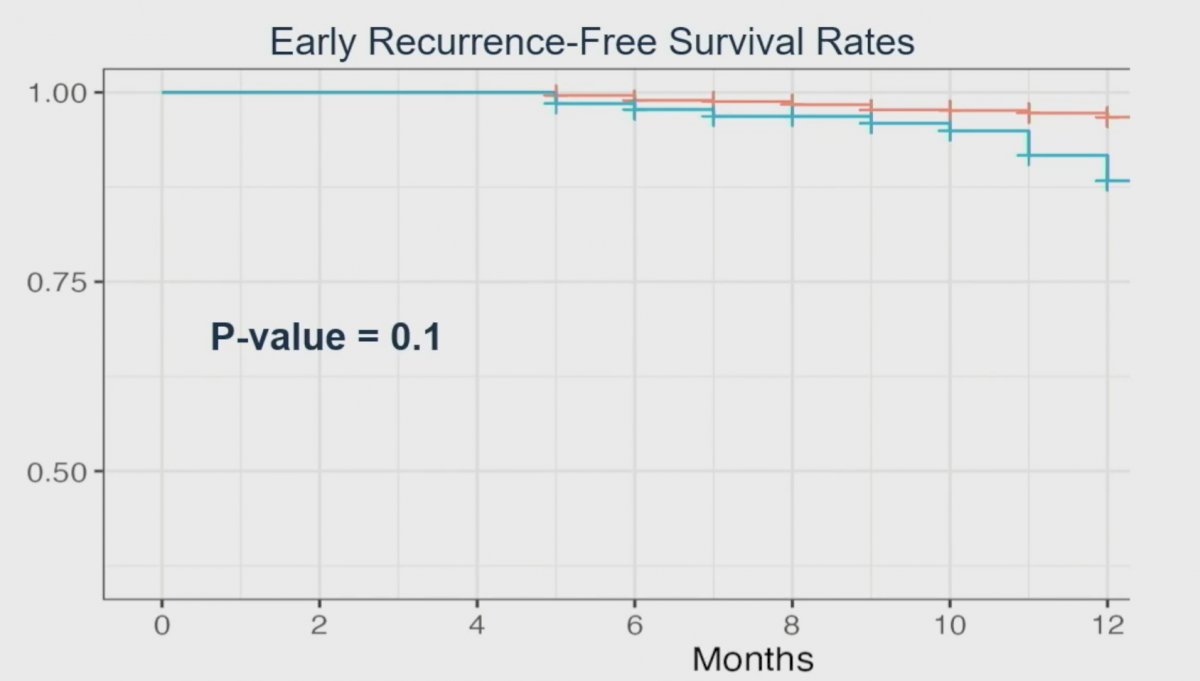
Despite this, early BCR rates were similar between the two groups (12% vs. 10% for group 2 and group 1, respectively, p=0.3). On MLR, being staged with PSMA-PET was associated with a lower risk of early recurrence (OR 0.61, p=0.01) after accounting for PSA, clinical stage, and biopsy ISUP GG.

Focusing on men with available PSMA-PET and CT, the presence of positive PET-PSMA (OR: 4.34, p=0.004) but negative CT-scan predicted early recurrence. The discrimination was higher for model 1 including PSMA-PET compared to model 2 (73 vs 67%). The adoption of model 1 including PSMA-PET was associated with a higher net benefit as compared to model 2.
Based on this, the authors conclude that clinically N0M0 PCa patients staged with PSMA PET scan are at lower risk of early recurrence when compared to those staged with conventional imaging alone. PSMA PET scan helps clinicians to improve preoperative risk stratification and to the identification of men who might benefit most from treatments.Presented by: Simone Scuderi, MD, Department of Urology San Raffaele Scientific Institute, Milan, Italy
Written by: Thenappan (Thenu) Chandrasekar, MD – Urologic Oncologist, Associate Professor of Urology, University of California, Davis @tchandra_uromd @UCDavisUrology on Twitter during the 2023 American Urological Association (AUA) Annual Meeting, Chicago, IL, April 27 – May 1, 2023