

(UroToday.com) The 2023 American Urological Association (AUA) annual meeting held in Chicago, IL between April 28 and May 1st, 2023, was host to an advanced prostate cancer session. Dr. Mark Preston presented the analysis of a real-world study examining testosterone recovery following androgen deprivation therapy (ADT) for prostate cancer.
ADT remains the backbone of treatment of most men with advanced prostate cancer. Unfortunately, treatment with injectable ADT is associated with delayed testosterone recovery to normal levels after treatment cessation. Delays in testosterone recovery may last years, adversely affecting patient quality of life. Data evaluating the clinical impact of time to testosterone recovery remain sparse. As such, the objective of this study was to examine, in a real-world setting, clinical events among prostate cancer patients with and without testosterone recovery within 1 year after discontinuing injectable ADT.
This was a retrospective, longitudinal cohort study that was conducted using the Optum Enriched Oncology EMR with integrated claims data. This study included eligible adult patients with a prostate cancer diagnosis between January 2010 and June 2021 who were initiated on first-line ADT monotherapy and had ≥1 serum testosterone level recorded during ADT treatment and within 1 year of ADT discontinuation.

Patients were classified as having testosterone suppression if their serum levels recovered to >280 ng/dL at any time within 1 year of ADT discontinuation. Clinical events at 12 months were reported: sexual dysfunction, diabetes, hot flashes, myocardial infarction, depression, and cerebrovascular accidents. Multivariable Cox proportional hazards models estimated events hazard ratios based on the testosterone recovery status, adjusting for:
- Demographics
- 1st line ADT monotherapy
- 1st line ADT treatment duration
- Use of 1st generation non-steroidal anti-androgens (NSAA) and sexual dysfunction therapies
- Clinical and comorbid conditions
- Charlson Comorbidity Index (CCI)
This analysis included 1,553 patients. The overall median age at ADT initiation was 69 years and baseline median serum testosterone was 254 ng/dL among patients with available data (50% of cohort). Almost half of the patients received concomitant NSAA therapy. Compared with the non-testosterone recovery cohort, the testosterone recovery cohort was:
- Younger
- Had higher baseline median testosterone levels
- Had a lower CCI
- Was less likely to have diabetes and a CVA
- More likely to have sexual dysfunction

During the 1st year post-ADT discontinuation, testosterone recovery was achieved by only 25% of the cohort. The median serum testosterone levels were 330.5 and 32.7 ng/dl for the testosterone recovery and non-recovery cohorts, respectively. As summarized in the figure below, most patients across both cohorts had their first testosterone lab test performed in the first 4 months post-ADT discontinuation.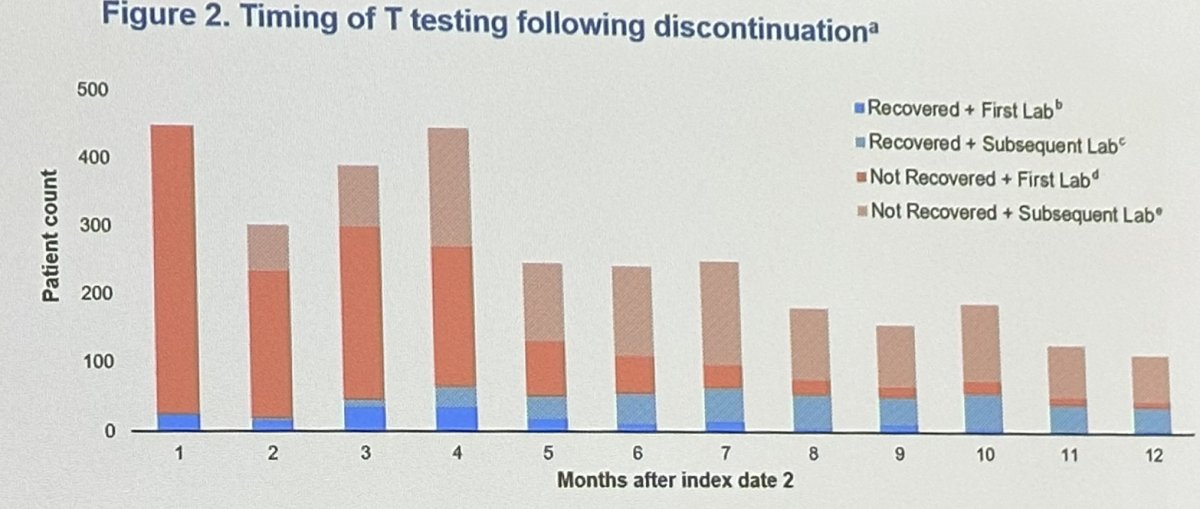
With regards to clinical outcomes, the testosterone recovery cohort had:
- A lower risk of new onset diabetes
- A trend toward lower risk of new onset depression
- A trend toward higher risk of seeking care/treatment for sexual dysfunction

Dr. Preston concluded that:
- Only 25% of patients achieve testosterone recovery within 1 year of discontinuing ADT.
- Patients with testosterone recovery:
- Were less likely to experience new onset diabetes
- Had a trend toward a lower rate of new onset depression
- Had a trend toward a higher rate of seeking care/treatment for sexual dysfunction
- Sexual dysfunction may have been higher in patients with testosterone recovery due to the fact that they were younger and may have had greater sexual interest post-testosterone recovery
- Further research is warranted in this field
Presented by: Mark A. Preston, MD, MPH, Associate Professor, Urologic Oncology, Brigham and Woman’s Hospital, Boston, MA
Written by: Rashid K. Sayyid, MD, MSc – Society of Urologic Oncology (SUO) Clinical Fellow at The University of Toronto, @rksayyid on Twitter during the 2023 American Urological Association (AUA) Annual Meeting, Chicago, IL, April 27 – May 1, 2023