

(UroToday.com) The 2023 AUA annual meeting included an advanced prostate cancer session, featuring a presentation by Dr. Antony Pellegrino discussing the effect of metastasis directed therapy (MDT) on progression patterns of patients with positive 68Ga-PSMA PET/CT and biochemical recurrence from prostate cancer. Indeed, among men with positive PSMA PET for biochemical recurrence after radical prostatectomy, MDT may represent a treatment option. However, there is little evidence regarding the role of MDT in terms of prognostic implications, as well as on the patterns of subsequent clinical recurrence.
This study retrospectively identified 225 patients with positive 68Ga-PSMA PET at biochemical recurrence after radical prostatectomy between 2016 and 2022 at a single institution. The following is a summary of the baseline characteristics:

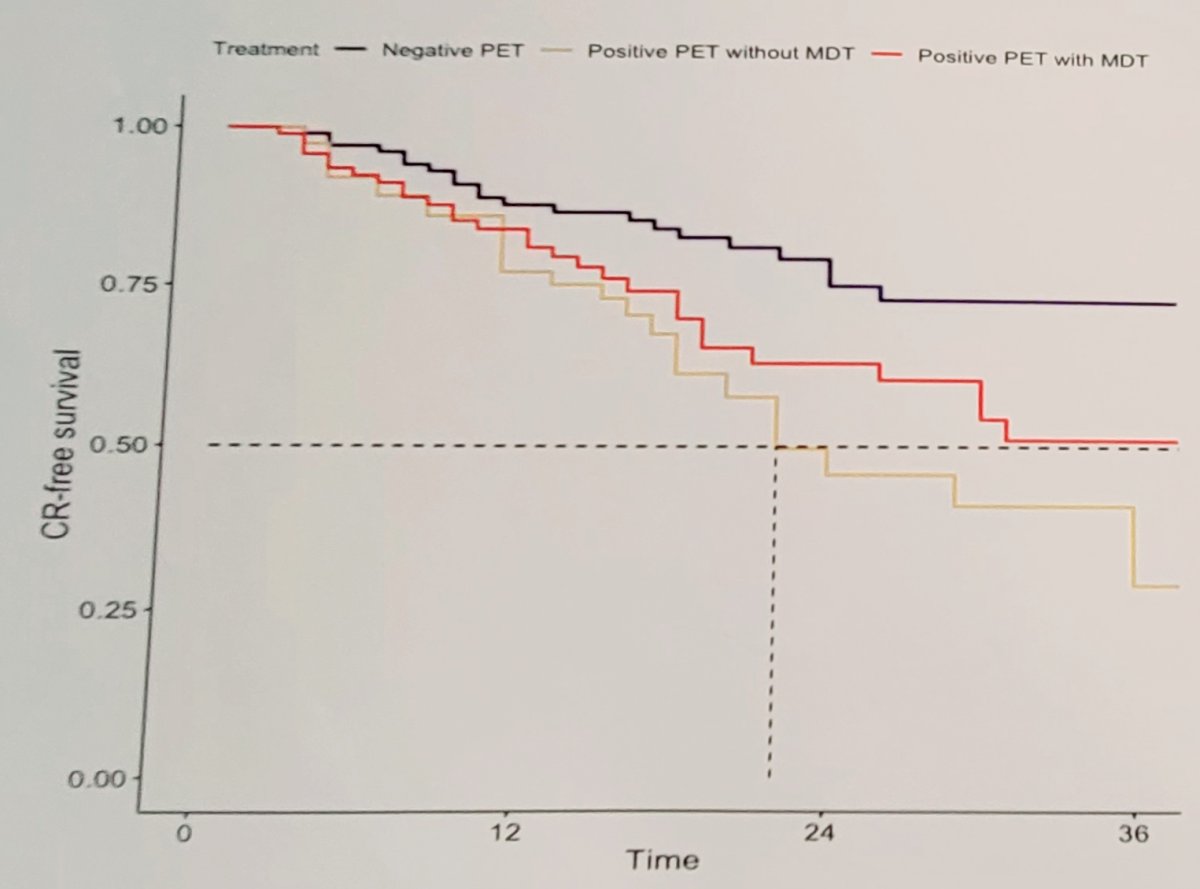
MDT consisted of stereotactic ablative radiation therapy on positive spots, either nodal, bone, or visceral. Clinical recurrence was defined as any new metastases detected at imaging after the first PSMA PET. Patients were stratified according to the use of MDT (n = 109) versus no MDT (n = 116). Kaplan-Meier analyses assessed the time to clinical recurrence. Per-lesion analysis using Pearson Chi-square assessed the impact of MDT on the location of clinical recurrence after a positive PSMA PET. The variation of the site of recurrence compared to the location of positive spots at first PSMA PET (pelvic vs non-pelvic distant spots) was tested and represented using alluvial plots.
At a median follow-up of 24 months after the first PSMA PET, 73 patients had clinical recurrence. The 3-year clinical recurrence-free survival rates were 51% for MDT versus 28% for no MDT:
The distribution of positive lesions location at first PSMA PET did not differ between men receiving or not receiving MDT (pelvic 19% vs 22%, retroperitoneal 19% vs 15%, bone 38% vs 34%, visceral 13% vs 12%, p = 0.6). Similarly, in men with clinical recurrence after a positive PSMA PET (n=73), no statistically significant differences in terms of site of clinical recurrence were observed based on MDT use (pelvic 29% vs 14%, retroperitoneal 8% vs 14%, bone 35% vs 55%, visceral 24% vs 17%, p = 0.4). However, while a significant increase in rate of distant metastases at clinical recurrence was reported in men not receiving MDT compared to the pre-MDT PSMA PET (from 77 to 86%), a reduction in the proportion of distant metastases at clinical recurrence was observed in patients receiving MDT (from 76 to 67%):

Dr. Pellegrino concluded his presentation by discussing the effect of metastasis directed therapy on progression patterns of patients with positive 68Ga-PSMA PET/CT and biochemical recurrence from prostate cancer with the following take-home messages:
- The use of MDT may represent a protective factor for metastases during follow-up
- Interestingly, the pattern of recurrence was influenced by the use of MDT with lower rate of clinical recurrence in non-pelvic distant sites
- Salvage therapies may alter patterns of prostate cancer dissemination
Presented by: Antony Pellegrino, MD, IRCCS Ospedale San Raffaele, Milan, Italy
Written by: Zachary Klaassen, MD, MSc – Urologic Oncologist, Assistant Professor of Urology, Georgia Cancer Center, Augusta University/Medical College of Georgia, @zklaassen_md on Twitter during the 2023 American Urological Association (AUA) Annual Meeting, Chicago, IL, April 27 – May 1, 2023