

(UroToday.com) At the 2021 American Urologic Association (AUA) annual meeting, the advanced prostate cancer session included Dr. Fred Saad discussing the effect of relugolix versus leuprolide on castration resistance-free survival (CRFS) among men included in the phase 3 HERO study. Androgen deprivation therapy is a foundational therapy for achieving castration levels for men with advanced prostate cancer and usually consists of gonadotropin-releasing hormone (GnRH) agonists and antagonists. Relugolix, an FDA-approved, oral GnRH receptor antagonist, is given once daily with an effective half-life of 25 hours. In the phase 3 HERO study, relugolix demonstrated suppression of testosterone to castrate levels in 96.7% of men, which was superior to leuprolide (88.8%).1 Relugolix was also well-tolerated and had a 54% lower risk of major adverse cardiovascular events relative to leuprolide. To further characterize the efficacy of relugolix, the HERO study assessed CRFS, a clinically relevant indicator of disease progression in the final analysis, in the overall modified intention-to-treat population as well as the metastatic disease cohort.
The HERO study was a multinational phase 3 randomized, open-label, parallel-group study to evaluate the safety and efficacy of relugolix in men with advanced prostate cancer. Men were randomized 2:1 to receive relugolix 120 mg orally once-daily after a single loading dose of 360 mg or leuprolide 3-monthly injections for 48 weeks. Randomization was stratified according to geographic region, the presence or absence of metastatic disease, and age. To further characterize the efficacy profile of relugolix, the HERO study randomized an additional 144 men to assess a pre-specified, secondary endpoint of CRFS during 48-weeks of treatment in men with metastatic prostate cancer, a clinically relevant indicator of disease progression in the final analysis. CRFS was defined as the time from the date of first dose to the date of confirmed prostate-specific antigen progression (defined by Prostate Cancer Clinical Trials Working Group 3) while castrated or death due to any reason, whichever occurs earlier. The CRFS analysis was conducted in the metastatic disease cohort as well as the overall modified intention-to-treat population. A posthoc multivariable Cox regression analysis was performed to assess whether any baseline characteristics were associated with CRFS events.
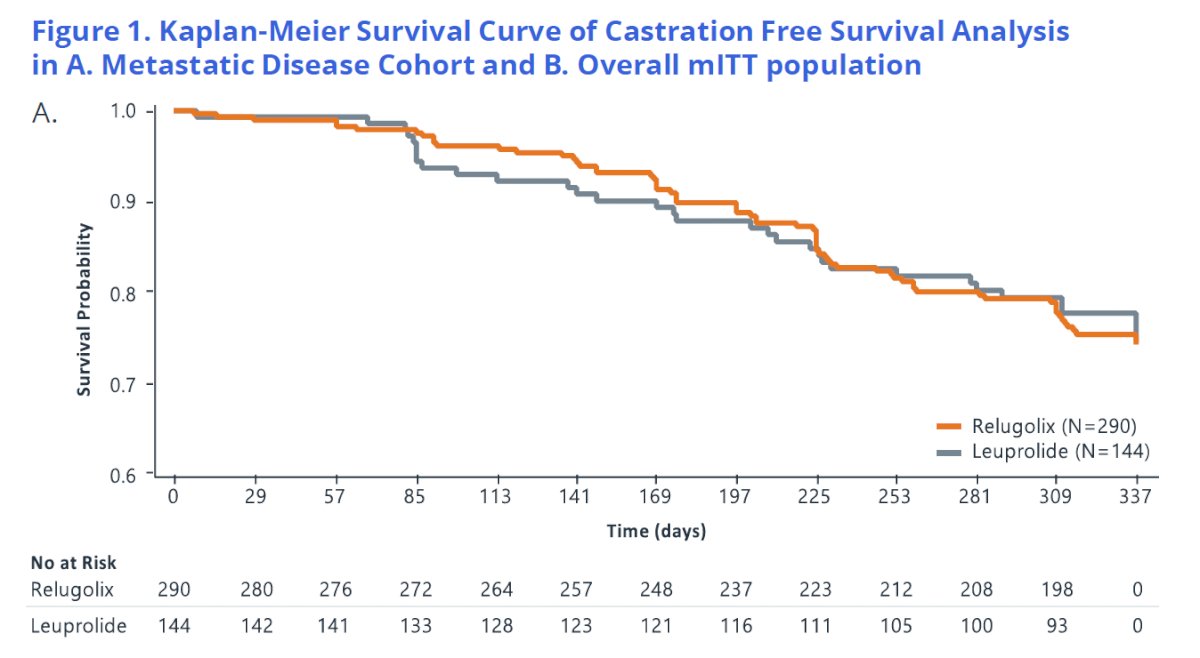
Overall, 1,074 men with advanced prostate cancer (relugolix: n=717; leuprolide: n=357) and 434 men with metastatic disease (relugolix: n=290; leuprolide: n=144) were included in the CRFS analysis (modified intention-to-treat population). Median age of men with metastatic disease was 71 years, with 29% of men over 75 years of age. Men included in the analysis were from North and South America (28.9% and 6.4%), Europe (37.8%), and Asia/rest of world (26.9%). At study entry, the most common location of metastasis was bone only (53%). CRFS rates at week 48 in the metastatic disease cohort were 74.3% (95% CI 68.6% to 79.2%) in the relugolix group and 75.3% (95% CI 66.7% to 81.9%) in the leuprolide group (HR 1.03, 95% CI 0.68-1.57, p=0.84). The Kaplan-Meier survival curve of CRFS analysis in the metastatic cohort is as follows:
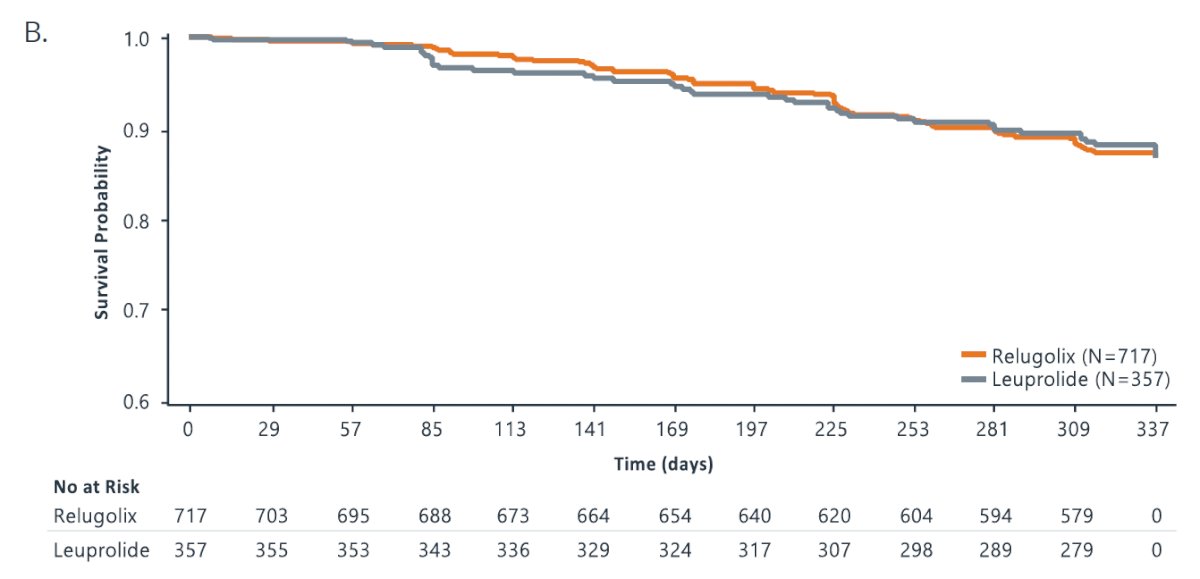
Additionally, the CRFS curve is as follows in the modified intention-to-treat population:
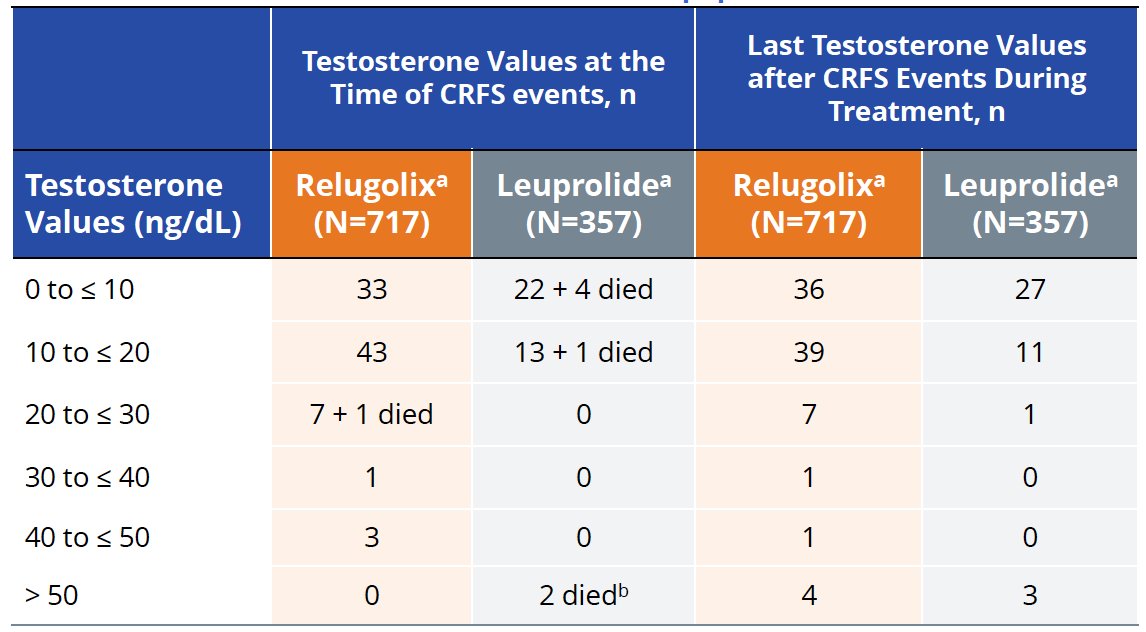
All men were under the castration threshold (<50 ng/dL) at the time of their CRFS event, with the exception of two men in the leuprolide group who died without attaining castration. Last testosterone values on or before week 49 show maintenance of testosterone suppression post-CRFS development:
Baseline characteristics associated with a CRFS event after stepwise selection were PSA >= 20 (p<0.0001), metastatic disease at baseline (p<0.0001), and former or current smokers (p=0.0284).
Dr. Saad concluded his presentation assessing CRFS in the phase 3 HERO trial with the following take-home messages:
- Relugolix achieved rapid, sustained suppression of testosterone levels that was superior to that with leuprolide in men with advanced prostate cancer
- In a secondary analysis, CRFS assessed during the 48-week treatment with relugolix did not significantly delay onset of castration-resistance compared to standard-of-care leuprolide in the subgroup of men with metastatic disease or in the overall modified intention to treat population
- Baseline characteristics that were significant risk factors included PSA >= 20, metastatic disease at baseline, and former or current smokers
- These results suggest that low testosterone levels on ADT are not a driver of early castration-resistance
Presented by: Fred Saad, University of Montreal Hospital Center, Montreal, Quebec, Canada
Co-Authors: Daniel George, Michael Cookson, Daniel Saltzstein, Ronald Tutrone, Hideyuki Akaza, Alberto Bossi, Bruce Brown, Bryan Selby, Sophia Lu, Jackie Walling, Bertrand Tombal, Neal Shore
Written by: Zachary Klaassen, MD, MSc – Urologic Oncologist, Assistant Professor of Urology, Georgia Cancer Center, Augusta University/Medical College of Georgia, @zklaassen_md on Twitter during the 2021 American Urological Association, (AUA) Annual Meeting, Fri, Sep 10, 2021 – Mon, Sep 13, 2021.
References: